You have a Base44 app that runs, and one thing it will not do. The subscription button inside the phone build has nothing behind it, or the data needs to be somewhere your accountant can reach, or the app gets slow on the day it finally gets busy. Whichever it is, you have stopped prompting and started looking for a person, and every result you find is somebody selling you one.
Almost every reason to hire a Base44 developer is one of four jobs, and which one it is decides what you are buying: an afternoon from one person, a longer piece of work from a shop, or a decision to stop building on Base44 at all. Base44’s own documentation settles more of that than any seller page does: it states plainly what the platform handles and where it stops. Reading it first tells you which of the four you are in, which is the one thing nobody can price for you.
Four jobs sit at the platform’s boundary, and they are the ones a Base44 hire most needs to know about: app store billing, moving the data out, staying up when the app gets busy, and running any part of the backend yourself. Ordinary feature building and workflow changes are hired for too, and those need no platform knowledge beyond the editor. The code itself is editable and the GitHub connection is real, but Base44’s documentation puts both the ZIP download and that connection behind a Builder plan or higher.
Nothing on this page comes from building an app in Base44. It comes from Base44’s own documentation read on 29 August 2026, the developer platform and backend pages, the data import and export page, the migration page, the partner program page and the partner directory itself, sorted against what the five Base44 pages already on this site had established, and grouped into the four jobs owners keep hiring for.
What can a Base44 developer actually change?
Everything about a Base44 app is editable by somebody who can read code, and the practical limit sits in one place. Base44 documents that during local development your frontend runs on its own dev server while the backend stays hosted by Base44, so a developer changes your app on Base44’s infrastructure rather than taking it away to theirs.
That single fact decides who you can hire, what you can hand them, and which of the four jobs below is a change rather than a departure.
The mechanics are documented and unglamorous. Base44’s developer tools documentation describes opening the full file structure from the Code view, downloading everything as a ZIP from the same screen, and connecting the project to GitHub from the top bar. The GitHub side is a real version-control workflow rather than a one-way copy: the page describes using branches and pull requests to review work before it goes live, and letting Base44 deploy from the reviewed code.
Then comes the gate that changes who you can hire. The developer tools page puts it in one line: “Downloading a ZIP file and connecting to GitHub both require a Builder plan or higher.” A developer who cannot get either of those works in the editor, in your workspace, on your credits. Plenty of good work happens that way, but it is a different arrangement from handing somebody a repository.
Base44’s app data documentation, linked in the next section, adds a third gate: connecting to an external service or API also requires the Builder plan or higher, because those calls run through Base44’s backend rather than from your browser. So the plan sets the ceiling on three separate things: the code leaving, the version control arriving, and the app talking to anything outside Base44.
None of that tells you how much of the app the export actually is. What a Base44 export actually contains was counted file tree by file tree on the review page, out of the public repositories people had already synced, and those counts stay there. If you only need the files in your hands, how to get the code out of Base44 covers the four routes.
Owners do ask the capability question before they spend anything. One person posted the shape of what they wanted before paying for a plan:
I am wanting to start a Base44 subscription soon, but wanted to inquire this before I pay. I am creating a website with a main general website and a separate client/staff portal …
That one has a documented answer, and it is yes. Base44’s app data documentation describes building a full role and hierarchy system on top of the built-in User entity, with your own Company, Team and TeamMember entities linked back to user records and row-level security keeping one customer’s people out of another’s records. Some of the walls people expect to hit are documented features they have not found yet, and a Base44-literate developer’s first value is telling you which of your four problems is actually a problem.
The four jobs Base44 owners hire out
| Job | What Base44 documents about it | Who you need | What to hand over |
|---|---|---|---|
| Charging for a subscription inside a phone app | Store prep inside the editor, and a documented line where Base44 stops: you set up and pay for the Apple and Google developer accounts and manage the listings and submissions | Somebody who has shipped store billing before, on any platform | The app URL, who holds the store account, and which screen you are stuck on |
| Getting the data somewhere else | A CSV download per collection, imports that only add rows, and a 5,000 item limit per request since 27 November 2025 | One developer for a copy, a shop for a move | The entity list, roughly how many rows each holds, and what has to keep working on the day it changes |
| Staying up when the app gets busy | Pagination guidance above 5,000 records, row-level and field-level security rules, and a MongoDB-compatible NoSQL data layer | Somebody who reads the generated code and the request pattern, not a growth consultant | The page that is slow, how many people were on it, and what hour it happens |
| Running any part of the backend yourself | A backend service in beta, defined in code and configuration files, deployed to Base44 | A developer who will tell you plainly that this one means leaving | Nothing yet, because this starts as a decision rather than a job |
Charging for a subscription inside a phone app
This is the wall people hit hardest, because the app is finished by the time they meet it. One owner got as far as a developer account and an uploaded build before finding that the subscription part had nothing behind it. An alert on 8 August 2026 picked up a comment in an r/Base44 thread titled “Base44 Management Company”.
Whether Base44 can package a phone app at all, and what its store flow hands you when it does, is settled where that flow is walked through end to end. The part that matters for the hire is who owns which half, and Base44 draws that line itself. Base44’s app store submission documentation, read on 29 August 2026, says you set up and pay for the Apple and Google developer accounts and manage the listings and submissions, and that Base44 prepares the app for submission but does not create or manage those accounts. The account fee and the enrolment wait sit with the store account you pay for yourself. No developer can take that off you, and any seller who offers to hold it for you is offering you a problem later.
So the person you want here is a store billing person rather than a Base44 person: somebody who has put a subscription through a store before, on any platform, and who knows what the store expects to see when a purchase has to unlock something inside your app. Why a subscription button inside a Base44 store build has nothing behind it, and the four ways round that, is the longer answer that starts where this paragraph stops.
Getting the data somewhere else
Base44’s documentation is detailed and generous about data coming in, and short about data going out. That asymmetry is the finding to read before you pay anybody to move anything.
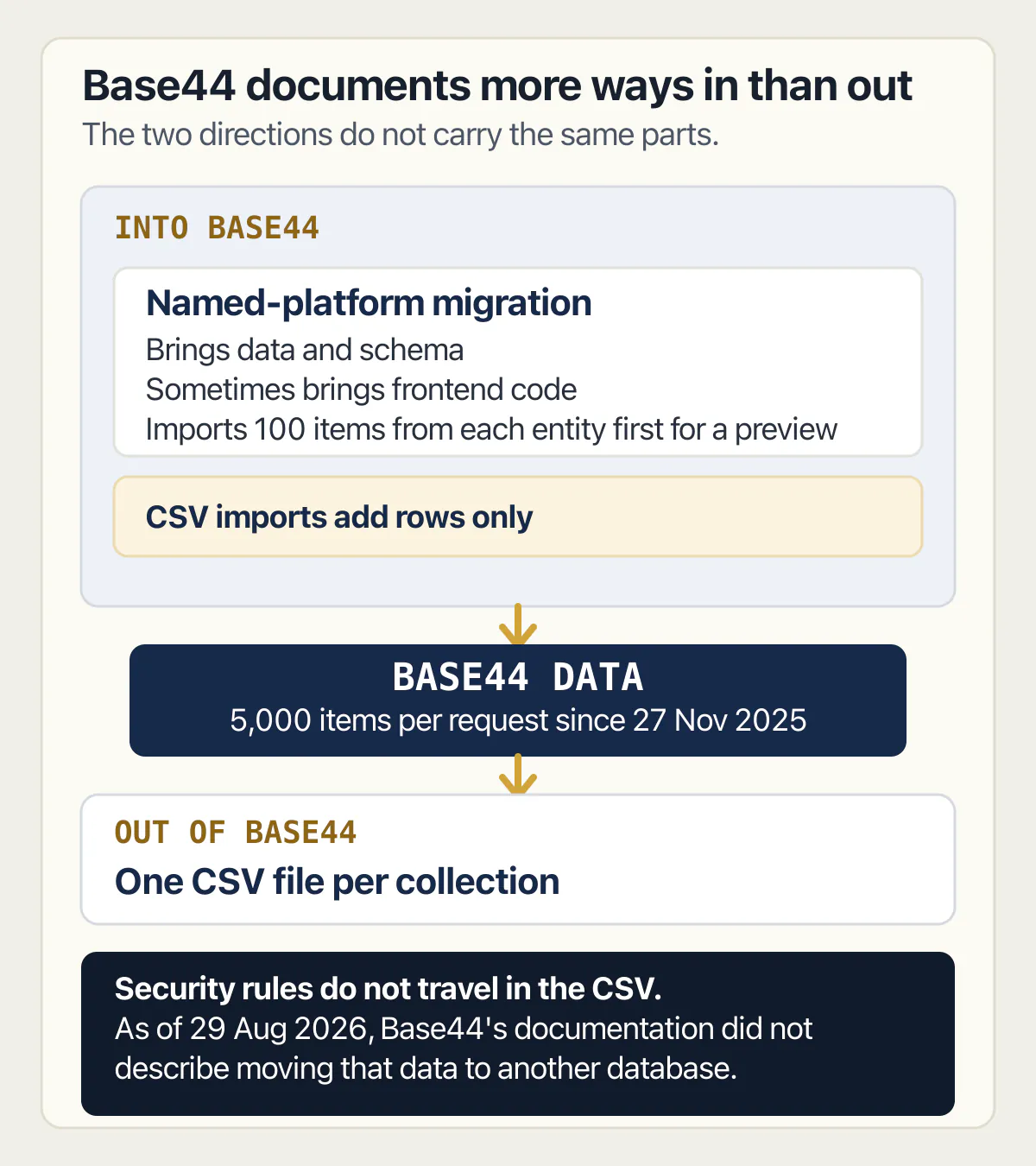
Coming in, Base44’s migration documentation covers named platforms one by one, including Salesforce, HubSpot, Shopify, WordPress, Lovable and Bolt.new, bringing across data, schema and in some cases frontend code. It even describes a trial run: “Base44 imports 100 items from each entity first so you can preview your app before committing.”
Going out, the app data documentation describes one route. You open a table in the dashboard, click Export, and your data downloads as a CSV file per collection. Imports are described as add-only, so a file never updates or overwrites existing records, and since 27 November 2025 there is a documented limit of 5,000 items per request. Above that number the dashboard table view shows only the first 5,000 while all the records stay stored. As of 29 August 2026, Base44’s entities overview describes entities as schemas for documents in collections in a MongoDB-compatible NoSQL database and does not document moving that data to another database.
A community post on 20 August 2026, titled “GitHub export is not the same thing as migrating off Base44”, says the same thing from the owner’s side. Somebody running a small business on a Base44 app wanted to pay a person to move their data across from a spreadsheet tool, which is the easy direction. The hard direction is the one with no documented destination.
The data integrity and safety pillar came out at 51.6 of 100, scored on 20 of the applications in a fixed set of 26 audited in June and July 2026, with each finding confirmed in the code itself rather than by a pattern match. The full method behind those audits is worth reading before you decide a data move is a two-hour job. What usually breaks in a move is the set of rules that were enforcing who could see which rows, and those rules do not travel in a CSV file.
If the destination is a stack you run, moving a Base44 app onto a stack you choose maps the entities to tables and the security rules to policies, and what breaks when you migrate covers the parts that go wrong on the day regardless of which two platforms you are between. Buying somebody else’s Base44 app is a different transaction again, and the question there is whether the workspace can move at all.
Staying up when the app gets busy
An alert on 28 August 2026 picked up a comment in an r/Base44 thread titled “Scaling on Base44 (URGENT HELP)”. Load problems arrive on the day the app finally matters, and they are where hiring the wrong shape of person costs most.
Base44 documents the mechanism honestly. Pages that fetch a whole collection in one request return at most 5,000 items, and the documented fix is pagination in your own app code, loading data in smaller pieces. That is a code change inside your app: a job for one developer who can read what the builder generated, not a platform upgrade you can buy.
The other half is rarely the platform’s. In a fixed study of 26 real applications audited in June and July 2026, no rate limiting sat in front of the most expensive endpoint in 13 of the 21 third-party apps. That is a common shape behind a slowdown or a surprise bill: one route that costs real money to serve, wired up with nothing in front of it. Whether it is yours is settled by the request logs, so a developer worth hiring for this job asks which endpoint costs the most, and what the logs show hitting it, before they ask anything about traffic.
Sorting a Base44 failure into the platform’s half and your app’s half happens symptom by symptom on the repair page, and this page picks up on the far side of it, once the answer is a person.
Running any part of the backend yourself
This is where “we need a custom backend” turns out to mean something else. Base44’s backend service introduction describes a backend-as-a-service whose entire backend is defined in code and configuration files, and states at the top of the page that the backend service and the CLI are currently in beta. As of 29 August 2026, that page documents installing the command line tool, creating a project and deploying it to production, and it does not document running that backend on infrastructure of your own.
So a Base44 developer can write backend functions, define entities as JSON files, set security rules and deploy all of it. What they cannot do is take the backend with them. If what you actually want is your own database, your own auth and your own hosting, the honest answer from a good hire is that you are describing a move rather than a change, and the price of a move is not the price of a change. How Base44 and Lovable differ on what you keep is the fastest way to see why this question sounds different on different builders.
Replit owners arrive at the same four questions in a different order, because what their platform hands back and what it keeps are not the same as Base44’s. A Bolt export lands somewhere else again, and the person who knows what to do with it is reading a different set of files.
What Base44’s partner directory tells you, and what it does not
Base44 runs its own directory of people to hire, and it is the most misread thing on this search. Read the terms it publishes and the badge stops being a verdict.
Start with what the directory is for. Base44’s partner documentation describes Base44 Partners as helping you find “experts, freelancers, and agencies who specialize in Base44 apps and workflows”, for work such as building features, customizing a workflow or creating an integration. The directory itself says every card carries the partner’s rates, languages and expertise, and the partner documentation adds filtering by service and language before you contact anybody.
Then the commercial terms, which are not what most people assume. The documentation says “Payments and agreements are managed directly between you and the partner you choose”, and answers the fee question in its own words: “No. Base44 does not charge a fee to use Base44 Partners.” On pricing it says “Each partner sets their own pricing model. Some charge an hourly rate, others a fixed project fee, or both.” And on what happens if it goes wrong: “Base44 does not charge commissions and does not mediate disputes or payments.”
Now the badge. Base44’s partner program page answers who can join with “Anyone! Once you reach Maker (Level 2), you can join the Partner Program …”, and answers whether approval is needed with “No.” One level up, the page says, “Once you reach Specialist (Level 3), your public partner profile can appear in the Partner Directory”, and “Once you reach Specialist (Level 3), your Base44 profile shows a Verified Partner badge.”
The Verified Partner badge marks a builder level reached on Base44, unlocked by milestones on the partner’s own profile. Base44 does not describe it anywhere as a review of work done for a client. It is still a real signal, because somebody who reached Specialist has built a great deal on this platform. The checking of what they built for other people is yours to do.
Two more documented details matter before you send anything. The program page says a partner’s Client Management Agent “introduces you and gives ballpark quotes using these details”, so the first number you get back may have come from an agent reading a profile rather than a person reading your app. And the partner documentation says you may see an option to connect with an expert at Fiverr from the same page, an experience it states is provided by Fiverr rather than Base44, intended for quick help such as reviews, targeted troubleshooting or small changes.
Checking somebody’s work when you cannot read the code is a skill of its own, and it is the half the badge does not cover. The program’s own feature list includes app transfer, described as transferring a finished app to a client workspace when the project is complete, a thing to agree in writing before work starts. The access side of that same conversation is written out at what to give a developer taking over your app.
Base44 agency or one Base44 developer?
One person suits one wall, and a shop suits a move. Neither suits the case where the honest answer is that Base44 does not do the thing yet. The four jobs above sort into those three outcomes once you know which one you are in.
The sellers here break into four shapes, and the shape tells you more than the sales page does.
| Seller shape | Good at | Wrong for you when |
|---|---|---|
| Offshore development shops | Volume, availability, and a start date this week | The job is one specific broken thing and you need judgment more than hours |
| Marketplaces such as Upwork, Fiverr and Freelancer | Small, well-specified pieces of work at a known price | Nobody has yet worked out which of the four jobs it is |
| Base44’s own listed partners | Platform fluency and a workspace they can work in immediately | You need the app to run somewhere that is not Base44 |
| Rescue and migration shops | Moves, rebuilds, and apps that have stopped being fixable in place | The thing you need is a change, not a move |
Prices from this group are published unevenly. Bacancy Technology, which ranks near the top of this search, answered a plain automated request with HTTP 403 on 29 August 2026, so none of what it advertises can be quoted here. One shop that does publish, Afterbuild Labs, priced a single broken thing in production at $299 on 29 August 2026 and quoted full migrations from $15,000, which is one seller’s published prices on one day rather than a market rate. Neither address is a link: both sell this kind of work to the people reading this. bacancytechnology.com, afterbuildlabs.com.
The phrase people search for, “base44 agency”, usually means one of two things: a shop that will do Base44 website development for you, or a shop that will take the Base44 app you already have and finish it. Those are different purchases and they rarely come from the same seller. Somebody with funding behind a Base44 build said they were going to pay a person to improve how it worked, which is the second kind, and that kind is much thinner on the ground. The labels in play, “Base44 expert” and “Base44 AI app developer”, cover both, so the words tell you nothing about which of the four jobs anybody has actually done.
There is also the case that is not a hire. One builder described the search that leads nowhere:
I kept falling into the same trap: searching for a single platform that handles e-commerce, SEO, intelligent applications, and API automation perfectly. That tool doesn’t exist.
If your list of four is really a list of four platforms, no Base44 app developer fixes that, and paying one to try is the expensive way to find out.
Which shape of seller takes work that an AI builder started, as against the ones who only want to start something new, is a map of its own, and the brand you built on is the least useful thing on it. Hiring for an app in general is a wider question with a wider set of sellers in it.
What to send before anyone can price the work
None of this needs writing up: five things you already know, in the body of one message, and the difference between a number and a range.
- The app URL. The address itself, so they can open it and see what you see rather than read your description of it.
- Which plan the workspace is on. This one matters more than it sounds: the ZIP download, the GitHub connection and any call to an outside service all sit behind Builder or higher, so the plan decides which routes are even open. Which plan a workspace needs, and which meter your own users spend rather than you, is worked out plan by plan on the pricing page.
- Whether GitHub is already connected. A connected repository and an unconnected workspace are two different first days.
- Which of the four jobs it is. Store billing, data out, load, or backend. If you are unsure between two, say both and say why.
- What happens today when it fails. The screen, the hour, the number of people on it, and what you tried. Two sentences beat a paragraph of theory.
None of it is a document you owe anybody before they will look. What to send so somebody can give you a real number, rather than a range, is the same short list whichever platform the app was built on.
One more line in the same message saves an argument later. Who keeps the thing running after the one job is finished is a separate arrangement, and it is worth settling before the work starts rather than after.
What this costs, and where that question is answered
The price question has one address on this site. What a developer costs, in the shapes the market charges in, is answered there rather than guessed at again here, so what hiring a developer costs carries the hourly bands, the fixed-price shapes and what changes the number. Base44 itself adds nothing to that bill, since its documentation says it takes no fee for the directory and settles nothing between you and whoever you pay.
AxonBuild works on apps built with Base44 and the other AI builders. The way in is a free 20-minute video call with Bilal: show him the app, explain what you want it to do and what it does instead, and he will talk through what needs checking. If the cause is not clear on screen, he will say which part of the code he needs to look at afterward. If you want him to make the change, whether that is one of the four platform-boundary jobs on this page or something smaller, he checks the app first and gives you a fixed quote. You agree what the app should do, he builds and tests it, and you pay after you see it working. Further features, releases and fixes can follow the first change.
Common questions about hiring a Base44 developer
What does a Base44 developer actually do?
A Base44 developer edits your app’s generated code inside Base44, using the Code view, the ZIP download or a connected GitHub repository, and deploys the result back to Base44’s hosted infrastructure. Base44’s developer tools documentation puts local development on your own dev server with the backend still hosted by Base44.
Do I need a Base44 developer, or will any developer do?
For three of the four common jobs, any competent developer will do, because the work is generated React code, a REST-shaped data layer and ordinary store billing. The exception is anything touching the platform’s own behaviour: entity schemas, security rules, plan gates and the editor’s habits. Somebody who has worked on Base44 before saves you the days it takes to learn those.
What is a Base44 partner, and does the badge mean Base44 checked their work?
A Base44 partner is somebody who joined Base44’s Partner Program, which its program page says anyone can do once they reach Maker (Level 2), with no approval needed. The public directory listing and the Verified Partner badge unlock at Specialist (Level 3). So the badge records how far somebody has got on Base44’s own milestones, and Base44 nowhere describes it as a review of work done for a client.
Can I hire someone to add App Store subscriptions to my Base44 app?
Yes, and the person to hire is somebody who has shipped store subscriptions before rather than a Base44 specialist. The store account stays in your name, so what you are buying is the wiring between a purchase and the thing it unlocks inside your app. The page on publishing a Base44 app to the app stores covers what stays yours after you press submit.
Can someone move my Base44 data into my own database?
Someone can copy it. Base44’s app data documentation describes exporting each collection as a CSV file from the dashboard, and as of 29 August 2026 its entities overview does not document moving data to another database. The job is therefore a rebuild of the destination plus a data load, priced as a move rather than a change.
How can I tell whether a Base44 expert has actually shipped on the platform?
Ask which plan their last three Base44 projects were on and what that let them do, because the answer separates people who have worked in the editor from people who have worked with an exported repository. Then ask what they did about the 5,000-item request limit on a collection that outgrew it. Both have specific documented answers and neither bluffs comfortably.
Does hiring a developer mean moving off Base44?
Usually not. Three of the four jobs owners hire for happen inside Base44 and leave the app where it is. Only the fourth, running part of the backend yourself, means leaving, because Base44’s backend introduction page describes a service Base44 runs and as of 29 August 2026 does not document running it on your own infrastructure.
What do I send a developer before they can price the work?
The app URL, which plan the workspace is on, whether GitHub is already connected, which of the four jobs it is, and what happens today when the thing fails. That is five lines in one message. A seller who wants a written specification before looking at the app is pricing their own reading time.
How much does it cost to hire a Base44 developer?
Rates vary by shape of seller rather than by platform, and Base44 charges nothing for its directory, so the number comes entirely from whoever you hire. Base44’s partner documentation says each partner sets their own pricing model, some hourly, some a fixed project fee. The costs page linked above carries the current bands and what moves them.
Built it with AI. Can’t get the last part right?
That’s the normal state of an AI-built app, and it’s fixable. I trace what the app actually does, explain what needs changing, and build it if you want me to.
Talk about your app →  Free 20-minute video call with Bilal.