The day somebody else’s money starts moving through a Replit app, the questions change. Which copy of the app are customers actually looking at. Which of its two databases the last change touched. What the next Agent attempt costs before it runs. Those are the questions behind the decision to hire a Replit developer, and page one of that search answers none of them.
A Replit developer worth paying is somebody who already knows Replit’s documented one-way doors: the publishing region that cannot be changed once you publish, the two databases behind every Replit App, and the 7 days you have before a removed database is gone for good.
Nothing here was built or run on Replit. What this page is made of: Replit’s own publishing, database and AI billing documentation, read on 29 August 2026; the nine organic results Google returned for hire replit developer on the same day, including the four seller pages that would not open to a plain read; the redirect Replit’s own bounty address now serves, followed on the same day; and one public post from a Replit community, quoted as the person wrote it.
People search for this job under several names, from Replit developer to Replit expert, and all of them describe the same person: somebody who can read what Replit Agent wrote and knows what the platform underneath it does on its own.
What actually breaks on a Replit app once a business depends on it
The failures that turn an owner into a buyer are rarely exotic. Often one is a documented platform behaviour meeting somebody who did not know it was there, and the checks below settle that before anyone looks for a code defect.
Start with the split between the app you are editing and the app your customers reach. A Replit-literate person checks which of the two is broken before touching anything, because the answer changes the whole job. Sorting which of the four shapes a breaking Replit app is in, before you buy another Agent attempt, is a diagnosis rather than a hire, and it is worth doing first: what a Replit app that keeps breaking is usually doing works through that.
Next is the gap between what Replit’s platform provides and what your particular plan turns on. Which of Replit’s production controls your plan actually includes, and what each one costs to run, is a checklist you can work through before anyone else touches the account, and how much of a production setup Replit itself covers is where that lives.
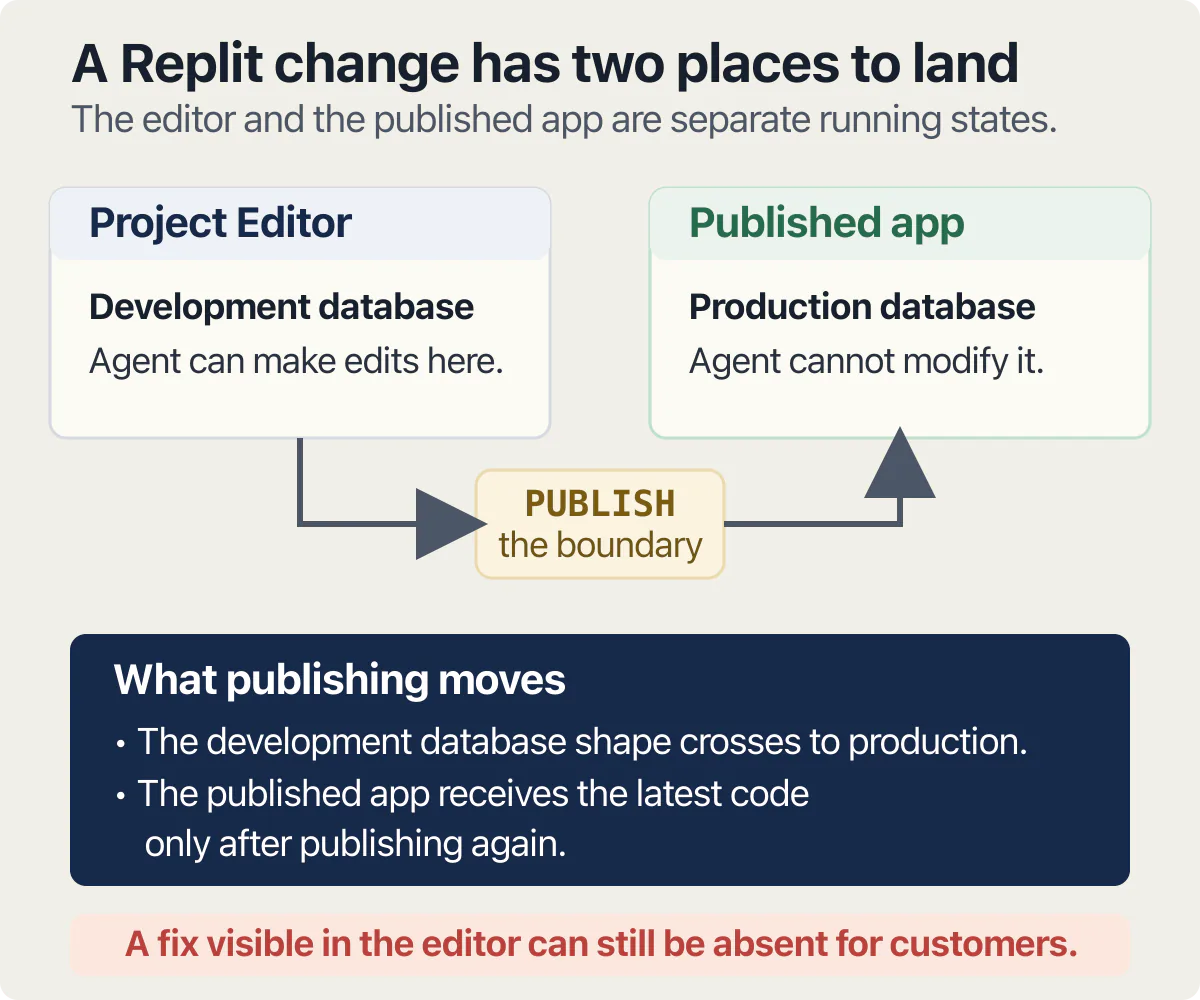
Then data, which is what produces the panicked message. Replit’s development and production database documentation opens with the sentence that surprises most owners: “Every Replit App works with two databases.” Agent works against one of them. In Replit’s words, “Agent can make edits to your development database” and “Agent is not able to modify the production database”. The shape of the development database, its columns and tables, crosses to the live one only at the moment of publishing. The same page sets a clock on deletion. Removing a production database is described as irreversible after a retention period of 7 days: “Databases have a 7-day soft delete period where databases can be restored”, and after that, “the database is hard deleted and unrecoverable”. Replit’s own instruction is the blunt one: “Make sure to back up any important data before proceeding.”
Last, and sharpest, is where the app physically runs. That choice gets made once, usually by accident, and never again.
Somebody about to move where their Replit app runs described what they had just worked out: “planning to change my Replit app’s deployment geography… deletes the existing production database”. That is one person’s account of a moment, and it is worth reading next to what Replit publishes.
Replit’s geography documentation, under its publishing geography limitations, is unambiguous about the choice itself: “Geography cannot be changed after publishing. Once you publish your project to a geography, that selection is permanent.” The same limitation adds, “You cannot migrate a published project to a different geography.” What it does not say is what happens to data if you try. As of 29 August 2026, that page documents no consequence at all for an existing production database when the region is changed after publishing.
That gap is the whole argument for hiring somebody who has met this before. The platform tells you the door only opens one way. It does not tell you what happens to the data if somebody tries it anyway. Replit’s deployment and publishing help page takes the direct version of the question, whether an app’s deployment region can be changed once it is published, and answers it with one word: No. The route it offers instead is a republished copy in the new region, and what that costs you in address and secrets is set out on the page about moving a published Replit app somewhere else.
Which region you get is also gated by what you are paying. The geography documentation says publishing geography selection is available to Core, Pro and Enterprise customers, and that free customers publish to North America by default. An app first published on a free account therefore has its region already chosen, permanently, by a default nobody read. Organisations get one lever back: the same page says an Enterprise admin can enforce a publishing geography across the organisation, and that the policy applies only to projects that have not yet been published.
One more thing about regions, and it is the kind of thing that only turns up when somebody looks. Two Replit pages read on 29 August 2026 describe the available publishing regions differently. The geography documentation lists five publishing selections, including Asia, South America and Australia. Replit’s publishing overview, read the same day, says all published apps are hosted in the United States, with a sales conversation for European hosting. Neither page says which of the two is current, which is an uncomfortable thing to find under a data residency question. If your app has one of those attached to it, the answer you need starts with what your Publishing tool shows for your app rather than either page, and that only covers where the app runs; where the database, backups, logs and support access sit is a separate question to put to Replit in writing.
What a Replit expert knows that a good generic freelancer does not
A capable developer who has never touched Replit will read your code fine. What they will not have is the map of platform behaviours that decide whether a change lands, survives, or takes something with it. Six of those behaviours are documented, checkable, and worth asking about directly.
| What a Replit expert knows | Where Replit documents it | What to ask them |
|---|---|---|
| The publishing region is chosen once and is permanent after publishing | Geography documentation | Which region is this app published in, and what would it take to change it |
| Every Replit App has two databases and Agent can only write to one | Development and production database documentation | Which database did that change touch, and when does it reach the live one |
| A removed production database has a 7-day window before it is unrecoverable | Development and production database documentation | Before anything is removed, what is backed up and where does the copy live |
| A published app is a separate running instance, and updating it means publishing again | Publishing overview | How do we prove a fix reached the published app and not just the editor |
| The published app reads deployment secrets, which are a different store from the editor’s Secrets pane | Deployment and publishing help page | Which keys exist in the published app that do not exist in the editor |
| Development databases moved from Neon onto Replit’s own PostgreSQL infrastructure, so older apps can still be pointed at the old host | Development and production database documentation | Does the code still reference a neon.tech connection string anywhere |
Two of those deserve a sentence more than the table gives them. Replit’s publishing overview says publishing an app “makes the app reliably available on the internet”, on infrastructure of its own, and that updating a published app with the latest changes means publishing again. Half the confusion in this territory sits on that one behaviour, and somebody who holds it in their head asks a different first question than somebody who does not.
The database host is the quieter one. Replit’s database documentation explains how to tell which infrastructure an app is on: a DATABASE_URL containing neon.tech means the older host, and Replit’s own is called Helium. It also records that under the older setup, forking an app copied the connection string so copies shared one database, and that those shared databases were shut down on 8 June 2026. An app built two years ago and forked once can be carrying that history without its owner ever hearing about it.
The reason to care about any of this is that the failures a person is hired to find are mostly failures of the boring kind. Across AxonBuild’s fixed June to July 2026 audit ledger, 13 of the 21 third-party applications had no rate limiting on their most expensive endpoint, and each of those findings was confirmed by reading the code itself, not by matching a pattern. The cohort rules and method behind these counts are on their own page. One caveat rides with that number and it matters here: no Replit application is in that cohort, so it describes those 21 apps and says nothing about Replit as a tool or about how often the same gap appears elsewhere.
What Replit controls at the platform layer, as opposed to what your generated code does with it, is a separate question about the tool rather than about the person you hire. Whether Replit is a good tool at all, and who it actually suits, is a question with its own evidence and its own answer.
The same question asked about a different builder produces a different list, because what a Base44-literate person has to know is not what a Replit-literate person has to know, and a Bolt export lands somewhere else again.
Where Replit itself sends you now
The obvious first stop is Replit itself. Its own hiring marketplace used to live at replit.com/bounties, where an owner posted a job and a community developer took it. Followed on 29 August 2026, that address returns a permanent redirect to contra.com/replit, carrying Replit’s own campaign parameter utm_campaign=bounties. Contra is a marketplace and a competitor of AxonBuild, so it is named here and not linked.
That redirect is current, and Replit says the same thing in its live navigation. The menu on Replit’s pricing page, fetched the same day, carries a “Replit Experts” link, and it points at the same Contra address. Replit has handed the hiring problem to a marketplace and says so twice, in the old address and in the current menu.
Nothing on page one of this search mentions that, which tells you what page one is made of. On 29 August 2026, the first result Google returns for hire replit developer is somebody asking for a developer to finish their Replit project. The ninth is a second person asking the same thing, on Replit’s own community forum. A third demand post ranks on replit expert. Google is ranking the question because so few people have written the answer.
The fifth result is Replit’s own job board, which is a different audience entirely and is why this page carries an FAQ about it.
Everything else selling on that search is either a listing or a staffing offer. Upwork, Toptal and Contra rank category pages. Bacancy and Suffescom are offshore staffing vendors. replitdevelopers.com is a single-purpose brand for this exact search. None of them is linked here, for the same reason Contra is not.
Only one of those seller pages opened to a plain read on 29 August 2026. replitdevelopers.com renders no price of any kind, describes itself as an “Official Partner”, and lists six service names: custom development, rapid prototyping, cloud migration, security audits, team training and AI integration. It says nothing about what Replit literacy consists of, which is the thing a buyer is actually trying to judge. As of 29 August 2026, none of the four seller pages whose search snippets carry a Replit rate, the Upwork, Contra, Bacancy and Suffescom results, opened to a plain read, so no rate of theirs appears anywhere on this page.
The bill is part of the hire
If whoever you hire works through Agent rather than in an outside editor, they will be spending your credits while they work, and the meter behaves in ways that surprise people mid-repair. Four documented behaviours are worth knowing before anybody starts.
Paid Agent work is metered by effort rather than by a count of messages, so the price of an attempt depends on what the attempt turns out to involve. As of 29 August 2026, Replit’s AI billing documentation renders no per-attempt figure, which means nobody, including the person you hired, can quote the exact cost of the next try in advance; what you can do is agree in writing whether Agent is used at all and set a credit ceiling before work starts.
Some of what Agent does runs on outside model providers, and that is a second line on the same bill. Replit’s AI billing documentation says those capabilities are billed at the provider’s public API rate and deducted from your Replit credits, so the balance your developer is spending is being drawn down by the tools they are working with as well as by the attempts themselves.
The numbers arrive late. The same page states plainly that “Usage data can take up to 30 minutes to appear on your usage dashboard”, which is long enough for two more attempts to happen before the first one shows up.
The running app is on the same meter as the repairs. Replit’s AI billing documentation says the monthly credits cover published apps, storage and databases as well as Agent. The database documentation adds that production databases are billed by usage and enter “an idle state after five minutes of inactivity, pausing compute time billing”, waking on the next query. An app nobody visits and an app with real traffic on it produce very different invoices from identical code.
A post titled “It’s now cheaper to pay a software engineer than use Replit” ran in r/replit on 23 July 2026. That is the question being asked out loud in Replit’s own community. It is not a comparison this page has made, and no arithmetic here supports it.
For the actual numbers, Replit’s pricing page is the source that stays current, and what a production Replit app costs to run is worked through separately. Whether the credits are costing more than a person would is a comparison with real numbers behind it, and the four builders do not meter in the same unit. An account that has run out of usage mid-repair is its own situation with its own fix.
What a Replit developer is the wrong hire for
Replit literacy is a narrow, real advantage, and it has edges. Four common purchases sit past them, and paying a premium for platform knowledge on any of the four is paying for something you will not use.
Getting the code out of Replit at all is one. Once the code is out of Replit and running somewhere else, Replit literacy stops being the thing you are paying for and the hire becomes an ordinary one. Getting the code out of Replit is four separate jobs, and moving the app off Replit entirely is the decision that sits above them.
A store submission is another. Getting the same app into the App Store or Google Play ends at your own developer account, your own listing and Apple’s or Google’s review queue, none of which Replit knowledge shortens, and what Replit does and does not do for a mobile app sets out the division.
A rebuild is a third. If most of the app needs redoing, the platform it was built on stops being the interesting question, and the person you want is whoever is good at the thing you are rebuilding it into. Some people arrive at this search wanting a person, and leave deciding they want a different tool, which is a separate list with separate trade-offs.
And then there is everything that was never a Replit job to begin with: a custom backend, app-store billing, an agent build, scaling an app that has outgrown its shape. Those are priced after somebody has read the code, and no amount of platform familiarity changes what they cost.
Talking through one problem before you pay for a project
Most people arriving at this search do not want a developer in general. They want one specific thing to stop being broken, and they want to find out what that costs without agreeing to a project first.
AxonBuild works on apps built with Replit and the other AI builders. It is not an agency, and it is not on any Replit partner or expert list.
The 20-minute video call with Bilal is free. Show him the app and what you have tried, and he will talk through what needs checking. If the cause is not clear on screen, he will say which part of the code he needs to look at afterward. If you want him to make the change, from one broken screen to finishing the app, moving it off Replit, a custom backend or app-store billing, he checks the app first and gives you a fixed quote. You pay after you see the change working.
The call produces no document. What you get is what you are shown and told while you are on it, and then the quote if you ask for one.
That shape exists because it is the cheapest way for both sides to find out whether the platform knowledge above is the thing your app actually needs. Who does this kind of work and what they are actually being paid for covers the wider version of the job. Who keeps the app running after the repair is a decision of its own.
Common questions about hiring a Replit developer
How much does it cost to hire a Replit developer?
Prices for work on an app that already runs vary sharply by who you buy from, and Replit knowledge is a small part of the number next to how big the job is. What developers charge for this kind of work, and what moves the number, is set out with real bands on its own page. None of the seller pages on this search whose snippets carry a Replit rate opened to a plain read on 29 August 2026, so none of their figures appears here.
Do I need a Replit expert, or will any developer do?
It depends on where the app is going to live. If it stays on Replit, platform knowledge saves you real money, because a good share of what breaks is a documented platform behaviour rather than a bug in your code, and somebody meeting the two-database model for the first time will bill you for the hours it takes to learn it. If the app is leaving Replit soon, any competent developer in the relevant stack will do, and Replit familiarity stops mattering the moment the code is running elsewhere.
How much does a Replit agent cost?
Replit prices paid Agent work by effort rather than by message count, so a small change and a large feature are not billed the same. Its AI billing documentation, read on 29 August 2026, renders no per-attempt figure, which means nobody can quote you the exact price of the next attempt before it runs, though a credit ceiling can be agreed in advance. That same page describes a free mode for paid subscribers, capped by an allowance, so not every request is a charge. Current plan and credit figures are on Replit’s own pricing page, which is the only place they stay accurate.
Does Replit hire remotely?
That is a job-seeker question and this page does not serve it. This page is for people paying somebody to work on their own Replit app. Replit’s own openings are listed at replit.com/careers, which is not linked here because it is a different destination for a different reader, and nothing on this site tracks its roles or its remote policy.
Can a Replit developer work on my app outside Replit?
Yes, and for some jobs that is the sensible arrangement. Replit’s own documentation covers connecting a project to GitHub, and once the code is in a repository you control, a developer can work in whatever editor they prefer and push changes back. What does not travel automatically is the rest of it: the database, uploaded files, and the secrets. Getting the code out of Replit sets out which of the four parts comes out which way.
What do I need to give a Replit developer before they can start?
Five Replit-specific things, and the list is shorter than most owners expect. Access to the Replit account or the project itself. Which publishing option the app is live on. Which database the live app reads from. The deployment secrets, which are stored separately from the ones in the editor. And the outside services the app talks to, such as a payment provider or a mail sender, because those hold their own keys. What to send any developer before they can put a price on the work is short, and it does not change with the builder the app came from.
How do I know the fix reached my live app and not just the editor?
Check the published app, not the editor preview, and check it after a publish rather than before. Replit documents the published app as a separate running instance from the one in the Project Editor, so a change that is visibly working in the editor can be entirely absent from what customers see until you publish again. Asking a developer how they will prove a change reached the live app is a fair question and a fast way to tell how much Replit they have actually done. What a Replit app that keeps breaking is usually doing works through the rest of that diagnosis.
Is it cheaper to hire a developer than to keep paying for Replit?
The two purchases are priced in different units, so there is no single number that settles it. Credits are metered per attempt and reset on a monthly cycle, while a person quotes once for a named problem. For ordinary changes to a working app, the meter is usually far cheaper and far faster. For one thing that has failed repeatedly, the attempts stop carrying new information and start writing on top of each other, which is the point where a person tends to be the better purchase. Which of the two is cheaper for your app is a calculation with real numbers behind it, and no two builders meter in the same unit.
Built it with AI. Can’t get the last part right?
That’s the normal state of an AI-built app, and it’s fixable. I trace what the app actually does, explain what needs changing, and build it if you want me to.
Talk about your app →  Free 20-minute video call with Bilal.