A bolt.new developer is a person who can read what Bolt.new generated, take the project out through the repository Bolt.new connects to GitHub, and write the parts the builder does not write for you. That is the whole job, and it is narrower than the word “developer” suggests, because the pieces that do not come out of the builder are the same pieces every time.
Search for one and you get a list of people. Page one of hire bolt.new developer on 29 August 2026 held four freelance marketplaces, two offshore development shops, a seller’s showcase page, a forum thread and Bolt.new’s own careers page. None of the pages that opened to a read says what the person you hire is actually being handed. So this page describes the job rather than the seller.
No Bolt.new account of ours sits behind this page: what leaves a Bolt.new project, what the token meter counts and what the GitHub connection does were read off Bolt’s own support pages and its pricing page on 29 August 2026, and the sellers ranking for this search were read the same day, which is how the page can say what those pages do and do not explain.
A bolt.new developer takes over a project whose code travels as a zip or a connected GitHub repository, whose database moves only by claiming it into Supabase, and whose secret values cannot be read back at all. Settle those three before you agree a price with anybody.
What a bolt.new developer actually receives on day one
Seven pieces change hands, and only one of them arrives by pressing a button. Every row below is what Bolt’s own support pages said on 29 August 2026, next to what it costs you in a hire.
| The piece | What Bolt.new’s own pages say | What it means for the person you pay |
|---|---|---|
| The application code | Export then Download produces a zip; the GitHub connection creates a repository that “starts as private, on a main branch” and receives a commit for every change that does not break the project | A zip is one afternoon frozen. A repository is somewhere two people can work from without emailing folders |
| The preview you have been looking at | Bolt’s product introduction says Bolt runs on WebContainers, “the technology that first made it possible to run Node.js directly in your browser” | Nothing the preview showed has been tested by a second real account or by a stranger |
| The published site | Bolt publishes “for free at a web address ending in bolt.host”, and attaching your own web address needs a paid plan | The address stays behind. Whatever host the app moves to issues a new one |
| The database | ”Claiming your database lets you migrate an existing Bolt database to Supabase”, and to claim it there “you must be a Supabase org owner” | Whether you have a Bolt database or an already connected Supabase project decides which of two jobs you are buying |
| The secret values | The Secrets page covers creating and deleting a secret, says the value “is hidden as you type”, and documents no route back to a stored value | Every key gets collected again from whoever issued it, and rotated on the way through |
| Server functions | ”Instead of running this logic directly in a user’s browser or mobile app, where it could be slower or less secure, the function runs on a server” | Anything touching money or a paid API lives here, and it needs redeploying wherever the app ends up |
| The change history | Version History is a timeline inside the project, and Bolt’s rollback page says restoring an earlier version leaves the current Bolt or Supabase database untouched | Outside Bolt.new, the record of what changed is whatever the connected repository holds |
Those rows come off Bolt’s own documentation, read on 29 August 2026: Bolt’s project files page, Bolt’s product introduction, Bolt’s publishing page, Bolt’s Supabase documentation, Bolt’s server functions page and Bolt’s rollback page, plus the GitHub integration page linked in the next paragraph, which is where the repository sentence in row one comes from. Every row is also one line of what actually comes out of a Bolt.new project and what stays behind, read here for what it costs in a hire rather than in a move.
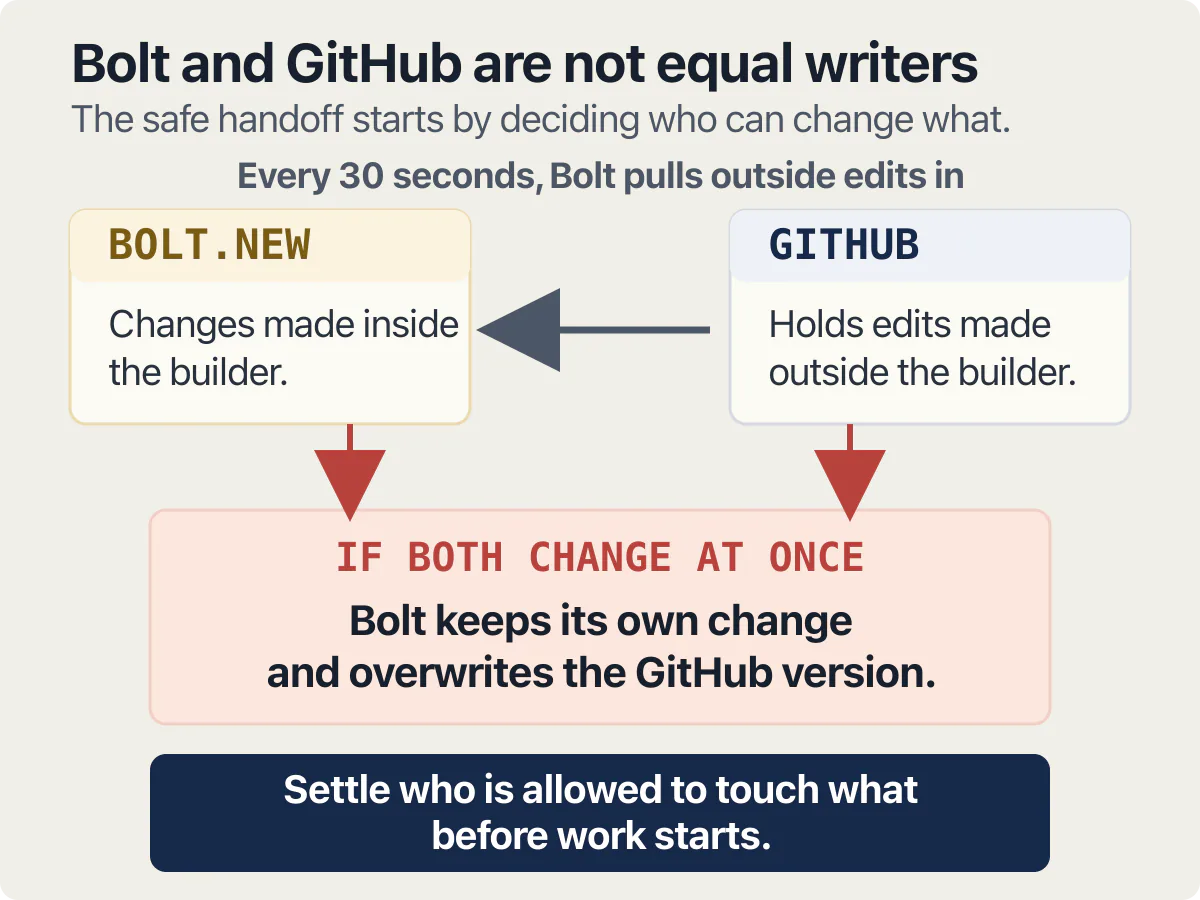
Two lines on Bolt’s GitHub integration page change how a person is able to work at all. The builder looks at the repository every 30 seconds for edits made outside it and pulls them in. And if both sides move at once, Bolt “keeps your changes and overwrites the GitHub version”. While you are still prompting inside the builder, then, the repository is a copy of Bolt.new rather than a second desk, and a developer editing that repository directly can watch an hour of work disappear. Somebody who has worked on a Bolt.new project before asks which of you is allowed to touch what, on day one, before they open the editor.
The apps that arrive at this hire are not demos. At least one owner has publicly described running a full production build on Bolt.new alone, billing, chat, email and install flows included, before any developer looked at the code. That case exists, and its shape is the one this page is written for: it works, real people use it, and nobody has read it. How common it is, nobody has measured.
Doing the move itself, from claiming the database into your own Supabase organization to pointing the domain at the new host, is written out row by row on the page about leaving Bolt.new, and this page stops at deciding who does it.
The people selling you a bolt.new developer, and what none of them explain
On 29 August 2026, page one for hire bolt.new developer was Upwork and Contra at the top, Fiverr and Toptal further down, the offshore development shops Nimap Infotech and Hidden Brains, a seller’s showcase page on LinkedIn, one forum thread, and Bolt.new’s own careers page at position three. That last one is there because Google cannot separate hiring a Bolt.new developer from getting hired at Bolt.
Two of the seller pages opened to an automated read, and neither is linked here because both sell what this site sells. Toptal’s Bolt AI developers page at toptal.com/developers/bolt-ai renders a few named profiles and says “You can hire Bolt AI developers on an hourly, part-time, or full-time basis”, with a trial period you are not billed for if you are not satisfied. It publishes no rate. It also contains nothing about exports, WebContainers, Bolt Database or tokens. Nimap Infotech’s Bolt.new experts page at nimapinfotech.com/hire-bolt-new-experts/ sells arrangements rather than work: a dedicated development team, IT staff augmentation, nearshore, offshore and on-demand development. It publishes no price either, and on 29 August 2026 it carried nothing specific to a Bolt.new project anywhere on it.
Three more could not be read at all. upwork.com/hire/bolt-developers/ and hiddenbrains.com/hire-bolt-ai-developers.html both returned HTTP 403 to an automated request on 29 August 2026, and contra.com/bolt returned its page title and no other text. Those are limits on the fetch rather than findings about the pages, so nothing of theirs is quoted here and nothing is concluded from their silence. Fiverr’s result carried two starting figures inside the search snippet. A snippet is not a fetched pricing page, so neither figure appears here.
The pattern across the pages that opened holds anyway: as of 29 August 2026, neither of the two readable seller pages publishes a rate or describes anything specific to a Bolt.new project. They tell you where to find a person. They say nothing about what that person receives.
Sellers have noticed the same group from the other side. A public post from 20 August 2026 is titled Built with Replit, Bolt or Base44?, which shows somebody is advertising to owners of apps built on those three builders. It shows that and nothing more, and the person behind it is not named here.
AxonBuild sits in the same gap, and it is worth being plain about the shape of it. Bilal works on apps that people have already built with Bolt.new and the other AI builders: tracing a problem into the code, adding what customers have asked for, and building and testing the change. It does not operate as an agency, there is no bench of people to assign, and Bolt has issued it no partner badge. That shape fits an app that already runs and fits a ground-up build badly.
Five things somebody who knows Bolt.new checks first
None of these five is a rate. They are knowledge, and a capable general freelancer picks all five up inside a week. What you are buying on day one is whether they already know to ask.
| The check | Why it decides the job | What a first-time Bolt.new hire misses |
|---|---|---|
| Is the GitHub connection live, and whose account owns the repository? | It decides whether two people can work at once, and who wins when they collide | That Bolt.new keeps its own version in a simultaneous update, so work done in the repository can be overwritten |
| Is this a Bolt database, or a Supabase project you already own? | They are two different jobs, with two different account holders | That claiming needs a Supabase organization owner, so the person with that account has to be available |
| Does the real value of each secret still exist somewhere outside the app? | Nothing redeploys anywhere without them | That Bolt’s Secrets cannot be read back, so “they are already in the project” is not an answer |
| Can anything privileged happen without a signed-in user? | It is the failure that survives every move intact | That the browser preview never had to prove it |
| Can anything expensive be triggered without a limit? | It is a stranger’s ability to spend your money | That the bill for it lands on the owner’s card in real time |
The first two are questions about accounts, and they are the ones that waste the most time when nobody asks. A Bolt database and a connected Supabase project produce completely different work: one starts with a claim into an organization you have to own, the other starts with credentials you already hold. Bolt’s own Supabase documentation warns that pointing a project with a Bolt database at a Supabase one takes over the existing connection and can lose data, which is the kind of sentence you want a candidate to have read before they are in your project rather than after.
The third check is where most of the delay actually lands. Bolt’s Secrets page covers creating and deleting a secret, hides the value as you type, and describes no route to read a stored one back. So the honest answer to “where are the keys” is a list of the providers that issued them, not a tab in the builder. This is also a place where AI-built projects have a measurable habit: 6 of the 21 third-party AI-built apps AxonBuild audited in June and July 2026 shipped a real secret, three of them permanently in git history, every finding verified against the code rather than pattern matched. Whoever takes the project on rebuilds the values a project needs before it will run anywhere else from each issuer, and rotates anything that has ever been pasted into a chat window.
Checks four and five are the two failures that the preview cannot show you, because the preview only ever had one user in it. Bolt builds and previews inside a browser sandbox; the published site answers real requests from people you have never met. In that same fixed cohort, 13 of those 21 had no rate limiting on their most expensive endpoint, which in a metered app means somebody else can decide what your month costs. A candidate who asks which endpoint is the expensive one, before they ask for access, has done this before.
The five checks are about one project. Whether Bolt.new is a sound platform to keep a business on is a verdict about the tool rather than about a hire, and it has its own page. The platform-level read on whether Bolt.new is a safe platform to run a business on settles none of the five above.
Working inside Bolt.new, or taking the app out
Most bolt.new app development stops being a Bolt.new job at a predictable point, and naming that point before anybody starts is cheaper than discovering it in week two. There are two shapes of hire here, and they are priced, staffed and finished differently.
The first shape stays inside the builder. A screen, a field, a page, a copy change, a flow the builder wrote once and can write again: all of it is still Bolt.new work, and keeping it there keeps everything visible to you in an editor you can open yourself. It also keeps the subscription, which matters more than people expect and is covered further down.
The second shape needs the code underneath. A custom backend, app-store billing, an integration the builder has no path to, anything that has to run somewhere the browser sandbox never had to prove: that work happens in the repository, on somebody’s machine, and it lands back with you as a running app rather than as a project you can prompt. Builders on that tool report a fast start and then a set of limits that show up once the thing carries real work, with some of them leaving entirely.
You do not have to choose today, and you should not let the choice be made as a side effect of one repair. Ask a candidate directly which of the two they are proposing, and ask what happens to the Bolt.new project afterwards. Whether the app is ready for strangers at all, tested gate by gate, is a different question from who you pay to work on it, and the Bolt.new readiness page runs those checks. The six gates a Bolt.new app has to pass before customers rely on it are the same six whichever shape of hire you end up buying.
The same decision reaches owners on the other builders from different directions. Base44 owners are making the same hire with a different set of parts underneath, including the app store billing the builder does not write. Replit owners arrive at the same decision from a different direction, usually because a deploy or a bill made it urgent.
The Bolt.new token meter keeps running while somebody else works
Bolt’s tokens page attributes most token use to the model reading, understanding and syncing project files, and says a larger project therefore spends more per message. Read that again with a paid job in mind. The same bug costs more to fix in month six than in month one, because the file the model has to read through got bigger, and nothing about the bug changed.
Two consequences follow for a hire. If the person works inside your project, they are spending your tokens, and the estimate they gave you was probably not a token estimate. And if they work in Code view instead, Bolt says that once a free account has hit its daily limit, direct edits to a project’s existing code are still free there and use no tokens, so a developer editing code that way costs you nothing on the meter for that part of the work. Those are two genuinely different spend profiles for the same afternoon.
The free plan is where this stops being theoretical. Bolt’s tokens page puts a daily cap of 300K on free-plan tokens, sitting underneath the monthly allowance rather than replacing it. A person hired by the hour who works by prompting cannot work at any pace against a daily ceiling that resets tomorrow, so the practical answer for a prompt-driven job, or for one that needs a paid hosting feature such as your own web address, is a paid plan, decided before the work starts rather than halfway through an afternoon. A job done entirely as direct edits in Code view does not need one for the token reason.
Cancelling mid-job is the expensive mistake. Bolt’s tokens page states that cancelling a paid plan costs you access to every allocated token, rollover balance included, once the billing cycle ends, and that a fresh allocation arriving on renewal stays spendable for two months. So an owner who cancels to save a month while a developer finishes can lose a balance they had already paid for.
One dated absence is worth knowing before you plan around top-ups. As of 29 August 2026, Bolt’s pricing page does not render a top-up or reload path anywhere on it. The path does exist, and it lives on Bolt’s tokens page rather than the pricing page, on named plans only: Bolt says buying extra tokens is open to accounts on the highest individual monthly Pro plan and to any annual Pro plan, and names no other plan that can. Bolt adds that the price of a reload varies by plan. So the answer to “can I just buy more while somebody is working” depends on which plan the project is on, and it is not answerable from the page most people look at.
What has to be in your hands before anybody starts on the Bolt.new project
Five things, all account questions, none of them technical. A bolt new developer can start on the day these are settled and not before, and every one of them is a message you can send this afternoon.
Whose email holds the Bolt.new project, first, and whether that person is reachable. Then the GitHub connection: whether it exists, and whose account owns the repository it created. Treat disconnecting as a decision rather than a step. Bolt says the connection is removed permanently, the project stops syncing to GitHub, and there is no manual way to put it back, so nobody should press that while still working out whether they like a candidate.
Third, the database: claimed or not, and if it was claimed, into whose Supabase organization. Fourth, each secret, by which provider issued it and who has the login to reissue it, because the value itself is not readable anywhere. Fifth, the custom domain: who bought it, and where the DNS is administered.
One item stays open and a hire has to close it with Bolt rather than with you. As of 29 August 2026, Bolt’s User Management page and the Claim documentation do not establish whether claiming transfers signed-in users or password credentials. That is an absence in what those pages say on that date, not a statement that logins break. Anybody planning a move should get the behaviour confirmed in writing before they promise you that nobody has to reset a password.
The accounts and access to gather before anybody starts covers the general version of this list, across every builder. The general message that gets a real price back, and the six facts it has to carry, is written out for people whose app already exists.
Common questions about hiring a bolt.new developer
Can you hire a developer to work inside Bolt.new?
Yes, and it is the more common of the two arrangements for an app that already runs. The developer works in your Bolt.new project, using your account and your tokens, and you can watch the change appear. It suits screens, fields, flows and anything the builder has already proved it can write. It suits a custom backend or app-store billing badly, because that work has to run outside the browser sandbox the builder previews in.
Do I have to move off Bolt.new to hire someone?
No. Hiring somebody and leaving Bolt.new are two separate decisions that often get bundled by whoever is quoting. Plenty of paid work happens inside the builder with the project untouched. Moving off is a bigger job with its own reasons, its own cost and its own risk to the database and the logins, and it should never fall out of a request for one repair. Put the question to the candidate straight: which of the two are you quoting for?
Is a Bolt.new developer the same thing as a Bolt developer?
No, and the confusion is real enough that the search results mix three companies. Bolt.new is the browser-based AI app builder StackBlitz makes, and its source repository sits under the StackBlitz account on GitHub. Bolt the ride-hailing company is unrelated, bolt.com is a separate payments business, and a bolt is also a fastener, which is why a search for “Bolt developer” returns jobs, taxis and hardware. Write Bolt.new in full when you post the job.
What does a bolt new developer need from me before they can start?
Five account facts and nothing else on day one: who holds the Bolt.new project, whether GitHub is connected and whose account owns that repository, whether the database is a Bolt database or a Supabase project you already own, which provider issued each secret and who can reissue it, and who bought the custom domain. None of these needs you to read code. All five are questions you can answer from your own inbox and billing pages.
Where do people find developers who know Bolt.new?
Mostly on the same marketplaces everybody else uses, which is why the search results are full of profile directories. Of the pages ranking for this search that opened to a read on 29 August 2026, neither published a rate or described anything specific to a Bolt.new project, so the listing tells you very little. What separates the profiles is whether the person can answer the five checks above without opening your project first, and that answer arrives in a reply to a message rather than on a directory page.
Will hiring somebody stop the Bolt.new token spend?
Only partly, and it depends on where they work. Somebody prompting inside your project spends your tokens, and Bolt says most usage comes from the model reading and syncing your files, so a bigger project costs more per message. Bolt says direct edits to existing code in Code view use no tokens, which is the route it points a free account to once the daily cap is hit. If the token bill is part of why you are hiring, say so at the start and ask which way they intend to work.
Can I hire someone to finish a Bolt.new app that is nearly done?
Yes, and “nearly done” is worth turning into a list before anybody quotes. In practice the remaining items on an AI-built app are usually the same few: sign-in that holds up against a second account, money that arrives intact, who is allowed to see whose records, and limits on anything expensive. Name the specific ones you know about, and expect the person you hire to find one or two you did not.
Should I connect Bolt.new to GitHub before or after I hire somebody?
Before, if you are comfortable doing it, because a repository gives the developer somewhere to work that survives whatever happens to the project. The repository Bolt creates is private from the start, and Bolt writes a commit into it for every change that leaves the project working. Do not disconnect it to tidy up: Bolt says doing so “permanently removes its connection to the GitHub repository”, the project stops syncing, and there is no manual way to reconnect it afterwards.
What does it cost to hire someone for a Bolt.new app?
That depends entirely on which of the two shapes of work you are buying, and the going market bands are collected on a page of their own: what people actually pay for work on an app that is already running. What the going rate is for work on an app that already runs is a money question this page routes to rather than answers. On this site there is no published price. The 20-minute video call with Bilal is free. If you want him to make a change, including moving a Bolt.new app off Bolt.new, he checks the app first and gives you a fixed quote, and you pay after you see the change working.
Built it with AI. Can’t get the last part right?
That’s the normal state of an AI-built app, and it’s fixable. I trace what the app actually does, explain what needs changing, and build it if you want me to.
Talk about your app →  Free 20-minute video call with Bilal.