Two of the reviews on the first page for this search timed the build. Superblocks got a working bill-splitting app out of Replit in 8 minutes and put 36 minutes in its headline. Emergent built a photo-sharing app in 38 minutes. Both numbers look real. Neither of them describes the person who comes back in month three because the app is down and the bill went up.
Replit is a real product that builds a working app faster than most people expect, and its bills and its breakages are what people complain about afterwards. Across 83 posts about Replit in a 1,255-row corpus, cost is the largest single situation at 21 rows.
A word on where that comes from. I have never opened a Replit account, so nothing here reports on how the editor feels or how quickly a credit balance drains in front of you. The platform facts below come from Replit’s own documentation and pricing page, which I read on 17 August 2026. The build experience comes from four named reviewers who did run a build, each attributed where I use them. What I have that they do not is 83 posts from people who were already living with the thing, counted by what each person was actually dealing with.
Is Replit legit?
Replit is a legitimate product from a real company. Its information-security page records a SOC 2 Type 2 attestation of compliance, and the complaints attached to this query are arguments about bills and broken builds rather than accusations of fraud.
That claim is checkable rather than decorative. Replit’s information-security overview, read on 17 August 2026, names Google Cloud Platform as the underlying infrastructure and records a SOC 2 Type 2 attestation of compliance for Replit. An attestation is an outside auditor’s report on a named set of controls, so it is a document somebody can be asked for, and it settles the corporate half of the question.
Legitimacy and security are separate questions, though, and whether Replit is safe turns on what the platform isolates for you and what your published app still decides on its own. A company can pass an audit of its service and still hand you an app where one signed-in customer can read another customer’s rows.
Legitimacy is also the easy half of what people mean when they type this. Almost nobody searching is replit legit believes the company is fictional. They have seen a thread calling it a scam, or a bill they did not expect, and they want to know whether the product does what it says before they put a business on it. The rest of this page is that question.
Is Replit a scam?
No. Replit is not a scam, and the Reddit thread sitting at rank 2 is about bills that grew and apps that stayed broken. The snippet Google returned for that thread on 16 August 2026 led with a user calling it the worst AI tool they had used, which is a complaint about value and not an accusation of theft.
Here is the snippet as Google displayed it for replit review on 16 August 2026: “Replit is, without a doubt, the absolute worst AI tool I have ever used. I deeply regret purchasing it, and it’s the single worst AI tool I’ve …” The thread body sits behind a block on automated fetching, so that snippet is the only part of it I can stand behind, and what it carries is one person’s opinion. Trustpilot’s page for replit.com ranks on the same searches. I am printing no score from it, because the page refuses non-browser requests and the two summaries Google returned for it within minutes of each other on 16 August 2026 did not agree with one another.
Read enough of these and the accusations split into two piles that share a word and nothing else.
The first pile is fraud in the ordinary sense: the company took my money and gave me nothing. Nothing in the documentation, the pricing page or the corpus supports that reading. Replit publishes its plans, bills against them, and ships a product that demonstrably produces working apps.
The second pile is the one that actually fills the threads: the bill was larger than I expected and the app still does not work. That is a real grievance and it is not fraud, which matters because the two have completely different remedies. Working out what a Replit app costs per month, and what to do about a charge that looks wrong, takes the credit arithmetic and the refund policy, and this page carries neither.
What Replit actually builds, and how fast
Replit is fast, and a review that buries that to get to the criticism is not being honest about the product. Most of what people mean by a Replit AI review is a review of Agent, the part that reads a prompt in plain English and writes the app, and the four reviewers who ran a build all came out the other side with something running.
Superblocks, which sells a competing internal-tools platform and closes its Replit review by recommending itself, reported that Replit produced a working bill-splitting app in 8 minutes, in a piece published on 6 October 2025 and headlined with a 36-minute total. Emergent, which sells a competing AI app builder and points readers at its own product at the close, built a photo-sharing platform in 38 minutes, published 25 June 2026. What its write-up actually walks through is signing up, a profile, photo uploads, comments, likes and search.
The other two are less invested in the outcome. No Code MBA, which sells courses on the tools it reviews, built a recipe tracker and reported that Agent outlined a plan with its own time estimates, detected and debugged several of its own errors, and then lost the recipes already entered during a redesign. Its review was last updated on 19 May 2026. Hackceleration, a commercial review directory, scored Replit 4.2 out of 5 on the page as it read on 17 August 2026, next to a community score of 3.7 out of 5 drawn from 15 reviews on G2 and Capterra, with 73 percent of those reviewers saying they would recommend it. Source ledger captured 17 August 2026: hackceleration.com/labs/review/replit.
Four small test sets by four interested parties do not make a benchmark. What they agree on is worth something anyway: the first working version arrives quickly, and the trouble starts on the second or third pass, when the thing has to change without breaking what already worked.
The mobile path is further along than most people assume. Replit’s iOS upload documentation, read 17 August 2026, says its Launch feature creates the build, selects or creates a distribution certificate and provisioning profile automatically, compiles on Expo’s servers and lands the result in App Store Connect, and that you need an Apple Developer account first.
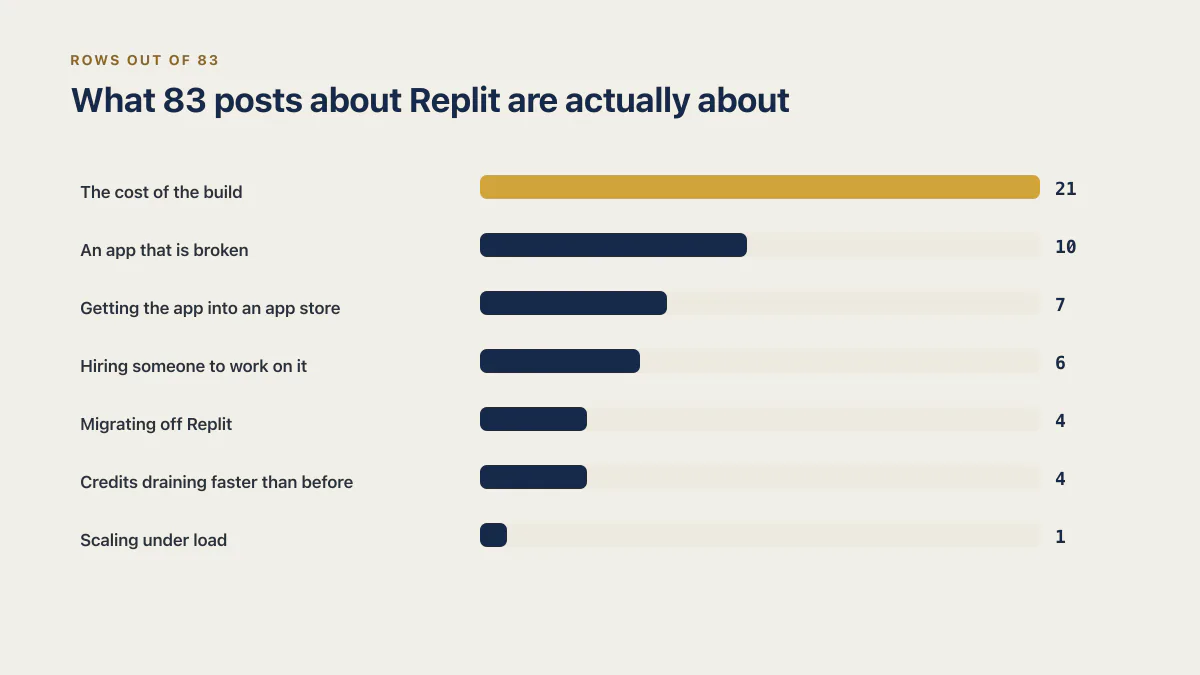
What 83 posts about Replit are actually about
Every review above is one app, built once, by one person. The corpus is the other way round: it has no first-hand experience in it at all and a denominator instead.
AxonBuild keeps that corpus for its code review work. It was read once, on 14 August 2026, and holds 1,255 posts from public builder communities, each logged with the person’s own words, the situation they were in, and the tools in play. Eighty-three of those rows are the Replit line in the corpus table that crosses each tool against each situation, and that table states its own counting rule: rows matching both the tool and the situation. Every count below is that line, read across.
| What the person was dealing with | Rows out of 83 |
|---|---|
| The cost of the build | 21 |
| An app that is broken | 10 |
| Getting the app into an app store | 7 |
| Hiring someone to work on it | 6 |
| Migrating off Replit | 4 |
| Credits draining faster than before | 4 |
| Scaling under load | 1 |
A row can match more than one of those situations, and a Replit row need not match any of them, so the seven do not add up to 83 and no residual can be read off them. Two readings hold up.
Cost is Replit’s own largest bucket, at 21 rows of 83. And of the six tools counted the same way in that table, Replit’s rows are the most likely of any tool to be about an app that is broken, at 10 rows of 83. That second one is the finding I did not expect. The reputation Replit carries in these threads is a pricing reputation, and the thing that separates it from the other builders in the same table is repair.
One limit belongs in the same breath. The corpus is weighted to proof-of-build posts: 644 rows come from people who already have traction, 314 from people running an app in production, 170 from people shopping for a tool, and 123 from agencies. So these counts show which situations recur among people who post about their builds. They say nothing about how common any of them is across everyone using Replit, and a happy owner has no reason to write anything down.
The downsides, in order
The four subsections below run in the order the corpus counts put them: cost at 21 rows, broken apps at 10, the app store at 7, and getting your work out at 4.
The bill you cannot predict
The complaint is rarely that Replit is expensive in the abstract. It is that the same work costs a different amount each time, so there is no number to plan against. A month of steady building and a month of fighting one stubborn bug produce very different invoices, and the second month is the one where the app was already going badly.
The pricing table further down is the honest half of what a review can say about this. The other half is arithmetic: how credits convert into work, what happens when the included balance runs out, and what recourse exists for a charge that looks wrong. All of that needs its own page and its own numbers, and none of it belongs in a verdict.
The fix that does not fix it
This is the one the counts single Replit out for, and the mechanism behind a lot of it is documented. A published Replit app is a separate running thing from the version in the editor. Replit’s deployment documentation, read 17 August 2026, describes a published app as a running instance of your app on Replit’s cloud infrastructure and says that to update it with the latest changes you publish again to create a fresh snapshot. So the fix you watched Agent make and the app your customer is looking at can be two different pieces of software, and the loop of “it says it fixed it, it is still broken” often starts right there.
Data works the same way. Replit’s development and production database documentation, read the same day, describes two databases behind every Replit App: a development one that you and Agent work in, and a production one holding the live data, with Agent locked out of the production side and structural changes crossing over only when you publish.
Diagnosing a Replit app that keeps breaking starts with settling which of those copies you were actually looking at, and that is the step where most people stop making progress on their own.
The app store step nobody mentions
Seven of the 83 rows are about getting a built app into a store, which is more than the corpus records for scaling or credits and roughly as many as for hiring. The mobile pipeline described above does real work, and it stops short of the parts that need your name on them. Replit’s current Expo guide focuses its walkthrough on iOS. For Android, it sends builders to Expo’s Android deployment guide and the Google Play Console process. The iOS path needs an Apple Developer account enrolled before Launch can sign anything.
None of that is hidden. It is absent from every timed build on the first page of this search, because a review that stops at “the app runs” never reaches it. Whether Replit can build mobile apps and what the store submission actually asks of you are two separate things worth reading about in order.
What leaves with you
Replit’s documentation on copying a project, read 17 August 2026, is blunt about the boundary: a copy carries neither the secrets, nor the database, nor the deployment configuration, and each of those has to be stood up again on the other side. Your code travels, and the parts that make the code run stay behind.
That is the single most useful sentence a review can give a buyer, because it turns leaving from a download into a rebuild. Getting your app, database, files and secrets out of Replit is four separate jobs, and knowing that on day one is worth more than knowing it in the week you decide to leave.
What Replit costs
| Plan | Price | Included credits |
|---|---|---|
| Starter | Free | Free daily Agent credits |
| Replit Core | $20 a month, or $17 a month billed annually | $20 of monthly credits |
| Replit Pro | $95 a month billed annually, $100 a month otherwise | $100 monthly credits |
| Enterprise | Custom | Everything in Pro, with custom configuration |
Prices checked on replit.com/pricing on 17 August 2026. That page also carries an FAQ entry headed “What is Effort-Based Pricing (pay-as-you-go)?”, which is the label Replit puts on the part of the bill that moves with how much work you ask for.
The verdict on the sticker price is that it is unremarkable. Core at $20 a month sits in the same band as every competing builder, and the corpus rows in that cost bucket are about bills that grew well past the plan price. The number that matters is the one nobody can see in advance, and working it out is the exercise this page hands over.
One of the review pages ranking alongside this one prints a plan fact that replit.com/pricing does not show. Hackceleration lists a Teams tier at $35 per user per month; there is no Teams tier on the pricing page as it reads on 3 September 2026. Emergent lists Core at $20 a month with $20 in monthly credits, and that matches the pricing page today, though $20 is the month-to-month price and the annual rate is $17. The Teams error is not enormous on its own. It is the kind of thing that happens when a plan table is copied once and never revisited, which is a decent reason to check the vendor’s page yourself before you budget anything.
That is the whole of the cost verdict here. What a Replit app costs per month once real users are hitting it, and what to do when the invoice does not look right, is a separate exercise with its own numbers.
Is Replit good, and who is it good for?
Replit is good for the person who wants one browser tab to hold the editor, the database and the hosting, and who can read the code it writes when it goes wrong. It fits worst where nobody involved can do that second thing. Ten of the 83 corpus rows are about an app that is broken.
Three situations, and what the corpus shows each of them running into.
The person who can already code a little is where Replit does its best work. One row in the corpus describes the job exactly: “Right now I pay a developer because adding features usually means changing the database, backend and frontend separately”. Replit collapses that into one conversation, and somebody who can read a stack trace when the conversation goes wrong gets most of the upside and very little of the downside. This is also the honest answer to how good Replit is, because the answer moves so much with who is holding it.
A non-technical founder building something strangers will pay for gets the fastest start and the sharpest cliff. The first version arrives in an afternoon. Then a payment fails, or a customer sees a page they should not, and the 10 broken-app rows are what that stage looks like from the inside. Publishing an app and having an app that survives customers are separate milestones, and what Replit’s platform does and does not test for you is the gap between them.
The person who wants an app in the App Store should read the store steps before starting, not after. Seven rows of 83 are people who got the app built and then met Apple or Google. Replit is ok for that job, and it goes further than most builders do, and it still ends with your developer account, your listing and your review queue.
The limits of this page, stated plainly. I have no Replit account and ran no build, so nothing here is a judgement on the editor, the prompt quality or how the product feels to use. No Replit app appears in AxonBuild’s fixed 26-app code review cohort, so no finding from that work is attached to anything above. The 83 rows are people who chose to post, which is not a sample of Replit’s users, and I have no way to tell whether the quiet majority is having a better time or just a less quotable one.
Common questions about Replit
Does Replit actually make apps?
Yes. Replit Agent produces working web apps, and the reviewers who ran a build in 2025 and 2026 each came away with one: a bill-splitting app, a photo-sharing platform with signup and photo uploads, a recipe tracker, and a landing page with email capture and Mailchimp integration. Working correctly on the first prompt is a different claim, and the same reviewers describe form validation problems, image upload errors and, in No Code MBA’s case, losing the recipes already entered during a redesign. The pattern across all four is the same: something running quickly, then a slower stretch getting it right.
Can I make money from a Replit app?
Charging for a Replit app is possible, and Replit’s own documentation is clear that the store steps stay yours. On iOS, its Launch feature builds and signs the app and lands it in App Store Connect, and you need your own Apple Developer account enrolled before that runs. On Android, you download the .aab file and drop it into Play Console yourself, with your own Play Console account. Whether the app then earns anything is not something Replit’s documentation or these 83 corpus rows can tell you, and nobody should trust a review that puts a number on it. Seven of those 83 rows are people still trying to get the app listed at all.
How good is Replit compared with other AI app builders?
The tools separate by which problem dominates their users’ posts, which is a more useful split than a score. In the corpus table, Replit’s rows lean to cost first at 21 of 83 and broken apps second at 10 of 83, and the other builders counted the same way lean elsewhere. So the comparison worth making is about which failure you would find easiest to live with. Working that out properly means a feature and price comparison across Replit alternatives, with a swap table at the end, and this page stops one step short of that.
Is Replit safe to use?
Replit’s platform carries a SOC 2 Type 2 attestation and runs on Google Cloud Platform, and the app Replit Agent generated for you is a separate matter that nobody has checked. Those two halves get confused constantly, because a search for whether Replit is safe returns platform answers to what is usually an application question. The platform decides how your project is stored, isolated and recovered. Your app’s own code decides who can sign in, whose records they can read, and what a request costs you when somebody sends it a thousand times.
Why do Replit reviews disagree so much?
Because each one is a single app built once, and several of them are written by companies with something to sell. Superblocks closes its Replit review by recommending Superblocks for internal tools, and Emergent closes its own by pointing readers at Emergent, both checked on 17 August 2026. Hackceleration’s 4.2 out of 5 sits beside a community score of 3.7 drawn from 15 G2 and Capterra reviews, so even one page can hold two different verdicts. A product that is genuinely fast at the start and genuinely difficult in month three will also generate honestly opposite reviews depending on when the reviewer stopped.
Does Replit own my code?
On rights, Replit’s terms decide, and this page does not restate them; read the current terms of service for ownership and licence wording before relying on either. The question people are usually asking is whether they can leave with what they built, and the documented answer is about reassembly. Replit’s projects-and-files documentation says a copy of a project arrives without its secrets, its database and its deployment configuration, so the source travels and the environment around it has to be rebuilt. That is why leaving takes longer than people budget for. Four of the 83 corpus rows are people in the middle of exactly that job.
Is Replit good for beginners?
Partly, and the qualification matters. Every reviewer who ran a build got a working app without installing anything, which is the beginner promise delivered. Emergent’s review, written by a company selling a competing builder, says the workspace still looks and feels like a developer tool and calls Replit a stressful first AI app builder, and the corpus counts point the same way: 10 of the 83 Replit rows are about an app that is broken, and getting out of that reliably needs somebody who can read what Agent wrote. A beginner will get to a running app. Staying there is where the second skill starts being required.
Built it with AI. Can’t get the last part right?
That’s the normal state of an AI-built app, and it’s fixable. I trace what the app actually does, explain what needs changing, and build it if you want me to.
Talk about your app →  Free 20-minute video call with Bilal.