Replit publishes four plans and two prices for each of the paid ones. The invoice is a different document. It carries the plan fee, plus whatever the Agent spent once the included credits ran out, plus whatever the published app metered while people were using it. The first of those three is fixed and the other two are not, which is the whole reason this search exists. The question people actually post is how much are you spending monthly on replit? (I'm a heavy user), and that is not the same question as what a plan costs. This page takes the fixed part of the bill apart from the metered part, using Replit’s own pages.
Replit costs $20 a month on Core and $100 a month on Pro, or $17 and $95 a month billed annually, read off Replit’s pricing page on 31 August 2026. Each paid plan carries a monthly credit balance, and publishing and Agent work spend that balance before anything is billed on top of the plan.
How much does Replit actually cost?
Four plans, two of them priced in public. On Replit’s pricing page, read 31 August 2026: Starter free, Core $20 a month or $17 on the annual rate, Pro $100 a month or $95 on the annual rate, Enterprise quoted rather than published. Each paid plan includes a monthly credit balance the meters spend first.
| Plan | Month to month | Billed annually | Credit each month |
|---|---|---|---|
| Starter | Free | Free | Free daily usage, no dollar figure published |
| Core | $20 | $17 a month | $20 |
| Pro | $100 | $95 a month | $100 |
| Enterprise | Custom | Custom | Not published |
Plan names, both prices and the Pro credit figure come from Replit’s pricing page, read on 31 August 2026. The Core credit figure is the one Replit’s billing and refunds documentation states in a sentence rather than a bullet: “Your Core plan includes $20 in monthly credits, and Agent usage beyond those credits is billed separately once it reaches the threshold.” The pricing page also states that prices are subject to tax depending on your location, so the plan figure is a floor rather than a total even before any meter runs.
The plan prices, the meters and the refund rules on this page were read on 31 August 2026 from five Replit surfaces: the pricing page, the publishing-costs and AI-billing pages in Replit’s documentation, the billing and refunds help page, and the terms of service. Nothing here was run on an account, and where two of those pages state the same thing differently, both readings are shown with the date.
What separates the two paid tiers is mostly capacity rather than features. Core runs 2 parallel agents and unlimited workspaces. Pro runs 10 parallel agents, allows up to 15 collaborators, allows up to 50 viewers to be invited, and extends the database rollback window well past the Core one, which is a tier difference worth knowing about before you pick, though the day counts belong on the page that owns the recovery question. Enterprise is where the security and control items sit: custom seat limits, SSO and SAML, advanced privacy controls, single-tenant environments and static outbound IPs, all listed on the pricing page without a figure attached.
None of that is what makes a Replit bill hard to predict. The plan decides how much parallel work you can run and how many people can be in the workspace. It does not decide what the app costs to keep online, or what the Agent spends getting it there.
What the plan price does not cover
Publishing an app is a second, separate meter, and it is the number missing from most write-ups of what it costs to build an app on Replit. Replit charges for a published app by type, and the types price completely different things: one charges while requests are served, one charges for a machine whether or not anybody arrives, and one is close to free.
| Publishing type | What it meters | Rate on 31 August 2026 |
|---|---|---|
| Autoscale | Base fee, compute units, requests | $2.00 a month, plus $0.60 per million compute units and $0.40 per million requests |
| Scheduled | Base fee, compute units, the scheduler | $2.00 a month, plus $0.60 per million compute units, scheduler at $0.00 |
| Reserved VM, shared | One shared machine at 0.5 vCPU and 2GB RAM | $15.00 a month |
| Reserved VM, dedicated | One dedicated machine, by size | $35.00 at 1 vCPU and 4GB, $50.00 at 2 vCPU and 8GB, $130.00 at 4 vCPU and 16GB, each a month |
| Static | Hosting and data transfer | Hosting free, Replit data transfer at $0.05 per GB |
Every rate above comes from Replit’s publishing-costs documentation, read on 31 August 2026. Two sentences on that page decide how those rates reach your card. Replit states that “All publishing costs are deducted from your monthly credits. You only pay usage-based fees after your monthly credits are fully used.” So a $20 credit balance on Core absorbs a small Autoscale app entirely, and a Reserved VM at the dedicated sizes eats it in the first days of the month with the app doing nothing at all.
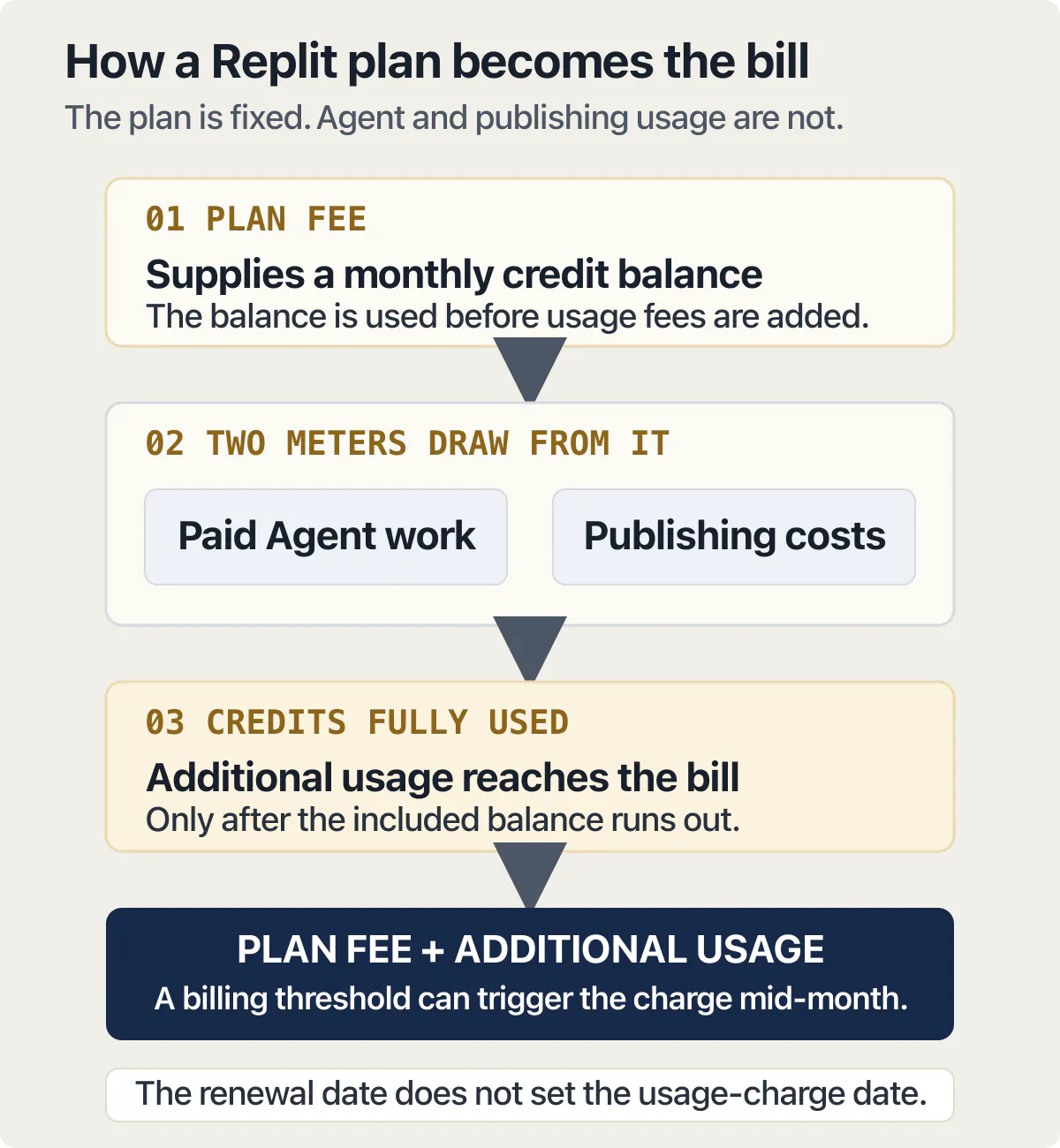
The plan price is the part of the bill you agree to. The rest of it is agreed to by whoever is using the app.
Two Replit pages state the rollover rule differently, and both readings are printed here rather than resolved into one. The publishing-costs documentation says plainly that unused credits do not carry into the following month. Replit’s AI billing documentation, read the same day, lists rollover as a Pro subscriber item instead, and gives tiered monthly credits with rollover for two months. Replit fills that length into the sentence from a stored value rather than writing it out, so a plain automated read of the page comes back with the gap empty and the period missing. Those are the two things Replit’s own documentation said on 31 August 2026, and neither page says which of them governs a Pro account.
Which publishing type a live app should be sitting on is a choice about how it behaves under traffic, and it is made before any of these rates matter. That choice has its own answer, set out in which publishing type a live Replit app should be on, including what each type does under load rather than what it charges.
The seller-written breakdowns that rank for this query are where the deployment rates go wrong most often, because deployment pricing is the part nobody re-reads. Bilt, a mobile app builder, publishes a Replit pricing article at bilt.me/blog/replit-pricing, dated 17 June 2026, that gives the Autoscale base fee as $1 a month and its compute as $3.20 per million. Replit’s own documentation on 31 August 2026 gives $2.00 and $0.60. Launchpad, which sells development services, publishes one at launchpad.io/blog/replit-pricing, dated 25 February 2026, that lists Core at $25 a month, where Replit’s pricing page today shows $20. Superblocks, which sells an internal-tools platform, publishes one at superblocks.com/blog/replit-pricing stamped 13 October 2025, whose plan figures do still match Replit’s page. All three were read on 31 August 2026, none of them is linked from here, and none of them goes anywhere near the refund rules.
How much does a Replit agent cost?
No per-request figure is published. Replit’s AI billing documentation prices Agent work by effort, with the charge scaling to how complex the request is and one checkpoint written per request. Core and Pro subscribers get a free mode inside an allowance the page does not size in dollars, and paid work is confirmed before it starts.
Effort-based pricing is the model Replit announced in 2025 and the one the documentation describes today. The page states that “One checkpoint per request eliminates intermediate checkpoints and reduces billing noise”, which is the mechanism: the charge lands once per request rather than accumulating across the steps inside it, and a simple request carries less of a charge than a complicated one. It also states that a paid action does not begin until it has been confirmed, and that a free mode covers everyday Agent work at no cost for subscribers on the two paid plans, within an allowance.
The part worth reading twice concerns work Replit does not do itself. Agent capabilities reach paid third-party models behind the scenes, and the documentation states the consequence in one line: “You’re billed at the provider’s public API rate, deducted from your Replit credits.” That is a pass-through charge at somebody else’s list price, spent out of your Replit balance, and it is why two requests that look identical to you can carry very different charges. What each paying customer costs you in model spend is the same question counted per user instead of per month, and it is answered on its own terms there.
As of 31 August 2026, Replit’s AI billing documentation states no dollar figure for a single request. It points to an interactive demonstration for cost examples instead. The figure is absent from the documentation rather than hidden in it, and that is the honest reason nobody can quote you a price for one Agent attempt before you buy it. It also means the only Agent number you can plan around is the ceiling you set yourself.
What one repeated repair attempt adds to the same invoice is counted one attempt at a time, and that count is kept where the breakage is. If you are on the fourth attempt at the same fault, the relevant number is what each repeated fix attempt costs you rather than the plan price.
Why the bill moves when you did not change anything
The most common shape of a Replit billing surprise is not a price change. It is the same price applied to work you did not ask for. A meter counts requests and compute. It does not know which requests you wanted.
Somebody running a real business application on the platform put it this way:
an application that retrieves information from my ERP system… Recently, this cost has spiked
They did not describe a new feature or a new plan. They described a cost that moved under an application that was already built and already running, which is the specific complaint this section exists to explain. Somebody else described the same thing from the other end: their use of the tool had not changed at all while the cost of using it climbed enough within a single month to send them looking at other options.
There are only a few ways a metered bill moves on its own, and they are all mechanical. Traffic went up, which is the good version. A retry loop or a scheduled job started running more often than anybody remembers configuring. Or an expensive route is reachable by people who are not your customers. In an audit of 26 applications built with AI tools in June and July 2026, counted from a ledger of confirmed findings rather than a scanner’s raw output, the most common of the findings that only apply to apps with an AI feature was exactly that last one: a way for a stranger, or for anyone holding a free account, to push work through the owner’s paid model or compute bill. The full findings from those audits set out the counts pattern by pattern.
The reason that shows up as a billing problem rather than a defect is the order in which you find out. A route that anybody can call in a loop does not produce an error, a crash or an alert. It produces requests, and requests are a line on an invoice. The owner meets the problem as a number at the end of the month rather than as a bug report, and then spends a while looking for the feature that caused it.
Two things are worth doing before you conclude Replit repriced anything. Check whether request volume moved, because Autoscale bills for requests served and does not distinguish a customer from a script. Then check whether anything that reaches a paid model can be reached without logging in. Those two checks explain most of the invoices that arrive larger than the month before them.
Replit overcharged me: what the refund rules say
Subscription payments are refundable within 30 days of purchase, usage-based charges are not, and only the most recent subscription charge is in reach. Replit states all three in its terms of service, which the page says was last updated on 3 August 2026, and its billing documentation repeats the usage rule in its own words.
| Charge | Refundable | Where Replit states it |
|---|---|---|
| A subscription payment | Yes, within 30 days of purchase | Terms of service |
| Usage-based billing charges | No | Terms of service |
| Agent and AI usage | No | Billing and refunds page |
| Custom domain registration fee | No | Billing and refunds page |
| An earlier billing cycle | No | Terms of service |
The three sentences that table rests on are worth reading in full, because they are short and they decide the answer. Replit’s terms of service states: “We allow for full refunds for subscription payments made within 30 days of purchase.” On the metered half it states: “Usage-Based Billing (UBB) charges are non-refundable, as they reflect metered usage that has already occurred.” And on how far back a request can reach: “Refunds are only available for the most recent subscription charge and do not apply to partial usage or past billing cycles.”
Read together, those three sentences say a subscription payment can be refunded in full within 30 days of purchase, on the terms’ own wording, while metered usage stops being refundable the moment the compute runs. The billing and refunds documentation gives the same rule for Agent and AI usage, on the grounds that each charge reflects compute that has already been consumed, and states separately that custom domain registration fees are non-refundable because the cost is paid on to somebody else.
Two mechanics turn a routine month into a surprise one. The first is the billing threshold: rather than waiting for the end of the cycle, Replit bills for usage above your included monthly credits once that usage reaches a set amount, which its billing and refunds page names as a billing threshold. So the charge can arrive mid-month, unrelated to your renewal date, which is exactly when people conclude something has gone wrong. The second is renewal. The terms state that “Your subscription will automatically be rebilled at the end of your subscription term at the then-currently applicable rates until you cancel”, so the rate that renews is the rate in force then rather than the one you signed up on.
There is also a documented limit on how much of this you can settle from a help page. On 31 August 2026, the billing and refunds documentation does not publish the subscription refund window as a rule of its own. It routes the question to support instead: the page says the window and the eligibility that apply to your own account and plan are things the support team confirms, and it tells you to cancel from the billing settings in your account before asking. The contract carries the 30-day sentence; the help page carries the process.
Then there is the case that is neither a meter nor a plan. Somebody posted this:
Hi, i am a PRO user. I was overcharged by $14,000 in one day. i chose monthly upgrade and it went through as Annual. Im still waiting for a refund.
A billing term applied wrongly is not what the meter charges, and nothing in that account tells you anything about what a month of Replit costs. It belongs in a refund section for a different reason: it is a subscription charge rather than a usage one, which is the half of the bill the terms of service say is refundable, and it is the half where the 30-day clock and the most-recent-charge limit actually apply.
Is Replit too expensive?
Before the swap question, there are controls that make the same tool cost less. Replit publishes usage alerts and hard budget limits, a free mode for everyday Agent work on the paid plans, a cheaper annual rate on both paid tiers, and a publishing type you choose. Most bills that feel out of control have none set.
The budget cap is the one that matters most and the one almost nobody turns on. Replit’s AI billing documentation states that alerts and budgets are configured in the billing section of the account settings, and a budget is the only control on this page that puts a ceiling on the metered half rather than trimming it: it turns an open-ended meter into a number you picked. An alert on its own tells you afterwards. A budget stops the spend.
The tier question is the second one, and it runs both ways. Pro exists for parallel agents, collaborators and the longer rollback window, so if you are one person building one app, the capacity you are paying for on Pro may be capacity you never use. Core exists for a single builder with the smaller of the two credit balances, so if the Agent is regularly spending past that balance, the plan is not the expensive part. Annual billing takes both paid tiers down to their lower published rate, at the cost of committing for the year, which is a real trade rather than a free saving.
The publishing type is the third, and it is usually the largest single lever on a small app. A Reserved VM charges for the machine whether or not anybody arrives. Autoscale charges while requests are served. Static hosting charges nothing for hosting at all. An app that is idle most of the day is paying a different amount on each of those three, for the same app.
If the answer turns out to be that none of this helps, the exit is a separate exercise with its own costs and its own timing, and taking the code and the data off the platform is set out step by step where that decision lives.
Is Replit really worth it?
Worth it here means worth what it bills, not whether the tool is good. Whether the tool is any good at the job, judged on what it builds rather than on what it bills, is a verdict of its own. The money test is narrower: did the month you paid for produce work you can keep?
Is Replit still worth it after the new pricing changes? is how the question gets asked out loud, and the pricing half of it has an answer that does not require a review. Three things make a month worth its charge. The app got closer to being usable by somebody other than you. The work survives outside the platform, in code you can move and data you can export. And the spend produced features rather than repeats, which is the difference between paying for progress and paying for a loop.
That last one is where the honest answer usually sits. One founder ran the numbers and concluded that using their builder as their main tool full time would cost more each month than the work it was replacing. The question is whether the meter is buying output at a rate you would agree to if somebody quoted it to you in advance.
Which tools people move to when the meter stops being worth watching, and what each swap costs them in practice, is kept on its own list. That is a different decision from this one, and it is worth making after the budget cap and the publishing type have been checked rather than before.
When another month of agent spend is not the answer
There is a point where the spending question stops being about pricing. A fault that has survived several billed attempts is not a budget problem. It is a problem nobody has read the code for, and buying another attempt at it costs the same as the first attempt while carrying less information than the first attempt did.
The signal is repetition rather than size. One thing failing once is normal. The same thing failing after three or four rounds of confident fixes usually means the fault is somewhere the Agent is not looking, and every further round is charged in full. Whether the next dollar buys more from the meter or from a person is settled by arithmetic this page does not repeat, and it is worth having in front of you before another cycle starts.
For what the alternative side of that costs, what hiring a developer for an app costs sets out the market rates by route. Finding somebody who already knows this platform, rather than any developer at all, is a different search with its own shortlist. And what it costs to keep somebody available month after month, rather than to have one thing fixed once, is counted separately again.
AxonBuild fixes and finishes AI-built apps that already run, including ones built on Replit. It starts with a free 20-minute video call with Bilal: show him the app and what is wrong or missing. If you want him to make the change, he checks the code and gives you a fixed quote, and you pay after you see it working.
Where the other tools’ monthly prices are tracked
Every AI builder meters something, and no two of them meter the same unit, which is why a straight comparison of monthly prices tends to mislead. Each of these is kept on its own page, against its own vendor’s current pages, rather than summarized here.
How one builder counts credits and what a top-up buys covers the credit model in the most detail. What another builder charges on each of its tiers covers a platform that runs two separate meters at once. What the coding agent next door charges per month covers the subscription model without an app-hosting bill attached. What a token-metered builder costs per month covers the one that sells tokens rather than credits.
Two more sit alongside them. OpenAI’s coding agent meters work in a different unit again, and its plans and limits are priced out on their own page. Bubble bills in workload units rather than in dollars of model spend, and what that does to a growing app is priced separately.
Two adjacent sums are also worth keeping distinct from this one. Adding the subscription, the credits and the human finishing into one build total is a different sum from a monthly one. And hosting, the database and the third-party meters that keep charging while the app sits idle are counted together elsewhere.
Common questions about Replit’s monthly cost
Is Replit free?
Yes, on the Starter plan. Replit’s pricing page, read on 31 August 2026, lists Starter at no cost with free daily usage, a built-in database, and one live published project. It publishes no dollar credit figure for Starter, so the free allowance is stated as daily usage rather than as a balance. The paid tiers start at $20 a month on Core, or $17 a month billed annually.
Do Replit deployments cost money?
Yes, except for static hosting. Replit’s publishing-costs documentation, read on 31 August 2026, prices Autoscale and Scheduled at a $2.00 monthly base fee plus metered compute, Reserved VMs at $15.00 a month for a shared machine, and static hosting at no cost with data transfer charged at $0.05 per GB. Those charges come out of your included monthly credits first and are billed on top once the credits are used.
What happens when my Replit monthly credits run out?
Usage is billed on top of the plan. Replit’s publishing-costs documentation states that all publishing costs come out of the monthly credits and that usage-based fees start only after those credits are fully used. The billing and refunds documentation adds that Replit charges for usage above the included credits once it reaches a set amount, which it calls a billing threshold, rather than waiting for the end of the cycle.
Do unused Replit credits roll over?
Replit’s own pages give two different answers, so both are recorded here. The publishing-costs documentation states that unused credits do not carry into the following month. The AI billing documentation lists rollover as a Pro subscriber item instead, describing tiered monthly credits with rollover for two months. Both were read on 31 August 2026, and neither page says which answer governs a Pro account.
How much does Replit cost per year?
Replit publishes annual pricing as a reduced monthly rate rather than as a yearly total: Core at $17 a month billed annually and Pro at $95 a month billed annually, read on 31 August 2026. There is no yearly total printed on the pricing page; multiplied out, those rates come to $204 a year for Core and $1,140 a year for Pro before tax, with publishing and Agent usage on top. Prices are subject to tax depending on location, which the page states. Publishing and Agent usage above the included credits are billed separately from the plan.
Why did Replit charge me more than my plan price?
Because the plan price and the meters are separate charges. Publishing and Agent work spend your included monthly credits first, then bill on top. Replit’s billing and refunds documentation also states that usage above the included credits is charged once it reaches a set amount rather than at the end of the cycle, so an extra charge can arrive mid-month with no change to your plan and no change to your app.
Which Replit charges can be refunded?
Subscription payments only, and only recent ones. Replit’s terms of service, which state they were last updated on 3 August 2026, allow full refunds for subscription payments made within 30 days of purchase, limit refunds to the most recent subscription charge, and state that usage-based billing charges are non-refundable because the usage has already occurred. The billing and refunds documentation gives the same answer for Agent and AI usage, and states that custom domain registration fees are non-refundable.
What is the cheapest way to keep a Replit app online?
Static hosting, where the app can be static. Replit’s publishing-costs documentation, read on 31 August 2026, charges nothing for static hosting and bills data transfer at $0.05 per GB. Anything needing a server costs more: Autoscale at a $2.00 monthly base fee plus metered compute and requests, or a Reserved VM at a flat monthly rate for the machine whether or not anybody uses the app.
How do I cancel a Replit subscription?
From the billing settings in your account, which is also the step Replit’s billing and refunds documentation asks you to complete before requesting a subscription refund from support. Cancelling matters for timing as well as cost: Replit’s terms of service state that a subscription is automatically rebilled at the end of its term, at the rates applicable then rather than the rates you signed up on, until you cancel.
Built it with AI. Can’t get the last part right?
That’s the normal state of an AI-built app, and it’s fixable. I trace what the app actually does, explain what needs changing, and build it if you want me to.
Talk about your app →  Free 20-minute video call with Bilal.