A white-label partnership in software delivery is an arrangement where one company writes or repairs the software and another company sells it to its own client under its own name. Three other things wear the same phrase and none of them is this: retail goods rebranded for a shop’s own shelf, white-label marketing and SEO resale, and the white-label crypto and reputation products that fill most of the results for these words. Agency here means a company that builds and sells software work rather than a government body or a talent agency, and client means the business buying that work from the agency rather than the client half of a client-server pair.
The phrase is worth pinning down because the arrangement decides who gets paid late, who answers the angry email, and whose name sits in the commit history. Branding settles none of that. The answer sits in which two of the three companies signed something with each other.
Every clause quoted below comes from one place: a master software development agreement filed with the United States Securities and Exchange Commission and read on 3 September 2026, together with the ranked pages for this phrase, read the same day for what they say rather than for whether they are right. No such arrangement was set up for this page, no agreement was drafted, negotiated or reviewed, nobody was subcontracted and nothing here was tested. Nothing on this page is legal advice about your own contract, and the words in quotation marks are the filed agreement’s words, not a recommendation about what yours should say.
Choosing which company to put behind your own logo is a separate sitting from understanding how the arrangement works, and it has its own list of things to check first.
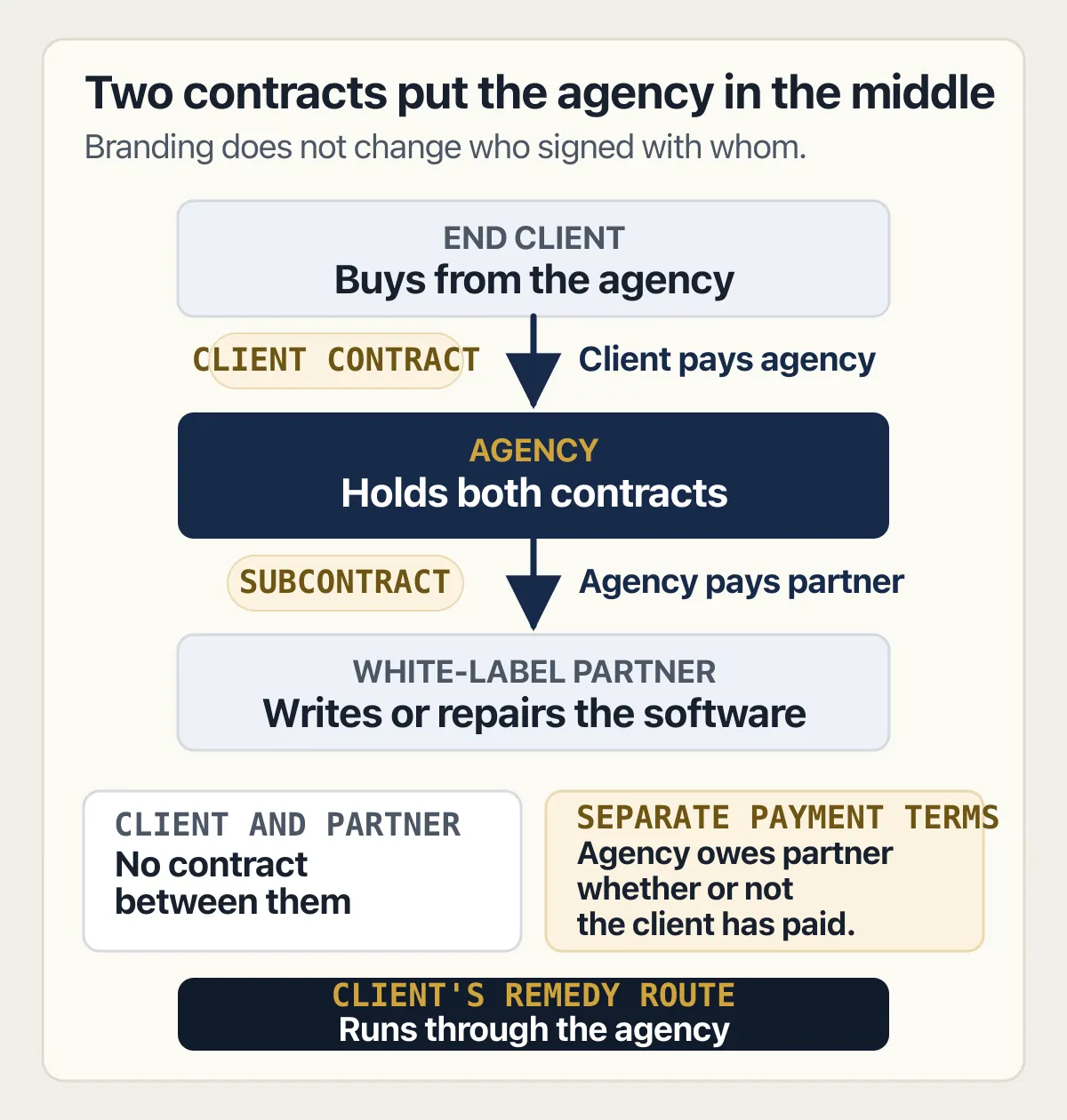
A white-label partnership, in the closed form this page describes, is two contracts and no third. The client signs with the agency, the agency signs with the partner, and nothing is signed between the client and the partner unless the client’s own contract asks for it, as the filed agreement does with subcontractor confidentiality terms. Who invoices whom, who owns the code, and who answers when the app stops working all fall out of that one shape.
Who holds which contract, and who pays whom
The agency sits in the middle of both money flows, holding one of the two contracts with the client and the other with the partner. It invoices the client, the partner invoices it, and everything else on this page follows from the fact that the client and the partner have signed nothing with each other.
The decision usually arrives before any of the paperwork does. One person running a small consultancy had a client come to them wanting a booking and stock system built, and their first decision was not how to write it but which route would let them hand it over sooner and for less. That is the moment a partnership starts: work already sold, capacity that does not stretch to it, and somebody else who can write the thing.
Four things follow from that shape.
The first is that the agency invoices the client at the agency’s own price. The client is buying from the agency and pays the agency. Whatever the partner charges is a cost inside that transaction, and the client has no sight of it and, unless the client’s contract says otherwise, no right to ask.
The second is that the partner invoices the agency on the partner’s own terms, which is the contract most agencies think about last. In the filed master software development agreement, the developer is required to “be responsible for all fees and expenses payable to, by, or on behalf of each Permitted Subcontractor in connection with this Agreement”. An agency taking work from a client and passing it to a partner is standing where that agreement puts the developer, with the partner in the subcontractor’s position.
The same agreement’s invoicing section, which is paraphrased here rather than quoted, requires the developer to bill against an agreed schedule and to itemise each charge in enough detail for the customer to check the calculation. An agency that has accepted that from its client, and asked nothing like it of its partner, is the one doing the arithmetic twice.
The third consequence follows from the second: the agency usually owes the partner whether or not the client has paid. The filed clause makes the subcontractor’s fee the developer’s responsibility and says nothing about timing, so whether that payment can wait for the client’s money is a term of the partner contract itself, and one to read before signing. The client’s payment terms and the partner’s payment terms are two separate facts that only meet inside the agency’s bank account.
The fourth is that the client’s usual route to a remedy runs through the agency, because in the closed form there is nobody else the client has a contract with. What that costs when something actually goes wrong is further down.
What a client contract usually says about bringing anybody in
Approval is the clause to look for. In the master software development agreement filed with the SEC and read on 3 September 2026, the developer may not engage any third party to perform the work without the customer’s prior written approval, and the customer’s approval does not reduce the developer’s own liability.
The operative words are worth reading slowly. The agreement says the developer “shall not, without the prior written approval of Customer” engage “any Third Party to perform Services (including to create any Work Product) hereunder”, and that an approved third party becomes a defined thing, a “Permitted Subcontractor”. That approval does real work. It is the difference between a partner who sits inside the agreement and a partner whose presence is itself a breach of it, whatever the code turns out to be like.
The sentence immediately after it closes the obvious escape route. The customer’s approval of a third party “shall not relieve Developer of its representations, warranties, or obligations under the Agreement”. Approval moves nothing off the agency’s side of the table. It only makes the arrangement permitted.
Section 15.9 of the same agreement blocks the other way around the problem. The developer may not assign or transfer its rights, or delegate its obligations, without the customer’s prior written consent, and “No delegation or other transfer will relieve Developer of any of its obligations or performance under this Agreement.” The filed form also treats a merger, consolidation or reorganisation involving the developer as a transfer needing that same consent, which is a clause worth knowing about before an agency sells itself.
One honest caveat about the source. This is a real executed exhibit, filed as Exhibit 4.19 and dated as of 28 May 2018, and its text is still full of square-bracketed optional language: counted on 3 September 2026, the extracted text of the filing opens a square bracket 211 times, including inside the approval clause itself. It reads as a form adapted for a filing rather than a one-off negotiated between two particular companies, which makes it a good picture of what these agreements usually contain and a poor picture of what any specific one says. The agreement that governs any particular arrangement is the one those two companies signed, and that is the one to read.
Getting at the document took three tries. sec.gov refused both a plain request and a browser-shaped request on 3 September 2026 and answered a request that identifies itself, which is what the SEC’s own automated-access policy asks for.
The contract the client signs with the agency is a different document with a different list, and what an owner should put in that one is set out on its own page.
What goes in the subcontract
The subcontract carries three obligations before the partner writes a line: confidentiality, work made for hire, and an assignment of intellectual property rights, in a form the client finds acceptable. The filed agreement also lets the client ask for a fully executed copy of each one.
That requirement is section 2.10(d)(i), and it is the sentence this whole page turns on. Before any permitted subcontractor provides services or creates work product, the developer must “obtain from such Permitted Subcontractor confidentiality, work-for-hire, and intellectual property rights assignment agreements, in form and substance acceptable to Customer”, and “upon request, provide Customer with a fully-executed copy of each such agreement”.
Read that beside the ownership clause and the reason for it is plain. Section 9.1 makes the customer “the sole and exclusive owner of all right, title, and interest in and to all Work Product, including all Intellectual Property Rights therein”, created as work made for hire, with an assignment of anything that fails to qualify as work made for hire. An agency that has promised its client that and has not obtained the same thing from the partner has promised something it does not hold.
Confidentiality in the filed form runs one level further than the ranked pages describe. Its optional wording makes “the financial terms and existence of this Agreement” confidential information in themselves. On the white-label side that is the clause doing the invisible work: the existence of the arrangement, not only what passes through it.
Read as one chain, the clauses line up like this. Every left-hand cell is the filed agreement’s own requirement on the developer, read on 3 September 2026.
| What the filed agreement puts on the developer | What that means the partner signs | Why the two have to match |
|---|---|---|
| No third party performs without the customer’s prior written approval | Nothing until the client has approved this partner in writing | An unapproved partner is a breach whatever the code is like |
| Approval does not relieve the developer of anything | A remedy the agency can use against the partner | The client’s claim lands on the agency either way |
| Responsible and liable for the partner’s acts and omissions | Terms that bind the partner’s own staff, not only the partner | The partner’s mistake reads as the agency’s mistake |
| Responsible for all fees payable to the partner | Payment terms that stand on their own | A slow client does not pause what the agency owes |
| The customer owns all work product, as work made for hire | Work-for-hire and an assignment of intellectual property rights | Nobody can pass on rights they never received |
| Financial terms and the existence of the agreement are confidential | The same confidentiality, in the second contract | Otherwise one side may say what the other has promised not to |
The demand under this phrase is being served by forms and by law firms. Of the nine organic results for software development subcontract agreement on 3 September 2026, three are free contract templates offered as downloads, two are law-firm pages, one is a video, one a personal blog post about subcontracting rates, one a software company’s client-resources page, and one is the filed agreement itself. This page publishes no form, offers no download, and gives no legal advice: it reads one filed document and says what is in it.
How the client never learns a third party touched it, and where that breaks in software
Invisibility is a contract term on the selling side and a configuration problem on the delivery side. The ranked pages describe an NDA and a partner who never contacts the client. A repository name, a platform seat, a deploy notification and a support inbox each carry a name that somebody chose without thinking about it.
Two of the ranked pages state the practice plainly. A chatbot vendor’s post at wotnot.io/blog/white-label-partnerships, dated 4 May 2023 on the page itself, describes what it calls a closed white-label arrangement, in which the end client never learns that a white-label partner is working behind the scenes, the partner never contacts the end client directly or reveals its presence, and both companies sign an NDA. A contributor post on the Forbes Agency Council, dated 30 March 2021 at forbes.com/councils/forbesagencycouncil/2021/03/30/white-label-partnerships-benefits-and-considerations-before-jumping-in/, says a white-label partner typically will not interact with the agency’s clients at all, that the agency gets the credit for the work, and that the partnership is usually kept confidential with no unauthorised sharing of identity.
Those are statements about paperwork. Software leaks names in places no agreement reaches, and that is where the invisibility usually goes.
The repository is the first one. A client who is given the code gets the commit history with it, and the commit history carries author names and email addresses on every line of it. The organisation the repository sits in has a name too, and it is usually the partner’s.
Then the accounts. A platform seat is billed to somebody, and the billing address on it belongs to a legal entity. Deploy notifications, error alerts and uptime warnings go from the account that owns the project to the address that opened it. The support inbox the client’s users write to is somebody’s inbox, and the signature at the bottom of a reply usually says whose.
None of that is exotic and none of it needs a leak to happen. It needs one person to forward one alert, or one client to click through to a status page, or one developer to be added to a shared chat channel that already had another company’s name on it.
The list of accounts that must end up in the client’s name is longer than the two or three most agencies think of, and it is worth reading through before the arrangement starts rather than on the day the client asks. What the agency actually owes the client on delivery day, when the thing being delivered was built with AI tools, is the other end of this arrangement and is set out separately.
Whose problem is it when the app breaks after the client has it?
The agency answers. The client’s contract is with the agency, and in the filed agreement the developer’s indemnity to the customer expressly covers a permitted subcontractor’s acts as well as its own, so the paperwork points the same way the client’s instinct does.
Two clauses do that work. Section 2.10(a) makes the developer “responsible and liable for the acts and omissions of each such Permitted Subcontractor” to the same extent as if those acts had been the developer’s own. Section 12.1 then extends the general indemnity to any breach of the agreement “including any action or failure to act by any Permitted Subcontractor that, if taken or not taken by Developer, would constitute such a breach by Developer”. A client with a broken product does not have to work out whose keyboard the problem came from, and under those terms it does not matter to them.
That has a practical consequence an agency feels in its calendar rather than in court. The agency is the one who has to answer the email on a Sunday, whether or not the partner is reachable, and whether or not the partner has any obligation to be reachable. If the second contract says nothing about response times, the first contract’s expectations arrive anyway, and they arrive at the agency.
When the software was built with AI tools, the timing of the first real failure is what makes this concrete. Demos hold. The failures show up when the client’s own users arrive with real logins, real payments and real data, by which time the money has usually moved and the arrangement has gone quiet. When the app in the middle of the arrangement was built on a builder, what an agency runs into is specific and predictable, and it arrives in the week the client’s own users do.
Why nobody publishes a number for this arrangement
The number nobody publishes is the agency’s own commercial position: the gap between what the partner charges and what the client pays. Across the six of nine ranked pages that could be read on 3 September 2026, the words invoice, margin and markup appear zero times between them.
That count is measurable rather than impressionistic. The six results that answered a read on 3 September 2026 were loganix.com/white-label-partnership/, impartner.com/glossary/what-are-white-label-partners/, wotnot.io/blog/white-label-partnerships, linkedin.com/pulse/unlocking-power-white-label-partnerships-deep-dive-digital-qelkf, promodo.com/blog/white-label-partnership and forbes.com/councils/forbesagencycouncil/2021/03/30/white-label-partnerships-benefits-and-considerations-before-jumping-in/, each taken as raw page text including its embedded navigation. The word invoice appears zero times across all six, the word subcontract appears zero times, and margin and markup appear zero times. Four of the six do mention confidentiality and two of those name an NDA, so the silence is specific to the money rather than general.
A page written by a company that wants to be your white-label partner has no reason to describe what you can charge over its own cost. So the ranked set describes capacity, focus and confidentiality, all of which are real, and stops at the edge of the part the reader came for.
No figure appears anywhere on this page either. What the market actually charges, route by route is collected on one page and not repeated here.
Two of the nine results refused to be read at all. On 3 September 2026, intandem.vcita.com/blog/4-different-types-of-white-label-partnerships and whitelabelpartner.com each answered a plain request and a browser-shaped request with 403, so neither is included in the counts above. The community thread ranking fifth is not included either: reddit.com returned an automated-access challenge page rather than the thread to both request shapes on the same day, so all that exists for it is the search snippet, which shows the conversation happens and nothing more.
Partnership, referral, reseller and subcontract: four things the phrase covers
People use one phrase for four arrangements, and what separates them is who holds the client contract, and therefore who carries a failure. A partner-relationship-management vendor’s glossary entry at impartner.com/glossary/what-are-white-label-partners/, read 3 September 2026, defines white-label partners as businesses that take a product or service developed by another company and rebrand it as their own, which describes the first row and none of the other three.
| Arrangement | Who holds the client contract | Who the client deals with | Who carries a failure |
|---|---|---|---|
| White-label partnership | the agency | the agency only | the agency |
| Referral | the partner | the partner, after an introduction | the partner |
| Reselling a finished product | the agency, for its own work | the agency, on somebody else’s software | split: the agency for delivery, the vendor for the product |
| Named subcontract | the agency | both, openly | the agency, with the partner named |
The rows people mix up most are the first and the third. A white-label app is a different purchase from a white-label partnership: one is a finished product you rebrand, the other is a company that builds under your name, and the buy-versus-build arithmetic on the product side sits on its own page. The retail sense of the phrase, a manufacturer’s product sold under a shop’s own label, is the ancestor of all four and explains none of them.
Some builders run partner arrangements of their own, with published tiers and a public directory, and what one of those actually gets a firm is documented separately. That is a fifth shape: the vendor is not building anything for the agency, and being listed by one is a marketing position rather than a contract about delivery.
Common questions about white-label partnerships
What is a white-label partner?
A white-label partner is the company doing the work that another company sells under its own name. The glossary entry at impartner.com/glossary/what-are-white-label-partners/, read 3 September 2026, puts it as businesses that take a product or service developed by another company and rebrand it as their own. In software delivery the partner writes or repairs the code, holds no contract with the end client, and is paid by the agency rather than by the client.
Is a white-label partnership the same as outsourcing?
The mechanics are the same and the branding is not. Outsourcing describes where the work is done; white-label describes whose name is on it when the client sees it. An agency can outsource openly, with the partner named in the room, and that is a subcontract rather than a white-label arrangement. What makes it white-label is the second half: the client deals with the agency and the partner stays out of sight.
What is a white-label agreement, and what does it usually cover?
A white-label agreement is the second contract, between the agency and the partner. The post at promodo.com/blog/white-label-partnership, whose page carries a published date of 26 September 2025, says its own agreement sets out what will be provided, how communication will happen, who is responsible for reporting, and what guarantees are in place. The filed master software development agreement read for this page goes further on the parts that matter later: confidentiality, work made for hire, an assignment of intellectual property rights, and who is liable for whose acts.
Can a client stop you bringing in a partner?
Under the terms of the master software development agreement filed with the SEC and read on 3 September 2026, yes. That agreement bars the developer from engaging any third party to perform the work without the customer’s prior written approval, and treats an approved third party as a defined category with its own conditions attached. Whether your own client contract says the same thing is a question about your contract, and the only way to answer it is to read that contract.
Who owns the code the partner writes?
Whoever the two contracts say owns it, and the risk is that they say different things. Section 9.1 of the filed agreement makes the customer the sole and exclusive owner of all work product and the intellectual property rights in it, created as work made for hire, with an assignment for anything that does not qualify. Section 2.10(d)(i) requires the developer to obtain confidentiality, work-for-hire and intellectual property rights assignment agreements from the subcontractor before it starts, in a form acceptable to the customer, which is the mechanism that turns the first clause into something the agency actually holds and can pass on.
Does the partner sign an NDA, and who is it with?
With the agency in the closed arrangement, where the client and the partner sign nothing with each other; a client’s own contract can require more. The page at wotnot.io/blog/white-label-partnerships, dated 4 May 2023, describes both companies signing an NDA in the closed arrangement it names. The filed agreement handles the same problem differently and more strictly: it requires the developer to obtain confidentiality agreements from the subcontractor in a form the customer finds acceptable, and to provide a fully executed copy on request.
Whether an owner needs one before showing an app to anybody at all is answered separately.
What happens if the client learns a partner wrote the code?
Contractually, it depends on what was promised, and the filed agreement’s optional confidentiality wording makes even the existence of the agreement confidential information. Commercially, the damage is rarely the fact of the partner and usually the fact of the surprise: a client who was told they were buying the agency’s own work, and who discovers otherwise from a commit history or an alert email, reads the whole relationship backwards from there.
Who is liable if the partner’s work fails?
The agency, on the terms filed in that agreement. It makes the developer responsible and liable for the acts and omissions of each permitted subcontractor to the same extent as if they were the developer’s own, and extends the general indemnity to a subcontractor’s action or failure to act that would be a breach if the developer had done it. Whatever the agency can then recover from the partner is a matter for the second contract, and it does not change what the client is owed.
What is a white-label partnership model?
The phrase covers four arrangements that differ in one thing: who holds the client contract. A white-label partnership puts it with the agency and keeps the partner out of sight. A referral puts it with the partner. Reselling puts somebody else’s finished software under the agency’s name. A named subcontract keeps it with the agency and tells the client who the partner is. Whoever holds that contract is the one a client’s claim reaches, whatever the arrangement is called.
If you have a working app built with these tools and need it ready for real customers, this is what we do.
Built it with AI. Now it has to hold up for real customers.
The Production Hardening Sprint takes the app you already have and builds the production foundation underneath it. Authentication and access rules, payments that stay consistent, error handling, monitoring, backups, automated tests and a documented handover. Our engineers work inside your existing codebase for ten working days. All 123 deliverables are included, and you get the evidence for each one.
See the Production Hardening Sprint →  $2,500 fixed price · 10 working days · One codebase