Type bubble agency into Google and the first result is a public relations, marketing and events company. Its LinkedIn, Instagram and Facebook profiles take three more of the seven results on that page. Two of the rest belong to Bubble itself and are written for people who want to sell Bubble work rather than buy it. The last one is a Bubble company’s ranked list of Bubble companies, with itself at number one. That was the entire first page on a US desktop pull dated 29 August 2026, and none of it was written for the person who typed the query.
Bubble agency returns three unrelated things: a public relations company that owns the name, Bubble’s own pages for sellers, and the companies that build apps on Bubble. Only the third one can touch an app you already own, and two extra letters in the query remove the first one completely.
This page sorts the three, says what Bubble’s agency account and directory listing actually are in Bubble’s own words, and then answers the question none of the ranked lists answer: whose account your app lives in, and what happens to it when the company leaves.
To write this page I pulled the Google results for bubble agency, bubble agencies and bubble io agency on 29 August 2026 and wrote down who ranked, then read Bubble’s own documentation on agency subscriptions, on collaborators and on plan tiers and took only what those pages state; the ranked agency lists on that same result set were read to see what they cover, and none of them was used as a source for anything about ownership, transfer or price.
Three businesses answer to bubble agency
The company at the top has nothing to do with software. Its own homepage, read on 29 August 2026, titles itself Bubble Agency, PR, Marketing and Events, and describes the business as public relations, social media, digital and traditional marketing, media buying, branding, messaging and event management. It is a real company with a real name that happens to be the same word as a software platform. It is named here so you can rule it out, and it is not linked.
The proof that the collision is the whole problem takes two letters. On the same day, on the same kind of pull, bubble io agency returns no trace of that company at any position. Bubble’s own site takes the first two results, the review directory clutch.co takes the third, and everything under that is ranked lists and forum threads. The searcher’s question did not change. Only the string did.
The middle result set is bubble agencies, which is a second query with the same volume as the first. There the vendor’s directory ranks first, clutch.co second, the public relations company third, and the marketplace category page on upwork.com ninth. Clutch and Upwork are named here for the same reason as everyone else on these pages and are not linked.
Google’s autocomplete on 29 August 2026 shows the split inside the query itself. Some stems are about the software product, including bubble agency plan, bubble agency account and bubble agency directory. Others are about the other company entirely: bubble agency ltd, bubble agency jobs, bubble agency nanny. Those stems are evidence that people are typing one phrase at several different businesses, and nothing more than that. This page did not fetch a company behind any of them and makes no claim about who they are.
| What you landed on | Who publishes it | What it can do for a Bubble app you already own |
|---|---|---|
| A public relations, marketing and events company that has the name | The company itself, at bubbleagency.com, and its LinkedIn, Instagram and Facebook profiles | Nothing. Different industry, no connection to the software platform |
| The agency account page and the experts directory | Bubble, the software company | Nothing directly. Both are written for the seller. One is a subscription a company buys in order to build client apps, the other is a list a company applies to appear on |
| Companies that build, finish or take over apps on Bubble | The companies themselves, plus the ranked lists they publish about each other | This is the only row that can do work on your app |
The third row is where the money goes, and it is also where the result set is least useful. Four of the six Bubble companies that ranked across the three pulls did so with a page whose own title is a ranked list of Bubble agencies: lowcode.agency, goodspeed.studio, closefuture.io and ayautomate.com. Two of those four were read in full on 29 August 2026, at lowcode.agency/blog/top-bubble-agencies and goodspeed.studio/blog/bubble-approved-agencies, and both put the publisher at number one. One heads its eleven with its own name; the other heads its seven with its own, under a section arguing why it stands out. The agency names inside those lists are not reproduced here, and neither page is linked, because both are sellers of the work. A list where the author wins is a sales page with a table in it, and reading it as a ranking is the mistake.
What a Bubble agency account is, in Bubble’s own words
A Bubble agency account is a subscription a company buys so it can build apps for clients and then transfer them. Bubble’s documentation calls it the Agency Subscription and says it exists to let a company build apps and transfer ownership to clients smoothly. It is a seller’s product, and nothing about it makes the seller better.
Read on 29 August 2026, Bubble’s documentation on building apps for others states: “We have set up the Agency Subscription to let you build apps and transfer ownership to your clients smoothly.” The same page says a company subscribes on its account page, and that once an agency exists it can add agency members who then start working on apps. It also records two limits worth knowing as a buyer. Apps on that plan are password protected in run mode. And the plan enables the features needed to build the app, without necessarily granting features that are only needed once an app is in production, which the page says would likely be the purview of the client.
Bubble’s plans documentation says the same thing from the other end. On the Agency plan, in Bubble’s words on 29 August 2026, the plan “gives you full access to both web and mobile features during development”, and then: “When your project is ready to go live, just transfer it to a client plan to enable deployment and app store publishing.”
Put those two pages side by side and the shape of the product is plain. The agency account is a build environment with a scheduled exit. The transfer at the end of it is the step that makes deployment and app store publishing possible, which puts it on the schedule alongside everything else that has to happen before launch. Any timeline that leaves the transfer vague leaves your launch date in someone else’s account.
Bubble’s own program page for this sits at Bubble’s agency account page, and the documentation names it as the definitive source for the plan’s full details. On 29 August 2026, a plain automated read of that URL returned the page title and nothing else, because the page builds its content in the browser. So no term, condition or figure on this page is quoted from it. Everything above comes from the two documentation pages that do return text. The same is true of bubble.io/agency-addendum, which is the terms page an agency account agrees to. It returned a title and no body to the same read, so its clauses are not restated here and it is deliberately left unlinked rather than cited for something it may or may not say.
What does a listing in Bubble’s agency directory prove?
A listing proves a company applied and that somebody at Bubble checked it exists. Bubble’s documentation says so directly, and says in the same paragraph that a listing is not an endorsement and not a partnership. Treat a directory entry as a filter against the worst applicants, and go and get your own evidence for everything above that line.
The mechanism is short. Bubble’s documentation on building apps for others says there are pages on the Bubble website, notably bubble.io/experts-directory, that show agencies and freelancers who wish to be publicly listed, and that an agency admin submits the agency or freelancer profile from the Account then Billing page. Then, in Bubble’s wording: “Upon submission, a member of the Bubble team will reach out to verify certain details before you will be shown in the list.”
The next line is the one that matters to a buyer, and it is Bubble’s own parenthesis: “This does not constitute an official endorsement by Bubble or partnership with Bubble - this is just to verify that you exist as an agency or freelancer and to filter out the more egregious forms of abuse of agency/freelancer status.”
That is worth holding next to the directory’s own page title. Bubble’s experts directory returns the title “Browse Bubble-Certified Experts | Find an Agency, Freelancer, or Coach” to a read on 29 August 2026, and bubble.io/agencies redirects to the same URL. The word certified in that title has a separate meaning in Bubble’s documentation. Bubble’s certification documentation, read the same day, describes an exam a developer sits: “The exam comprises 90 questions, randomly selected from a larger pool, ensuring that no two exams are the same.” The exam is proctored by a third party, and “Although the exam has a 3.5-hour limit, most candidates complete it within approximately 2 hours.” The same page states that from 1 April 2025 the Bubble Developer Certification Exam is valid for two years.
So there are two different things wearing similar words. One is a person passing a timed exam. The other is a company profile that a member of the Bubble team checked before it appeared. A listing does not tell you that the people who would work on your app hold the exam, and asking which named individuals hold it, and when they last sat it, is a fair and cheap question. Nothing inside the directory is quoted or linked here, because a listing is a company’s own copy about itself.
The app has an owner, and the owner is an account
Everything above is preamble to the question that actually decides how a Bubble project ends. A Bubble app lives inside one Bubble account. That account pays for it, that account owns it, and one button moves it somewhere else.
Bubble’s collaborator documentation, read on 29 August 2026, describes the people side first. Every editor added to an app is a collaborator, collaborators are attached to an app rather than to your account, and the account paying for the app is the owner. Access is set per person: whether they can edit the app or only view it, what they can do with the database, whether they can read the logs, and whether they are confined to the development environment. Those switches are the ones to talk about before anybody is invited, not after.
How many people can be in the app at once depends on the plan, and the plan is the buyer’s decision. The collaborator FAQ on that page, under the question about why a collaborator cannot be added, states it in two lines: “These plans do not support collaborators. Upgrade to the Growth plan or higher.” for Free and Starter, and “The Growth plan allows only two collaborators (owner + one editor).” The body of the same page puts the Growth limit as up to two collaborators, which is the same number in different words. There is one exception, and it explains why the account question is not theoretical: collaborators using Agency accounts do not count against an app’s collaborator limit, and Bubble’s page adds “This exception applies to all plans, including Free and Starter plans.”
Read that twice as a buyer. An app sitting on the company’s agency account can have several of their people working in it at once. The same app, sitting on your own Starter plan after transfer, can have none of your own collaborators; the exception quoted above is that the agency’s people can still be added through its Agency account.
The plan figures set the floor. On Bubble’s plans documentation on 29 August 2026, in the paid annually table where prices are listed per month, the entry paid tier for a browser app is Starter Web only at $29, and the first tier that allows a second person of your own in the editor is Growth Web only at $119 (Agency-account collaborators are the exception, as above). Monthly billing is charged at a higher rate for both. Those are Bubble’s prices for the plan, not anybody’s price for the work, and they move.
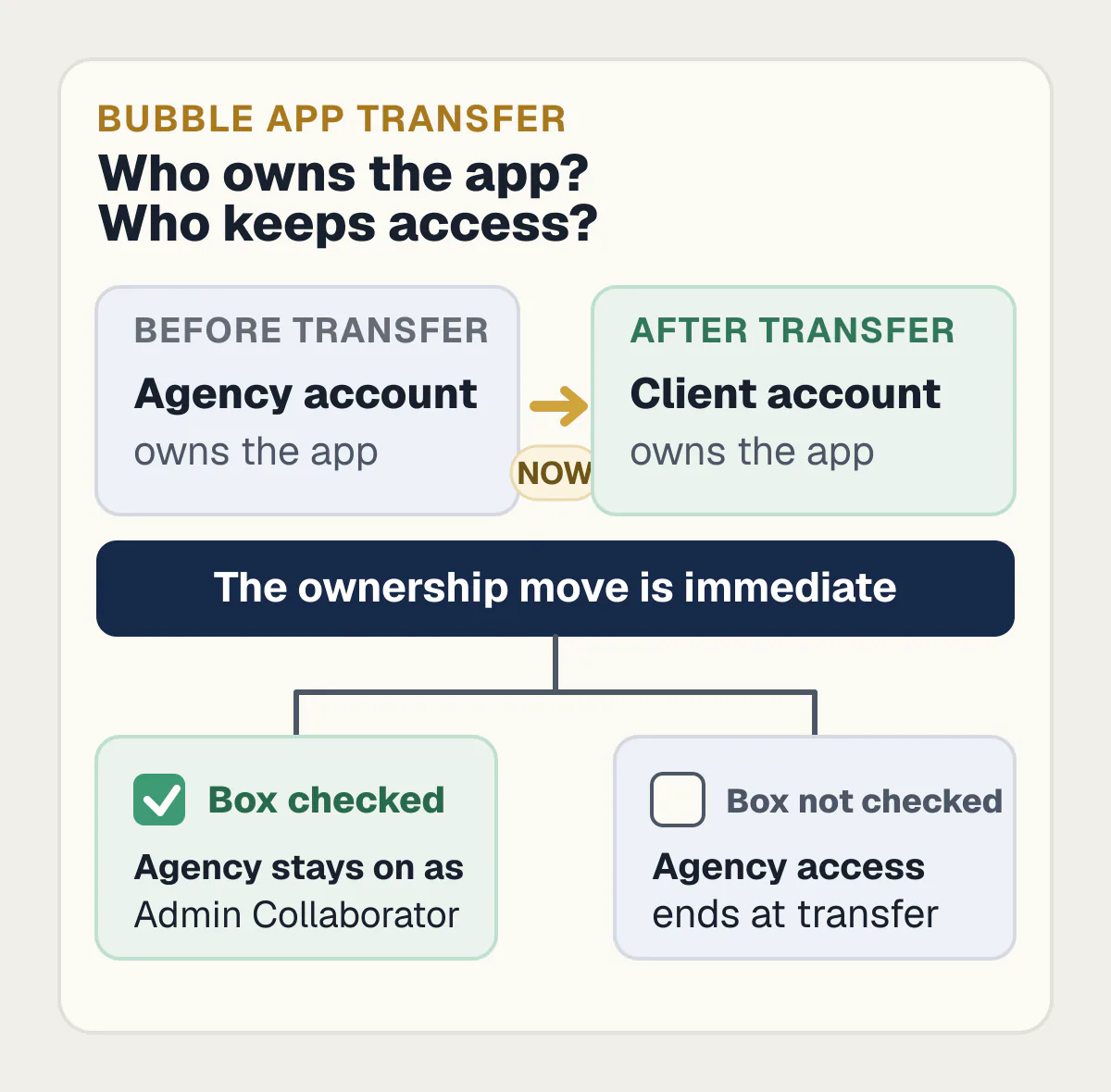
Then the transfer. Bubble’s collaborator documentation is blunt about it, and this is the single most useful sentence a Bubble buyer can read before a build starts: “This will immediately transfer ownership of the app to another Bubble user.” The page then warns: “Be careful when using - if you are not an admin collaborator on the app, upon transfer, you will not be able to undo the transfer.” And it names the escape hatch, which is a tick box: “If you would like to stay on as an Admin Collaborator, you must check the box on the Transfer modal.”
The transfer of a Bubble app is immediate, and the person losing ownership keeps access only if somebody ticked a box on the way out. It is worth knowing which side of that box you are on before the build starts, not after.
That cuts both ways, which is the part buyers miss. If the company built the app on their account and transfers it to you at the end, they are the ones who need the box ticked to stay involved, and if it was not ticked, their access ends the moment they press it. If the app was built on your account and you ever transfer it to theirs, you are the one who disappears. Neither outcome needs a falling out to happen. It is what the button does on an ordinary Tuesday.
| The question | What Bubble’s documentation says | What to settle before work starts |
|---|---|---|
| Whose account is the app built in | The Agency plan gives full access to web and mobile features during development, and the project is transferred to a client plan when it is ready to go live | Whether the build starts in your account or theirs, and the date it stops being theirs |
| Who is an Admin Collaborator | On transfer, the outgoing owner keeps access only by checking the box on the Transfer modal to stay on as an Admin Collaborator | Who is named as an Admin Collaborator at the moment of transfer, decided in advance |
| How many people can be in the app | Free and Starter support no collaborators; the collaborator FAQ says Growth allows two, the owner plus one editor; collaborators with Agency accounts are exempt on every plan | Which plan the app sits on after transfer, and how many of their people still need to be inside it |
| What transfer does | Transfer immediately moves ownership of the app to another Bubble user, and the documentation warns to be careful using it | Who presses it, on what date, and what has been checked first |
| Who pays the plan afterwards | Plans are chosen at the project level, and a paid client plan is what enables deployment and app store publishing | Whose card the plan is on from the transfer date, and what that costs |
None of that came from the ranked lists, and it could not have. Of the three incumbent pages read in full on 29 August 2026, one, lowcode.agency, tells readers to receive documentation and full access and warns against companies that offer no ownership transfer, without saying what a transfer is or what it does. The other two, goodspeed.studio and nerdheadz.com/blog/when-hire-freelance-bubble-developer-vs-bubble-agencies, do not use the words transfer or ownership anywhere. Not one of the three mentions the Agency plan, the agency account, the collaborator limits or the Transfer modal.
What to settle with a company taking over a Bubble app you already have
A takeover of a Bubble app has one platform question on top of every normal hiring question, and it is the account. Everything else follows from it: who can be in the editor, who can reach the live database, who can deploy, and who is still there when the arrangement ends.
Start with where the app is today. If you built it, it is on your account and on your plan, and the decision is simply which of the company’s people you invite and with what access. If somebody else built it and you have never logged in as the owner, that is the first thing to fix, before any work is quoted, because until the owner account is yours the rest of the conversation is hypothetical.
Then settle these, in writing, before the first invoice:
- Which account the work happens in, and whose card the plan is on for each month of it.
- Whether each of their people is confined to the development environment, and who among them can see the database and the logs.
- If the app moves accounts at any point, who ticks the Admin Collaborator box, and who is named in it.
- What happens to their access on the day the arrangement ends, written as an action somebody performs on a named date.
- Which plan tier the app sits on once the build is signed off, and who chooses it.
Who keeps a Bubble app running month after month, once the build is signed off, is a standing arrangement rather than a build decision.
Not all of that is Bubble-specific. Whether somebody has actually taken an app over, as opposed to agreed to, comes down to four checks that apply whatever the app was built with. Those are set out in the four checks that tell you somebody has actually taken an app over, and this page does not repeat them.
What to send a Bubble company before it starts is its own short list, and it does not change with the builder. It is written out as what to send before the work starts, and the Bubble-specific addition is the account and plan question above.
There is one diagnosis worth running before you hire anyone, because it changes what you are buying. A Bubble app that has become slow may have a build problem, which a good Bubble developer fixes in the editor, or a structural one, which no amount of editing fixes and which shows up in workload and in how the app searches its own data. Whether a slow Bubble app needs a hire at all is a diagnosis you can run before you talk to anyone. Measure one slow interaction first, which is where why a Bubble app gets slow starts, and take the measurement into the conversation instead of the symptom.
The last thing to settle is the smallest first job. Ask for one named result you can check yourself, on the app you already have, before anyone quotes a build. A company that can only price the whole thing has told you something about how it works.
Where a company is more than you need
Plenty of Bubble apps do not need a company. They need one person for a few days, or a plan change, or a measurement. The ranked lists have no reason to tell you that, because a company that takes small jobs is not the customer those pages are written for.
Choosing one Bubble developer, rather than a company, is a different judgement with its own tells.
What a developer costs, across every shape of seller, is priced on its own page. Read what hiring a developer actually costs before you take an entry price off any sales page as a market rate.
AxonBuild sits outside all three readings at the top of this page. It works on apps that AI tools built, with code you can read, and most Bubble work is not that: the honest route for a Bubble build or a Bubble repair is one of the Bubble companies or a single Bubble developer. The overlap is narrower: an owner who has a Bubble app and, sitting next to it, something an AI tool built that has stopped behaving. For that one, the first conversation is a free 20-minute video call with Bilal. If you want him to make a change, he checks the code and gives you a fixed quote, and you pay after you see it working.
Common questions about Bubble agencies
Is Bubble Agency the same company as Bubble?
No. Bubble Agency is a public relations, marketing and events company whose own homepage, read on 29 August 2026, describes public relations, social media, marketing, media buying, branding, messaging and event management. Bubble is a software platform for building web and mobile applications. The two are unconnected businesses that share a word, and the software company’s site is at bubble.io.
What is a Bubble agency account?
It is a subscription a company buys in order to build apps for clients. Bubble’s documentation on building apps for others calls it the Agency Subscription and says it exists so a company can build apps and transfer ownership to clients. Bubble’s plans documentation adds that the Agency plan covers web and mobile features during development, and that the project is transferred to a client plan when it is ready to go live. It is a plan sold to the company doing the building, and it carries no assessment of that company.
How do I transfer a Bubble app to another account?
Bubble’s collaborator documentation describes a Transfer modal that immediately moves ownership of the app to another Bubble user, and says that if you are not an admin collaborator on the app you will not be able to undo it. To keep access after the transfer, the outgoing owner has to check the box on that modal to stay on as an Admin Collaborator. Decide who ticks that box before anybody presses transfer, because the change takes effect straight away.
Who pays for the Bubble plan after the company finishes?
You do, in almost every case, because deployment and app store publishing happen on a client plan rather than on the agency plan the app was built under. Agree the plan tier and the billing date before the transfer, not after it. On Bubble’s plans documentation on 29 August 2026, the entry paid tier for a browser app was Starter Web only at $29 in the paid annually table, where prices are listed per month.
What does it mean when a company is listed in Bubble’s experts directory?
It means the company submitted a profile and a member of the Bubble team reached out to verify certain details before the listing appeared. Bubble’s documentation states that this is not an official endorsement or a partnership, and that the check is there to verify the company exists and to filter out abuse of agency status. That check sets a floor and stops there. It says nothing about who inside the company would work on your app.
Can a company keep my Bubble app if we fall out?
If the app is on their account and has never been transferred, then yes, in the practical sense: the account that pays for the app is the owner, and transfer is a deliberate act somebody has to perform. That is the whole argument for settling the account question at the start rather than at the end. If the app is already on your account, their access is a collaborator invitation you can remove.
Should I hire a Bubble company or one Bubble developer?
One developer is often the cheaper shape when the work is a defined change to an app that already runs, and a company earns its price when the work is a full build with several people on it at once. The comparison turns on how much of the work needs several people in the editor at the same time, which is something you can answer by looking at your own app.
Are the “top Bubble agencies” lists ranked by anything?
Read the byline before the ranking. Of the two such lists read on 29 August 2026, both were published by Bubble companies that ranked themselves first: lowcode.agency at the head of its eleven, goodspeed.studio at the head of its seven. Both publish criteria, and the criteria are reasonable. The order is still a sales page. Use those lists as a source of names to research elsewhere.
What should I settle before a Bubble company starts building?
Four things: which account the app is built in, whose card pays the plan each month, who is an Admin Collaborator at the moment the app transfers, and what happens to everybody’s access on the day the arrangement ends. All four are decided by Bubble’s account and collaborator mechanics rather than by anybody’s goodwill, and all four are cheap to agree in advance and expensive to argue about later.
Built it with AI. Can’t get the last part right?
That’s the normal state of an AI-built app, and it’s fixable. I trace what the app actually does, explain what needs changing, and build it if you want me to.
Talk about your app →  Free 20-minute video call with Bilal.