This page is about a chief technology officer brought into a company that already has a working software product, and about the five different names the market sells that one person under. The three letters collide with a lot. CTO is a lighting filter to a camera crew, a treatment order in mental health law, compensatory time off on a leave form, and a community takeover in crypto. None of those is the subject here, and neither are the salary and org-chart searches that surround the acronym.
Go looking for the person and you will meet outsourced CTO, part-time CTO, interim CTO, temporary CTO and half CTO within a few searches, almost always on a page written by somebody selling one of them. The names read like sizes of the same thing, and they measure at least two different things. Two of the pages below contradict each other in print about what one of the names means, and a third uses four different names for a single service on a single page.
The five names on this page were read on 2 September 2026 from the pages that rank for them: four sellers’ own published definitions, opened in raw form and dated, plus what Google’s own suggestions return for each name on the same day. Nobody was hired, placed or interviewed for it, no arrangement was bought, and no provider on any of these searches is recommended here. Where a name has money attached to it, the figure stays on the page that collects prices.
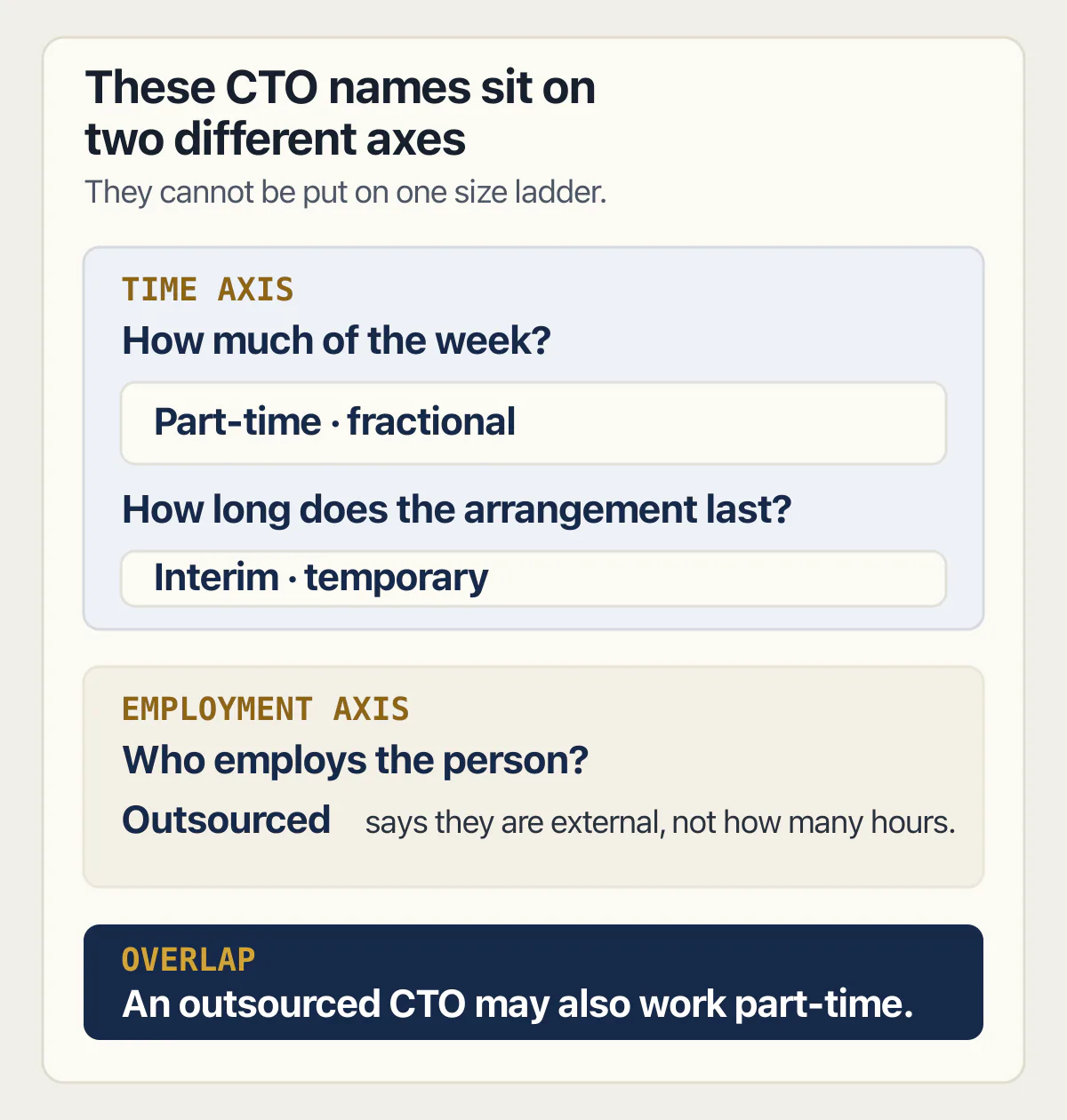
The five names sit on two different axes. Interim and temporary say how long. Part-time says how much of the week. Outsourced says who employs the person, and one of these pages states in print that it says nothing about time at all. Half CTO is not a role name.
The five names, and what the pages selling them say each one is
Four pages carry most of the definitional traffic for these names, and all four are published by somebody who sells the service. Stephan Schmidt’s comparison of interim, fractional, outsourced and coaching sits at www.amazingcto.com/interim-fractional-cto/, bylined, with 13 December 2025 in its page data for both publication and last change; the author sells CTO coaching, so everything on it is one practitioner’s position with a business behind it. CTO Fraction’s three-way comparison at ctofraction.com/blog/fractional-cto-vs-interim-cto-vs-part-time-cto/ shows a reader no date at all, and its page data gives 1 March 2024 for publication and 15 June 2025 for the last change. Evrone, a development agency, published its comparison at evrone.com/blog/fractional-cto-vs-outsourcing-vs-technical-advisor in August 2026, bylined Alexander Kirillov, with 18 August 2026 in the page data. PSP sells an outsourced CTO service at psp-it.com/services/outsourced/cto/ on a page carrying no date a reader can use, no usable date in its page data, and a footer copyright reading 2025. All four were read raw on 2 September 2026. None of them is linked here. Every one of these four companies sells senior technical people to the readers of this page, so the name goes in the sentence and the address goes in plain text beside it.
| Name | What a page selling it publishes | What it says about time | Who employs the person |
|---|---|---|---|
| Outsourced CTO | Evrone: an external technology executive who takes responsibility for the CTO function | Nothing, in print, on that page | Somebody else, usually a firm |
| Part-time CTO | CTO Fraction: the full spectrum of CTO duties, for limited hours or days each week | Limited hours, no figure given | You, on a contract |
| Interim CTO | Amazing CTO: a full-time, temporary technology executive | Full time, for a limited stretch | You, or a placement firm |
| Temporary CTO | PSP, for the same service it also calls outsourced and fractional | Nothing consistent | Not stated |
| Half CTO | Nothing. The phrase appears zero times across all four pages | Nothing | Nobody. Google’s suggestions on 2 September 2026 return lighting gel, colour temperature and filter foil |
The table has no cost column, and that is deliberate. One of these four pages prints money against these names, and it prints a great deal of it, and none of those figures belongs on a page about vocabulary. What any of these arrangements costs is collected in one place from the sellers’ own published pages, and no number appears here.
Two neighbouring questions are also not this page’s. What the job consists of when a company is three people and the code is already written is described where the role itself is the subject, without any of these part-time framings. The parallel set of words sellers use for developers rather than for a technology lead, on demand and dedicated and part time, is sorted out where those purchases are compared.
None of the confusion is invented for the article. One founder who says plainly they are not technical posted a single search using two different names for the role in one breath, which is the whole of this page’s subject stated by a buyer.
Two of these names describe hours. One describes who signs the contract
Evrone’s page is alone among the four in saying out loud what the axes are. On the question of what outsourced means, it prints this:
Unlike the term “fractional,” outsourced does not necessarily describe the amount of time the CTO spends with the company.
That sentence is why a straight comparison of the five names keeps falling apart. Three of them answer a question about time. One answers a question about employment. Lining them up from smallest to largest produces nonsense, because two of the rungs belong to a different ladder.
One set of these names tells you how many hours you get. The other set tells you who the person works for.
Evrone’s own FAQ block puts the same split in the plainest words on any of the four pages: “A Fractional CTO is defined primarily by their part-time involvement. An Outsourced CTO is defined by being external to the company and can work either fractionally or with much deeper involvement.” Read that as a buyer and the practical consequence is immediate. Two people can both call themselves an outsourced CTO accurately while one of them is around for a fraction of a week and the other is around most of it, and the word settles nothing about which of them you are talking to.
Amazing CTO’s page reads the same word a different way. Its definition is a supply channel: “An Outsourced CTO typically comes from a consulting firm or agency. They provide technology leadership as a service, often bundled with development team oversight.” That describes where the person comes from and what gets sold alongside them, and it says nothing about hours. Evrone says the name is silent on time. Amazing CTO treats the name as a description of an agency arrangement. Both are describing real things that exist in the market, under one word, and a buyer typing that word into a search box gets both.
PSP settles the argument by ignoring it. The page selling one service uses outsourced in its address and heading, temporary in one benefit block, fractional in the next, and third-party in a third. That is four names for one product on one page, and if the names were a taxonomy it could not exist.
Interim CTO and temporary CTO: the names for cover
Interim is the one name the sources agree on, and the agreement is worth having. Amazing CTO defines it as “An Interim CTO is a full-time, temporary technology executive”, and its own comparison table gives the time as full time at 40 or more hours a week. Its surrounding text puts the usual span at three to six months, arriving during a transition, a crisis or a search for a permanent hire. CTO Fraction defines it as “An Interim Chief Technology Officer (CTO) serves as a highly experienced executive who is temporarily engaged in a full-time capacity to fill a critical leadership gap”, which is the same shape in different words: all of somebody, for a while, to cover a hole.
That is a specific and useful meaning, and it is almost never what the owner of one working app is shopping for. The hole interim covers is a departed executive, and the market that fills it is priced and staffed for companies large enough to have had one. The search results say so. Of the nine organic results on interim cto on 2 September 2026, four are executive placement or executive search firms. Google’s suggestions for the same phrase on the same day include a day-rate query alongside interim cto mental health act, which is not this trade at all.
Temporary is the loose one. No page in this set defines it. PSP uses it as a synonym inside a service it markets as outsourced, in the sentence “Hiring a temporary CTO is a cost-effective way to consolidate the full-time CTO role into an agile and on-demand resource.” Temporary works as a mood more than a category: it tells you the arrangement ends, and nothing about how much of the person you get while it runs, or who pays them.
If the situation is that somebody senior has actually left and is not coming back, the interim market is genuinely the right one to search. Bringing somebody in permanently at the end of a time-limited arrangement is a different door, and what published surveys say about that door is gathered on its own page.
Part-time CTO: the name that returns job adverts as well as sellers
CTO Fraction gives the fullest published definition of the part-time version, and it is the odd one out in this set: “a Part-time CTO manages the full spectrum of CTO duties but does so for a limited number of hours or days each week”. Note what that sentence claims. The breadth is the whole job. Only the hours shrink.
The same page then draws the line between part-time and fractional in a place nobody else draws it: “The key difference between a Fractional Chief Technology Officer (CTO) and a Part-time CTO is the breadth of their responsibilities.” It goes on to say that “Fractional CTOs are more strategically oriented” while “Part-Time CTOs tend to have an operational focus”. Amazing CTO’s table puts the difference somewhere else entirely, listing fractional as part-time work at 8 to 16 hours a week and never defining a part-time CTO as a separate thing at all. One page says the two names differ by breadth of responsibility. The other treats them as the same arrangement described twice.
Neither page settles it with a figure, and one of them cannot. As of 2 September 2026, the body of CTO Fraction’s comparison states no hours figure, no number of days, no duration in months and no price for any of the three roles it compares. That was checked against the page’s raw HTML on the same day; the only time word in its body copy is the “week” inside the definition quoted above.
The bigger practical problem with this phrase is who else is using it. On 2 September 2026 a jobs pack sits above the organic results for part time cto, with ZipRecruiter at rank 3 and LinkedIn Jobs at rank 5, and four of the nine organic results are written for people who want to become a part-time CTO rather than buy one. Google’s suggestions for the phrase on the same day return part time cto jobs, part time cto roles and part time cto salary. Typing this phrase puts you in a market of candidates rather than a market of services, which is a poor place to shop from and a very good place to be found if you are the candidate.
Outsourced CTO: the name that describes who employs the person
This is the name with the most search behind it and the least agreement underneath it. Evrone’s definition is the clean one: “An Outsourced CTO is an external technology executive who takes responsibility for the CTO function without becoming a traditional permanent employee.” Everything in that sentence is about employment status. Nothing in it is about time, which is exactly what the same page says a paragraph later, and it admits the overlap directly: “An Outsourced CTO may work part-time, in which case the model overlaps with Fractional CTO services.”
Then there is PSP, the number-one organic result for the phrase, selling something else under the same words. Its own description of the service reads “PSP’s outsourced CTO service gives you flexible access to experienced CTOs who are experts at managing teams, projects and processes”, and its search description, which is not its body copy, reads “PSP’s outsourced CTO service lets you hire a part-time IT professional on a temporary basis”. Its fractional framing is on the same page: “A fractional CTO gives you the top-level skills of an IT Director for a fraction of the cost of hiring one.”
Here is what makes that page worth reading if you own an app. As of 2 September 2026, the whole of it, body copy and site chrome together, contains no occurrence of the words application, product, developer, engineer or startup, and its only occurrences of code sit inside a script library’s hostname. That was verified against the raw HTML. Its named service items are corporate technology management: a technology roadmap, business continuity and disaster recovery, technology budgets and spend, technical oversight, management of technology teams, cyber resilience, cloud adoption, and procurement. It is a real service for a real buyer, and the buyer it is written for runs an IT department full of purchased systems.
Two more names circulate in the same space and appear on these searches without appearing in any of the definitions above. Evrone names both: “In some markets, a similar model may be described as an outstaffed CTO or virtual CTO.” On the difference between one of them and the primary name, the same page prints this:
“Virtual CTO” typically emphasizes remote collaboration, while “Outsourced CTO” emphasizes that the role is provided externally.
CTO as a service is the fourth phrasing, used as a service name by several of the companies ranking on these searches. All four are marketing labels for arrangements that overlap, and none of them is standardised.
Which of these names tells you whether the person will open your code?
No name on this page settles it. Across four published definitions, five names and the one comparison table any of them prints, not one of the five words carries any information about whether the person will read or write the code themselves. Every one of these pages leaves that open.
That gap costs more than any of the others, because it is the difference between somebody who will tell you what is wrong with your app and somebody who will go and change it.
The two sentences that come closest are both instructions about something else. Amazing CTO’s author tells the reader “If you need a coder, hire another coder.”, which is advice about what to buy. It defines nothing about what any of these names covers. Evrone draws its line one role further out: “Unlike a Fractional or Outsourced CTO, an advisor generally does not own the technology function.” That separates an advisor from the other two without saying what the other two actually do with their hands.
So the answer to “which name means the person writes code” is that no name does. You have to ask the person. Whether the person under any of these names will open your code is the one question the names do not answer, and it is argued out where it belongs.
Which name should you search for when the app already runs?
The right name depends on your situation rather than your budget. If somebody senior has left, interim is the market that matches. When the work is regular and small, the part-time and fractional pages are where the sellers are. If nobody has read your code, none of the five names describes the first purchase.
That last case is the common one among people who arrive at this search from a working AI-built app. The app runs, customers are using it, and nobody has opened what is underneath since it was generated. Hiring a senior person on any of these arrangements puts somebody in a chair, and reading the code is a job you would then have to agree with them as part of the role, since none of the labels includes it by default; it is also a job you can buy directly and much sooner.
Whether you need anybody under any of these names yet, and the situations where one piece of work is the better purchase, is decided separately. Choosing between two people who both use the same name for themselves, and running the first conversation with either, is set out where buying one is the whole subject. Buying a single hour of somebody’s judgment, with nobody staying on afterwards, is the smallest purchase in this family and it is written up on its own.
And if what you want is for the whole thing to stop being yours to worry about, that is a different transaction again with its own tests. Handing an app that already exists to one named person for good, and the four checks that decide whether that has actually happened, is worked through from the buyer’s side.
None of the five names above describes that, because every one of them names a person and this names pieces of work.
Common questions about outsourced and part-time CTOs
What is an outsourced CTO?
An outsourced CTO is a senior technology person who runs the technology function for a company without being its employee. Evrone’s definition, read 2 September 2026, is “An Outsourced CTO is an external technology executive who takes responsibility for the CTO function without becoming a traditional permanent employee.” The word describes who employs them. It does not tell you how many hours a week you get.
Is an outsourced CTO the same thing as a fractional CTO?
Not reliably, and the pages selling both say so. Evrone’s own FAQ, read 2 September 2026, states that a fractional CTO is defined primarily by part-time involvement while an outsourced CTO is defined by being external and can work either fractionally or with much deeper involvement. The two overlap constantly in practice, which is why what is agreed matters more than the label.
What is the difference between an interim CTO and a part-time CTO?
Hours and duration. Both Amazing CTO and CTO Fraction define interim as a full-time role held temporarily, typically to cover a departure or a crisis, with Amazing CTO’s table putting it at 40 or more hours a week. Part-time, by CTO Fraction’s definition read on 2 September 2026, is the full spread of CTO duties compressed into a limited number of hours or days each week, running on indefinitely.
How many hours a week does a part-time CTO usually work?
No page in this set publishes a figure for a part-time CTO. Amazing CTO’s comparison table, read 2 September 2026, gives 8 to 16 hours a week for a fractional CTO, and its prose puts the typical pattern at one to two days a week. CTO Fraction’s comparison publishes no hours figure at all. Ask for the number in writing before you agree to anything.
What is a temporary CTO?
Temporary is not a defined category on any of the four pages read for this article. PSP uses it as a synonym for the service it markets as an outsourced CTO, in the sentence “Hiring a temporary CTO is a cost-effective way to consolidate the full-time CTO role into an agile and on-demand resource.” Treat it as a signal that the arrangement has an end date and nothing more.
Is half CTO another name for the same role?
No. Half CTO is a lighting term: CTO there stands for colour temperature orange, a gel used to warm a light source. Google’s suggestions for the phrase on 2 September 2026 return results about gel, colour temperature, filters and foil, and the phrase appears zero times across all four seller pages read for this article. Nobody in this market sells a half CTO.
What is a virtual CTO, and what is CTO as a service?
Both are marketing labels for the same territory as outsourced. Evrone, read 2 September 2026, draws the only published distinction in this set: virtual CTO emphasises remote collaboration, while outsourced CTO emphasises that the role is provided externally. CTO as a service is a third phrasing used as a product name by several companies ranking on these searches. None of the three is a standard with an agreed definition behind it.
Does an outsourced CTO write code?
The name does not say, and neither do any of the four published definitions read for this article. Every one of these names is silent on it, and the table above carries no column for it because none of the four pages supplies one. It is the first thing to establish in a first conversation, and the only reliable way to establish it is to ask directly whether they will be opening the repository themselves or reading other people’s work over their shoulder.
Which of these names should I search for if my app already works?
If somebody senior has left, search interim. For regular small amounts of senior attention, search fractional or part-time and expect job adverts mixed into the results. If the honest problem is that nobody has read the code your app is built on, none of these names describes what you need first, because all five describe hiring a person rather than getting a specific piece of work done.
Owning an app means being able to run it, change it and recover it without guessing. The sprint below leaves you with the runbooks and documentation to do that.
Built it with AI. Now it has to hold up for real customers.
The Production Hardening Sprint takes the app you already have and builds the production foundation underneath it. Authentication and access rules, payments that stay consistent, error handling, monitoring, backups, automated tests and a documented handover. Our engineers work inside your existing codebase for ten working days. All 123 deliverables are included, and you get the evidence for each one.
See the Production Hardening Sprint →  $2,500 fixed price · 10 working days · One codebase