A fractional chief technology officer, in the sense this page uses, means a senior technology leader a company buys part of, usually for a fixed number of hours each week, and this page is about buying one when there is already an application running and already people using it. Not fractional ownership of anything. Not the finance officer the search box keeps offering instead of the technology one. Not the crypto sense of those three letters.
Buying one is a sequence: pick a channel, read what that channel publishes about its screening, take the first call, and put the terms in writing. Four channels supply this market, and on the five buying pages opened for this page, every published screen checks the person and none checks your application.
Everything below was read rather than lived. The organic results on this search, on the finding phrasing and on the advisory phrasing were pulled on 2 September 2026; five provider, platform and firm pages were opened in full and read from their raw source on the same day, one refused every automated request and is described only as a refusal, and the one founder voice here comes from a public post, unnamed and paraphrased. No account was opened anywhere, nobody was shortlisted, interviewed, matched or paid, and no arrangement of any kind was entered into for this page.
No number appears on this page. Every published one belongs to the page that reads them for a living. This page is the sequence the call sits inside; the call’s own questions are somebody else’s list.
Three purchases arrive under one search
Type the phrase and three different things come back wearing the same words. The first is a person supplied by the month through a platform. The second is an advisory arrangement sold by a firm, where the firm supplies whoever it has. The third, and the rarest on this search, is somebody who will actually open the code that is already there.
The three are easy to tell apart once you know the tell. A platform supplying a person publishes counts, screening steps and matching times, because supply is the product. A firm supplying an arrangement publishes evaluation advice and a contact form, because the firm is the supply. Somebody who will open the code publishes nothing, because they are usually one person and are usually already busy.
Those three cost different amounts of your attention and produce different results, so the first useful move is deciding which one you are shopping for. If the app was built by an assistant, or by an agency, or by a contractor who has moved on, and you are the person answering for it now, you are usually shopping for the third and being sold the first. That gap is where most of the wasted calls in this market happen.
Whether the person you are buying will open the code or only advise on it decides most of this, and the answer is worked out where that split is the subject. What the role covers, and where its edges are, belongs to the definition page. Neither question is re-answered here, because a buying page that stops to define the role stops being a buying page.
One qualifier worth holding on to before any of that: if you did not write the software, an application somebody else built for you behaves differently in a first conversation than one you built yourself. You cannot check a claim you have no way of checking, which changes what you should be asking a candidate to demonstrate rather than describe.
Putting somebody in the seat full time is a different purchase with different numbers behind it, and it is a purchase almost nobody with one working application should be making yet. The same arrangement is sold under several other names, and what each name signals about hours is written out separately.
Where do you find a fractional CTO, and who is each channel written for?
Fractional CTO candidates reach a buyer through four channels: dedicated fractional marketplaces, general freelance marketplaces, consulting and development firms that sell the role as a service, and the buyer’s own network. Each publishes something about its supply. On this search, one of the four publishes nothing at all, because it is not a business.
Start with the marketplaces, because they are the only channel that publishes counts. Arc’s fractional CTO page, read from its raw source on 2 September 2026, carries the listing heading “1,878 Remote fractional CTOs and experts available to hire:” and describes its supply as “pre-screened, interview-ready top 2% of talent”. That count is rendered from live listing data and held steady across two reads on the same day, so treat it as a reading on one date rather than a stable figure. Its own answers state that for freelance work “Arc matches you with the right senior developer in roughly 72 hours”. MentorCruise’s fractional CTO page, read the same day, says it connects buyers with “over 104 vetted professionals” and that the platform accepts “less than 5% of applicants”. Both addresses are arc.dev/hire-developers/fractional-ctos and mentorcruise.com/fractional-cto/, named here and not linked, because both sell access to the people this page is about.
General marketplaces are the second channel, and the sharpest published description of them comes from a competitor. Arc’s own answer splits the market into general and niche platforms, states that “General platforms like Upwork, Fiverr, and Gigster offer a variety of non-vetted talents unlimited to developers”, and argues that top candidates avoid general marketplaces to escape bidding wars. That is a niche platform describing the alternative it competes with, so read it as a sales argument. It is still the only published account on this search of why the same phrase returns two very different kinds of supply, and the mechanism it names, bidding pressure driving experienced people elsewhere, is checkable against any general marketplace’s own listings.
One page on this search would not open at all. upwork.com/hire/fractional-cto/ returned HTTP 403 to an automated read on 2 September 2026 and was retried the same day with the same result. That is two refused requests on one date and nothing more: it is not a fact about that company, and nothing it publishes is described here. gofractional.com/hire/fractional-cto refused the same way twice and then answered a later request on the same date, so it is read below rather than recorded as a refusal.
That fifth page is a fractional marketplace, and it publishes supply claims in the same shape as the other two. It puts its network at more than fifteen thousand operators, its average time to match at about three days, and its match success rate at 98 percent, and it describes candidates as pre-screened by executive recruiters on track record, technical depth, references and the leadership work they have already done. Its own three-step route is a free discovery call with a recruiter, a short list of pre-screened candidates within days, and contract terms settled with the platform. The address is gofractional.com/hire/fractional-cto, named without a link like every other seller on this page.
Firms are the third channel, and they answer the finding question differently. Ten Mile Square, a technology consulting firm, runs an article with the heading “How Can I Find a Fractional CTO?” on tenmilesquare.com/resources/technology-leadership/looking-for-a-fractional-cto/. Under that heading, in the body copy read raw on 2 September 2026, the answer is two short paragraphs whose substance is that companies in this position look to technology consulting firms, its own named among them, closing with a prompt to get in touch. The page that ranks with your question as its heading answers it with itself. Modern, a development firm on the same results page, publishes the other kind of firm page: an explainer about why to hire the role at all, with the firm’s own services sitting in the navigation beside it.
| Channel | Named on this search | What its page publishes about supply |
|---|---|---|
| Fractional marketplace | Arc | 1,878 listed, top 2% claim, freelance match in roughly 72 hours |
| Fractional marketplace | Go Fractional | more than 15,000 operators, about 3 days to match, 98% match success rate |
| Mentoring platform | MentorCruise | over 104 vetted professionals, fewer than 5% of applicants accepted |
| General marketplace | Upwork | refused an automated read on 2 September 2026 |
| Firm selling the role | Ten Mile Square, Modern | five evaluation factors, what the first weeks contain |
| Your own network | nobody | nothing published, and the screening is yours |
One more feature of this search changes how you read everything on it. A third of the results for the finding phrasing are written for the supply side rather than for you. On 2 September 2026 the education seller ranking third carried a title asking what a fractional CTO is and how you become one; the essay at position nine was a working operator teaching other operators how to find clients; the page at position ten was a job board. The buyer typing this phrase is reading advice written for the person they want to hire, which is worth knowing before you take any of it as buying advice.
The network channel is the one nobody writes a page about, and it is where a lot of these arrangements actually start. Professional networks and founder communities are full of people announcing availability, which is why searches pairing this role with a network name or a discussion site are common. Those searches are navigation rather than research: they take you to a place where candidates are, not to an answer about how to pick one. What they do give you is language. One founder wrote an open search for an outside development company with a record of running this kind of system in production, which is a shopping brief rather than a job advertisement.
That distinction is the useful one. A job advertisement describes a person. A shopping brief describes the thing that has to keep working, and it lets a candidate self-select out. The order in which you find, write to and shortlist somebody to work on an application that already exists is set out step by step elsewhere.
What do the platforms check before they match somebody?
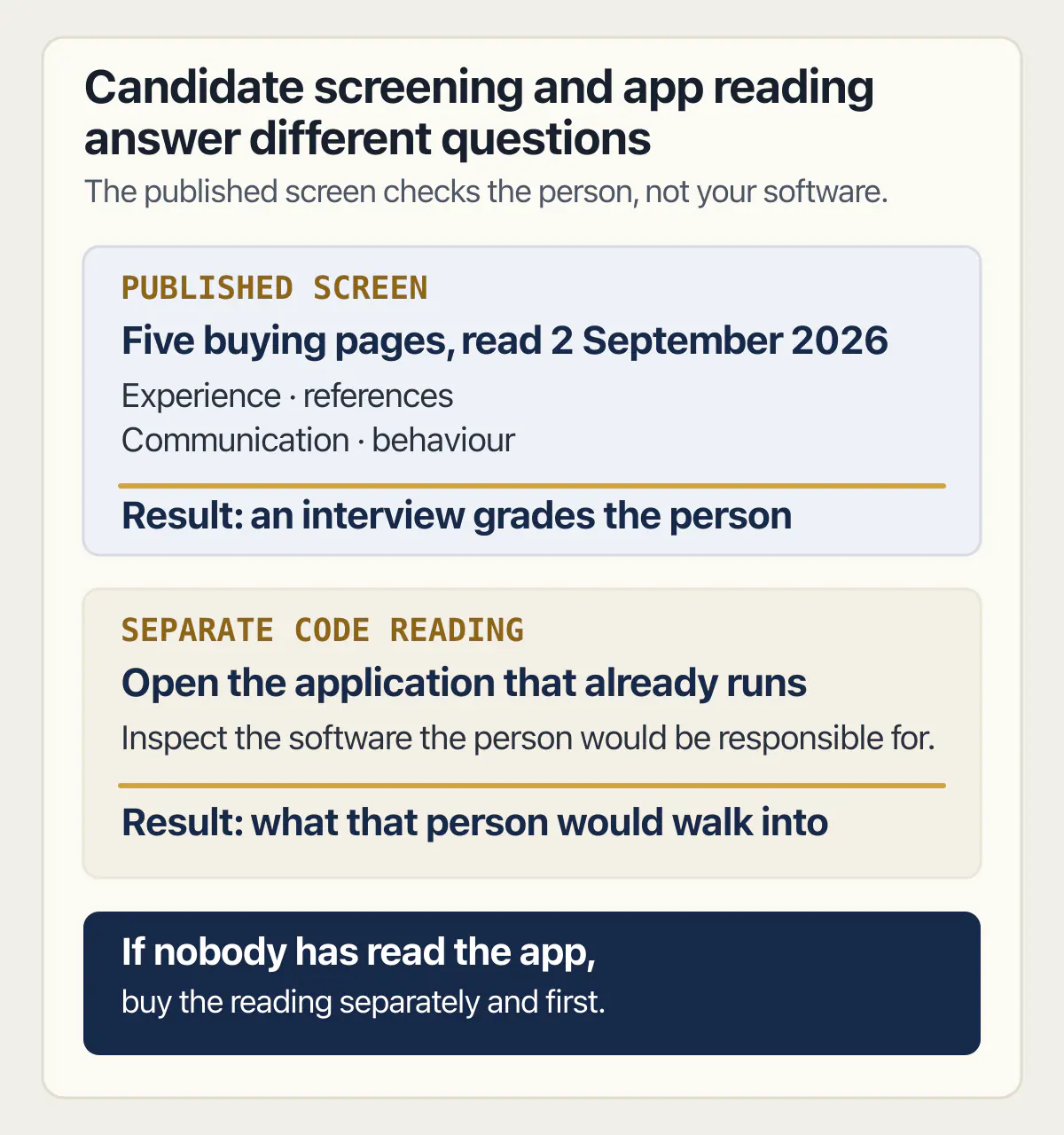
Every published screen on this search is run on the person. Arc, Go Fractional, MentorCruise and the firms describe checking experience, references, communication and behaviour, and one of them puts screened supply behind its paid plans. None of the five buying pages opened for this page describes reading the software the person will be responsible for.
Arc’s own answer states that to become a vetted fractional CTO for hire there, “developers must pass a profile screening, complete a behavioral interview, and pass a technical interview or pair programming”. The same answer draws the line that matters commercially: “if you’re using Arc’s free job posting plan, you will only have access to non-vetted developers”. Screening is the product, and the free door bypasses it. MentorCruise states that every fractional CTO on its platform “passes background checks, reference verification, and skill assessments”, and that “Every engagement starts with a 7-day free trial”. Ten Mile Square publishes five factors it uses when evaluating a candidate: operational and technical experience, cultural fit, leadership perspective, network and contacts, and putting the duties, responsibilities, terms and exit clauses in writing before anybody starts.
The same pattern holds where the platforms give buyers advice rather than describe their own process. Asked in its own page how to choose, MentorCruise answers: “Look for a track record with companies at your stage and in your industry. Check references and ask about specific outcomes they delivered. Start with a trial period before full engagement.” Track record, references, outcomes and a trial: four good things to check, and four things you can check without ever looking at your own software.
Read that list again as the owner of a live application. Every item is a property of the person. Not one is a property of the thing they are about to take responsibility for. That is a coherent way to buy leadership for a company that has an engineering team, because the team already knows what the software is. It stops working the moment the buyer is the only person in the room and the software is the thing nobody has read.
Here is the observation, with its scope stated so you can check it yourself. In the body copy of those five pages, read raw on 2 September 2026, the phrase code review does not appear at all, and the words codebase and existing code appear once each, in the same place: inside a candidate’s own self-written profile in Arc’s listing data, where an individual describes improving and stabilising existing codebases. It is not in any of the five platforms’ or firms’ own copy about how they screen. On Modern’s page the word audit occurs twelve times, and every one of those occurrences is the same navigation menu item naming one of the firm’s own services, not a line in the article.
So the screen is real, and it is a screen of the candidate. Whether the specific application you own can be understood at all, and how long that takes, is not part of anybody’s published process. None of the five pages hides that; each describes exactly what it checks. What they are selling is leadership, priced and screened as leadership, to buyers who mostly already have an engineering department to explain the software to whoever arrives.
If your situation is the other one, the check has to be bought separately and done first. A paid reading of the code, bought on its own answers a different question from any interview. An interview grades the person. A reading of the code tells you what that person would be walking into. Checking a person’s claims when you cannot read code yourself is answered on another page. What changes when an assistant wrote most of the application and nobody has read it yet has its own page.
CTO consulting, CTO services, and what those searches return
The advisory-shaped phrasings are a different door into the same market, and on today’s evidence they are a worse one for a buyer. A pull for the advisory phrase on 2 September 2026 returned nine organic results in which three of the top four were two Australian firms’ own estates: two companies whose names contain the phrase, plus one of those companies’ profile pages on a professional network. Further down sat two development firms’ explainers, a peer-community answer dated 10 June 2022, a jobs board whose ranking title advertises pay for the role rather than a way to buy one, an advisory seller’s page, and a firm’s article comparing the service phrasing against the consulting phrasing, dated 28 November 2025.
A phrase whose first page is mostly two companies’ brand estates is a phrase people are searching by name, not by need. Searching it will show you firms. It will not show you a comparison, because there is nobody neutral publishing one.
The distinction underneath the words is real, though, and one platform states it plainly. MentorCruise’s own line is that fractional CTOs “embed in your team and own outcomes; consultants recommend and leave; interim CTOs work full-time temporarily as a bridge hire”. Take that as the seller’s framing rather than a law of the market, but the axis it names is the right one: who carries the result after the advice is given.
For one working application, that axis decides the purchase. Advice that ends in a recommendation leaves you holding a decision you were not equipped to make in the first place, which is the situation you were trying to leave. Paying once for somebody’s opinion, rather than for their time by the month, is a separate purchase with a page of its own, and it is often the right one when the question is narrow. Paying somebody by the month for hands rather than for advice is a different purchase again, and it has its own page.
What the arrangement looks like on paper
A fractional arrangement is a published shape rather than a negotiation from scratch: a set number of hours each week, a trial before commitment on at least one platform, terms written down before work starts, and a first phase spent understanding what exists. The numbers below are each platform’s own, on one date, not a market standard.
MentorCruise’s definition puts the work at “typically 10-24 hours per week” on a part-time or contract basis. That is one platform’s number for its own supply, and it is the only hours figure any of the five pages publishes. It is still useful as a shape: this is a person present for part of a week, not somebody who will be there when a payment webhook fails on a Sunday.
The trial is the second published feature, and it is the one worth asking for by name whoever you buy from. MentorCruise states that “Every engagement starts with a 7-day free trial”, with no card required and a one-click cancellation. Nothing obliges a firm or a marketplace to offer the same thing, but one of the five pages read here publishes it as standard, which makes it a reasonable thing to ask for.
The exit route is the third published feature and the one nobody asks about at the start. Arc’s answer states that its buyers can hire “on a freelance, full-time, part-time, or contract-to-hire basis”, that it expects a full-time hire there to take 14 days against roughly 72 hours for a freelance match, and that “To extend a freelance engagement to a full-time hire, a contract-to-hire fee will apply”. No figure is published for that fee on the page, and the amount matters less than the fact of it: turning a part-time arrangement into a permanent one is a priced event on at least one platform, and the moment to find out what it costs on yours is before the part-time work starts, rather than later, once the arrangement has gone well and you want to keep the person.
The fourth feature is written terms, and it is the one buyers skip. Ten Mile Square puts it in its five factors: duties, responsibilities, terms and exit clauses, all defined before the work starts, along with a check that the candidate is not working with a direct competitor. The exit clause is the part people leave out, and it is the part that matters most when you cannot yet judge whether the work is good.
What the first weeks contain is published too. Modern states on modern.tech/insights/why-hire-a-fractional-cto/, read raw on 2 September 2026, that the early phase “is rarely about sweeping changes” and “mainly focuses on creating clarity”, beginning with understanding the current state of systems, teams and processes and identifying where risks and bottlenecks sit. The same page states that fractional CTOs are often brought in to support technical due diligence, to identify risks before deals close, and to guide stabilisation afterwards.
Two things follow from that for an owner with one live application. The first weeks buy you orientation, not repairs, and you should budget attention accordingly. And the person will need what any newcomer needs to start: what the person needs on day one is the same list whether they are part-time or full-time, and having it ready is what stops the first phase being spent on questions you could have answered in advance.
The questions worth putting to somebody on that first call, in the order they are worth asking, are listed separately. What published pages actually put inside an agreement billed by the month, and what they charge for one, is a separate page. What the arrangement costs, and where each published number comes from, is worked out separately with every figure named and dated.
When this is the wrong purchase for one working app
Start with the other side of the argument, in the sellers’ own words, because they are not wrong about it. Modern’s page names the moments it says the role fits: scaling beyond product-market fit, onboarding enterprise customers, preparing for regulatory or compliance requirements, planning major system changes, and fundraising, acquisitions or technical due diligence. Every one of those is a situation with recurring technical decisions attached, which is what a standing seat is for. None of them is one app with one broken thing in it.
Three situations make something else the better buy, and all three are common among people who own one application and no engineers.
The first is a single named failure with an end. Sign-ups stopped arriving, the export button returns an error, payments succeed but the confirmation email never sends. That is a repair with a finish line, and buying a recurring arrangement to get it is buying a subscription to solve a problem that ends.
Second comes one piece of work you can describe in a sentence. Move the file storage, add the second user role, get the app off a platform you have outgrown. Work that can be described can be quoted, and quoted work does not need somebody in a standing seat.
The third is the awkward one: nobody has read the code yet. Committing to a recurring arrangement before anybody has looked means agreeing a price for an unknown quantity, and both sides are guessing. The published screens on this search all check the person, so the unknown quantity stays unknown until somebody opens the software. Doing that first turns a vague standing arrangement into either a short list of specific jobs or a well-founded decision that you do need a technology leader after all.
It does not sell the arrangement this page describes: there is no part-time officer to hire here, no standing seat and nobody placed with you.
Common questions about hiring a fractional CTO
How do you hire a fractional CTO?
Decide which of the three purchases you actually want, pick a channel, read what that channel publishes about how it screens, run a first call, and put duties, terms and exit conditions in writing before work starts. On the five buying pages opened for this page on 2 September 2026, the published screens all check the person rather than the software, so if your application has never been read by anybody, get that done separately and first.
Where do people find fractional CTOs?
Four channels: dedicated fractional marketplaces such as Arc, mentoring and matching platforms such as MentorCruise, consulting and development firms selling the role as a service, and the buyer’s own professional network. The marketplaces publish supply counts and screening steps. The firms answer the finding question by naming themselves. The network publishes nothing, which means the screening is entirely yours.
Is CTO consulting the same as hiring a fractional CTO?
Not quite, and the sellers themselves draw the line. MentorCruise’s page states that fractional CTOs “embed in your team and own outcomes; consultants recommend and leave; interim CTOs work full-time temporarily as a bridge hire”. The consulting phrasing also returns a different kind of results page: on 2 September 2026, three of its top four results were two firms whose company names contain the phrase, plus one of their profile pages.
How many hours a week is a fractional arrangement?
MentorCruise’s fractional CTO page, read on 2 September 2026, states the work is “typically 10-24 hours per week” on a part-time or contract basis. That is one platform’s published figure for its own supply and not a market standard: none of the other four buying pages opened for this page publishes an hours figure at all. Treat it as a shape to negotiate against rather than a norm.
Should there be a trial before a longer commitment?
Ask for one. MentorCruise publishes a trial as standard, stating that “Every engagement starts with a 7-day free trial” with no card required and a one-click cancellation. No firm or marketplace is obliged to match that, but the fact that one platform on this search publishes it as its default makes it a reasonable thing to request everywhere else.
Do the platforms check whether somebody can read an existing codebase?
Not on the evidence published. In the body copy of the five provider, platform and firm pages read raw on 2 September 2026, the phrase code review does not occur, and codebase and existing code occur once each in the same string, inside a candidate’s own profile text in Arc’s listing data rather than in any platform’s description of its own screening. The screens describe interviews, references, background checks and behavioural assessments.
What should be written down before the work starts?
Ten Mile Square’s published evaluation factors include getting duties, responsibilities, terms and exit clauses defined in writing before the work begins, plus a check that the candidate is not working with a direct competitor. The exit clause is the one buyers most often skip and the one that matters most, because you are agreeing terms at the moment you are least able to judge the work.
Can one person part-time finish an application that is already half working?
Sometimes, and it depends entirely on whether that person will open the code or only advise on it. A part-time technology leader who works through other people needs those other people to exist. If there is nobody else, an advisory arrangement produces good decisions and no completed work, and the app stays where it is. Ask the question directly on the first call and ask for a specific example, because the published screens on this search will not answer it for you.
Owning an app means being able to run it, change it and recover it without guessing. The sprint below leaves you with the runbooks and documentation to do that.
Built it with AI. Now it has to hold up for real customers.
The Production Hardening Sprint takes the app you already have and builds the production foundation underneath it. Authentication and access rules, payments that stay consistent, error handling, monitoring, backups, automated tests and a documented handover. Our engineers work inside your existing codebase for ten working days. All 123 deliverables are included, and you get the evidence for each one.
See the Production Hardening Sprint →  $2,500 fixed price · 10 working days · One codebase