A fractional CTO here means one thing specifically: a fractional chief technology officer, a senior technical person brought in part-time by a business that already has a working app, for a few days each month rather than a salary. Type fractional cto ai into a search box and you mostly get the other sense, a part-time leader hired to decide what a business should do about AI, which is a different job sold to a different buyer.
The difference an AI-built app makes is that no human has been through the code it runs on, the person who did the prompting included. That puts reading the code first in the order rather than ninth. All nine organic results on that search on 2 September 2026 address a company’s AI plans, and none of them starts there.
Everything below about what the role covers comes from reading the pages that rank for the phrase, in their own published words, fetched in raw form on 2 September 2026. Three of the results on the second of the two searches are community posts that render nothing to an automated read, so they are used only as a description of what the search returns and nothing from them is quoted. The counts about AI-built applications come from AxonBuild’s fixed study of 26 of them audited in June and July 2026, whose own page carries the method and the limits. Nobody was placed, hired, interviewed, tested or run for this page, and no application was examined for it.
What one costs, whether the person writes any code, and when a company needs one at all are separate questions with separate pages, named below wherever they turn up.
What the phrase returns today, and why it is usually not this
Search results for the phrase describe a part-time executive for a company’s AI plans. Of the nine organic results returned on 2 September 2026, six are sellers or marketplaces, one is a directory of people, one is a publisher, and one is a post on a professional network. The company home among them, Fractional AI (www.fractional.ai/), sells AI transformation work to businesses, and the job title does not appear anywhere in that home page’s body copy. All nine treat the AI in the phrase as the thing the business is deciding about, not as the thing that wrote the app.
Read them in their own words and the shape is consistent. Agathon’s role article (agathon.ai/insights/what-does-a-fractional-cto-do), published in November 2024 and marked updated in June 2026, defines the job as senior AI leadership part-time, and puts the decisions it covers as “where AI is worth building, where to buy instead, and how to run it safely once it ships”. The same page is blunt about the market it sits in: “The market is full of people who will build you AI. Far fewer will tell you not to.”
Fractionus, a marketplace for fractional executives, published a piece on 7 May 2026 (fractionus.com/blog/how-ai-is-changing-fractional-cto-role) whose body states that a fractional CTO working in 2026 “is frequently expected to own AI strategy, not just comment on it”. Its section on how the work itself is changing lists technical audits, code quality analysis, security scanning and infrastructure assessment as the tasks AI tooling has shortened. One caution about that page, since it is easy to quote from the wrong part of it: the sentence about advising boards on AI risk that shows up in search results is not from the article, it comes from the question and answer block at the foot of the page, which is also repeated in the page’s structured data.
AmazingCTO’s definition article (www.amazingcto.com/what-is-fractional-cto/), dated 12 January 2026, is the one that puts a number on the time: it describes the arrangement as usually one or two days a week. That is the shape the market publishes for this, and it is worth holding on to for the rest of this page.
Three things are missing from all of it, and each of these is a dated read of the raw HTML on 2 September 2026 rather than a claim about the whole internet.
The first is vocabulary. Across the body copy of the five pages read for what the role covers (Agathon’s role article, the Fractionus piece, the AmazingCTO definition, Vadim Kravcenko’s service page and CTO Academy’s explainer, the last of which opened only to the second request described below), the word vibe does not appear once, and none of the five uses no-code as a term. The buyer this page is written for uses both words constantly.
The second is the application itself. Agathon’s role article never mentions the code a company already has: the single occurrence of the word code in its copy sits inside a case study about a business that had none. Fractionus names code quality analysis only as work that AI tooling has made faster, not as the first job on an application somebody already runs. Kravcenko’s page is the exception, and it gets its own paragraph further down.
The third is the reader. Widen the query to the longer phrasing people actually type, fractional cto for ai built app, and the composition flips: three of the top five results are user-generated posts, a community thread, a post on a professional network and a group post, all of which return nothing readable to an automated fetch. That is what a search looks like when the demand is real and no publisher has served it. What fills the rest of that page is a talent marketplace listing fractional CTOs as a hire-able category (arc.dev/hire-developers/fractional-ctos), under a page title that on 2 September 2026 offered the best freelance fractional CTOs for hire, and a post on Garrett Vargas’s own blog (blog.garrettvargas.com/how-ai-supercharges-a-fractional-cto-to-deliver-like-a-full-dev-team.html) about how AI tools make him personally more productive as a fractional CTO. Across both searches, on a whole-page read of every result that could be fetched, CTO Academy’s explainer included once it opened, not one is an informational page written for the owner of a working application that a generator produced.
Put the two searches next to each other and they describe one market at two stages. The head phrase is settled: nine results, every one of them written for a company deciding what to do about AI, and seven of the nine published by somebody selling into that reading of the words. Community posts are holding the top of the longer phrase, which is what an unsettled search looks like. The people writing in that second search already have the app. The pages that answer them have not been written yet, and that will change the first time one of those sellers notices.
Three sources across those results gave a plain automated request nothing on the day, and re-asking each one in the shape a browser uses, negotiating HTTP/1.1 and naming a browser as the client, separated them. CTO Academy’s definition article (cto.academy/what-is-a-fractional-cto-and-how-do-you-become-one/) answered an access-denied interstitial to the plain request on 2 September 2026 and served 292,402 bytes to the browser-shaped one the same day, so it is counted above with the pages that were read. Exa’s people directory (exa.ai/websets/directory/fractional-ai-executives) answered 429 to both shapes. Fracton’s service page (www.fracton.ai/fractional-cto) gave the plain request nothing at all and answered the browser-shaped one with a 200 status line that then never finished sending the page, in one minute or in four. Nothing on this page depends on either of the two that stayed shut, and both are named here so the gap is visible rather than papered over.
Owners who paid somebody else to build with AI reach the same question through a different door, and checking an application somebody else built with AI is written for that door specifically.
What changes when a generator wrote the application
Generated code is not automatically worse code, and that is the wrong thing to worry about anyway. What has gone missing is the usual first source of information about an application: the person who wrote it and can tell you why. Somebody prompted it and read the output as it scrolled past. That is a different act from having been through the code, and every plan made about the app inherits the difference.
Owners describe the position plainly when they are talking to each other rather than to a seller. One of them, posting about what they had produced for their own company, put it like this:
“I’m not a developer by trade but have taken on the task of making our company more cutting edge and what I’ve been able to create single handedly is astonishing.”
Both of those things hold together, and neither of them tells you what is inside the repository.
Unread is a specific condition rather than a vague one. There is no note anywhere explaining why the database is shaped the way it is. No second person reviewed the work and pushed back on any of it. Whatever tests sit in the repository came out of the same process as the code they are checking, so they agree with it by construction. And the parts nobody thought to ask for leave no trace at all, because an application says nothing about the checks it does not perform. Somebody has to open it and look. Until they do, everything said about that app is really a statement about apps in general.
Size and shape are the useful things to know about the reading job before buying anything. AxonBuild’s fixed study of 26 AI-built applications audited in June and July 2026 produced a ledger of 958 confirmed findings from its 21 third-party applications, and the way they sort matters more than the total: 135 hygiene items, 403 smells, 362 medium and 58 critical, with nothing counted until its mechanism had been confirmed in the code itself. The study behind that count, its method and its limits is published in full on its own page.
The point of those four numbers here is what they say about the work rather than about risk. A reading of one application produces a list that sorts, and a list that sorts has an end. Somebody goes through the app, writes down what is there, ranks it, and the job is finished, whether the answer turns out to be four items or four hundred. A standing part-time arrangement produces no such list. It produces availability, judgement and a person in your meetings, which are real things to buy, and none of them is the same purchase as finding out what you have.
One person who works with founders in this way said that getting something built with these tools all the way to production standard is a humbling job. That is one person’s phrasing rather than a finding, and it is worth hearing precisely because it comes from somebody who sells the ongoing version.
What a part-time technical lead can settle before anybody reads the code, and what has to wait
Plenty can be settled from a conversation. A senior person who has never opened your repository can still tell you whether a market is worth entering, whether to build or buy a capability, what a second hire should be, whether a vendor’s claim is plausible, and how to talk to a board about any of it. Those decisions run on context and pattern recognition, and neither one lives in your code.
Advice usually arrives long before anybody reads anything. One owner whose first working version had been produced by an app builder asked what came next, said the advice they kept meeting pointed at moving the project somewhere else, and added that they were not technical themselves. Every suggestion in that pile is a decision somebody can make in a conversation. Whether any of them is the right call for that particular application is a different kind of question.
The other half of the list does live in your code, and no amount of seniority substitutes for having read it.
| Settled from a conversation | Needs the application read first |
|---|---|
| Whether to build a feature or buy one | Whether the feature you have can carry the change |
| What the next hire should be able to do | How long any specific change actually takes |
| Whether a vendor’s claim is plausible | Whether your data is separated between accounts |
| How to structure a small team | Whether the tests prove anything runs |
| What to tell a board or an investor | What breaks when the traffic multiplies |
The distinction matters most on the estimates, because that is where a confident answer from the left column gets applied to a question from the right one. Nobody can tell you how long a change takes in an application they have not opened, and one or two days a week of somebody’s time does not become an answer to that question by being senior. It becomes an answer once somebody has read enough of the app to know what the change touches.
Reassurance is the other place the wires cross. Asking a senior person whether the app is fine is a reasonable thing to do, and the answer they can honestly give is about the odds rather than about your code. Odds are worth something when the decision is about a market. They are worth nothing when the question is whether one specific export endpoint hands back other people’s rows, which is a thing somebody either checked or did not.
Some practitioners do read the code, which is the honest counterweight to everything above. Vadim Kravcenko, who sells this service as an individual, publishes a list of what he helps with on his own page (vadimkravcenko.com/fractional-cto/), and reviewing the code you already have, along with the infrastructure and the deployment pipeline, is on it. The reason he gives for starting there is AI-generated code shipping without anybody genuinely understanding it, and things breaking months later with nobody able to explain why. No link goes to that page from here, because it advertises work that overlaps with what I sell, but its existence proves the role can be bought in a form that starts with reading. The word on the tin does not tell you which form you are getting. The questions in the next section do.
One footnote on how people search for this, since it explains a certain kind of enquiry. Owners sometimes type a builder’s product name next to the word team, looking for people who work on apps that builder produced. What comes back is that company’s own hiring pages. The people who read AI-built code for a living do not organise themselves by which generator wrote it.
The questions that tell the two apart
Four questions on a first call separate an arrangement that starts with reading from one that starts with advice. None of them requires you to be able to read code, and all four have concrete answers that somebody can be held to later.
- Who reads the code, and in what week? A date, or a shrug. Both are informative.
- What will exist at the end of the first two weeks that I can read myself? A plain list of what is in the app and what needs attention is a reasonable answer. A general offer of availability is a different purchase.
- When you tell me the app is fine, what will you have looked at to know that? The answer names files, tests, accounts and data, or it names nothing.
- If the reading turns up more than either of us expected, what changes? Ask before it happens, because the honest answer changes the price and the honest time to hear it is now.
If what you are actually shopping for is the reading rather than the role, that is a different market with its own way of being compared, and how to compare what different code reviewers actually check sets out what to ask them and how to judge what comes back. If the reading has already started or is about to, what the first week on an inherited application actually covers walks through the order the days go in.
When the role is the right purchase, and when one reading is
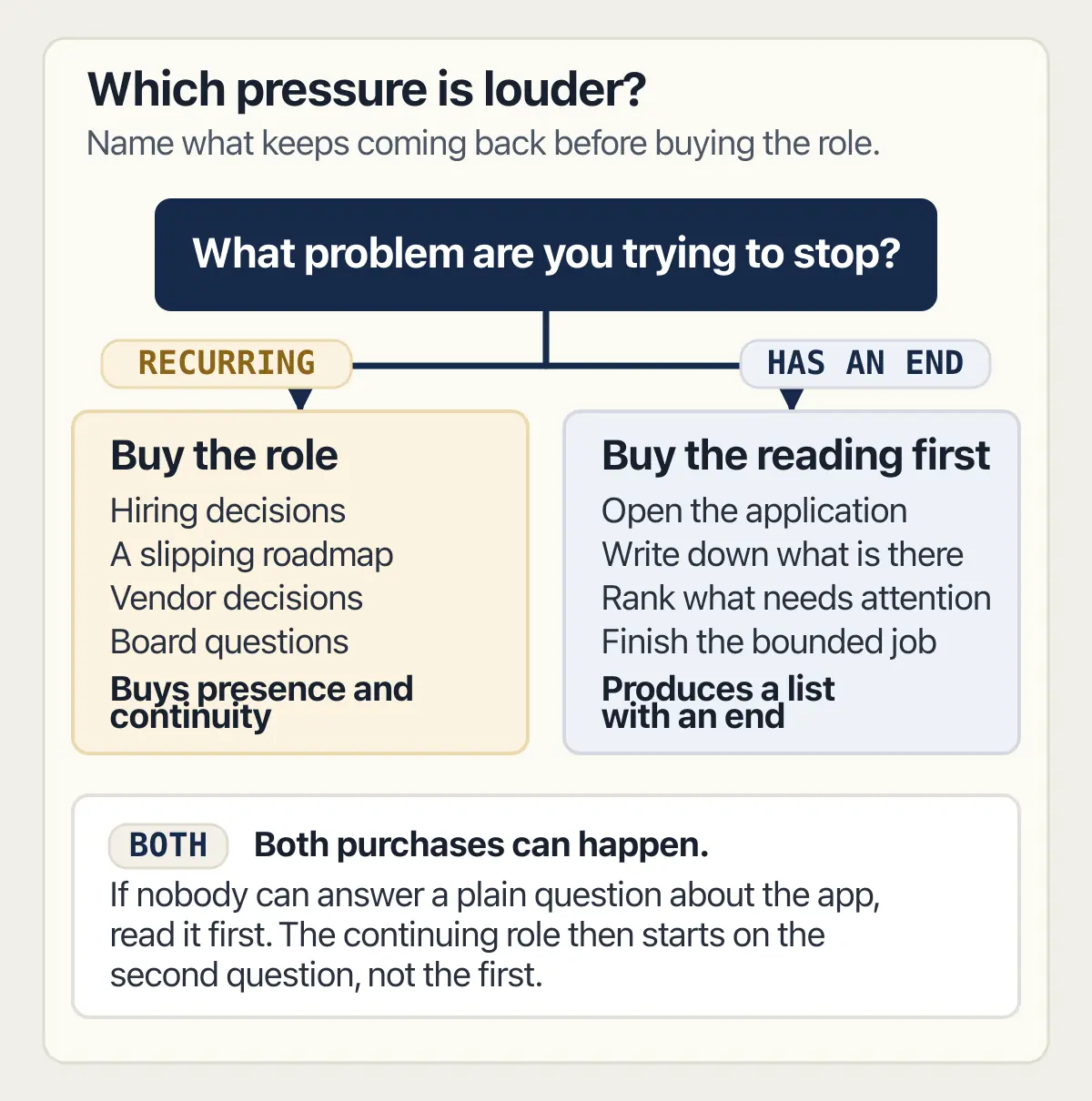
The role is the right purchase when the recurring problem is judgement. Hiring, a roadmap that keeps slipping, a vendor decision every quarter, a board that wants technical answers: those are problems that recur, and a person who shows up regularly is the shape of the answer. One or two days a week buys presence and continuity, which is what a recurring problem needs.
One reading is the right purchase when what looks like a standing condition turns out to have an end. Nobody knowing what is inside the application feels permanent while it is true, and it stops being true the week somebody reads it. Whether paying somebody by the month makes sense once an app is live is worked out where that decision is made, using a test of its own that is not repeated here. The shapes a written monthly arrangement takes, and what becomes of the hours nobody spends, are set out on another.
Two more decisions sit either side of this one. The general question of when a company needs a part-time technical lead at all, with the situations that call for one and the situations that call for a single piece of work instead, is its own page. So is the money: what these arrangements cost, in the published figures of the people selling them, is not stated anywhere on this page on purpose, because a number in the middle of this decision reads like an answer to it.
Before either purchase there is a plainer question about whether the app should be taking real customers at all yet, and whether the application is ready to carry real customers is where that one gets decided.
Nothing stops both purchases from happening, and the order usually gets decided by whichever pain is louder. If the pressure is a decision that keeps coming back, buy the decision. If the pressure is that nobody can answer a plain question about the app, the reading goes first, and it makes the part-time arrangement worth more afterwards: somebody joining an application that has already been read starts on the second question rather than the first.
That is not a fractional CTO, in either sense of the phrase: there is no part-time executive here, nobody to place in your meetings, and no team to hire by the week. The two purchases described above are both bought from other people, and this page exists to tell them apart rather than to add a third option to the list.
Common questions about a fractional CTO for an AI-built app
What does a fractional CTO do for an app that was built with AI?
Across the ranking pages read for this article, the job is senior technical judgement bought part-time: build or buy decisions, hiring, architecture direction, and how to run AI features safely once they ship. None of those descriptions includes reading the application you already have, with one practitioner page as the exception. If the app was generated and nobody has been through it, that reading is a separate job and worth naming separately when you are buying.
Does a fractional CTO read the existing code?
Some do and most do not advertise it. Of the pages read on 2 September 2026, one individual practitioner’s own service page lists reviewing your codebase, infrastructure and deployment pipeline among the things he helps with; the seller and marketplace pages describe judgement, strategy and team decisions instead. Put it plainly at the first meeting, and ask which week the reading happens in.
How much does a fractional CTO cost for an AI-built app?
Published prices exist and they vary by country, seniority and how many days a week the arrangement covers. No figure is printed on this page, because a price quoted out of context of the arrangement it buys is not usable.
What are the risks of hiring a fractional CTO for an app nobody has read?
The specific risk is paying for confident answers to questions that need the code read first, most often estimates and reassurance. A senior person can be right about your market and wrong about your application on the same call, and the second kind of wrong is expensive because you plan around it.
Can an AI coding assistant do this job instead?
An assistant can read a codebase and summarise it, and that is genuinely useful. What it does not do is carry responsibility for the answer: it will not tell you it is unsure in the way a person will, it has no memory of the last six decisions unless somebody gives it one, and it cannot be held to a judgement it made in a meeting. On an app the same class of tool wrote, a second opinion from a person who has been through the code is doing different work than a summary.
Should I hire a fractional CTO or a part-time developer?
The published descriptions of the fractional role are about decisions: what to build, who to hire, which risks matter. A part-time developer is hands that change the code. Some individuals sell both under one name, which is why the sensible move is to ask which of the two you are buying and how many of the days go to each. The mismatch to watch for is paying for decisions while expecting the code to improve as a side effect, since nothing in the published descriptions of the role promises that.
Do you need one before launch?
Usually not. Launching an AI-built app is a defined set of checks with an end, and the page on launch readiness linked earlier walks through what those checks are. A part-time technical lead becomes worth the money once the decisions repeat, which is normally after launch rather than before it.
What should the first two weeks look like?
If reading is part of what you bought, the first two weeks should produce something you can read yourself: what the application is made of, what runs, what is missing, and what needs attention in what order. If the first two weeks produce meetings and advice, that is a legitimate purchase, and it is worth knowing that is what you bought before the third week arrives. Either way, settle which of the two you are getting while the arrangement is still being agreed, because it is easy to fix at that point and awkward to raise in week three.
Owning an app means being able to run it, change it and recover it without guessing. The sprint below leaves you with the runbooks and documentation to do that.
Built it with AI. Now it has to hold up for real customers.
The Production Hardening Sprint takes the app you already have and builds the production foundation underneath it. Authentication and access rules, payments that stay consistent, error handling, monitoring, backups, automated tests and a documented handover. Our engineers work inside your existing codebase for ten working days. All 123 deliverables are included, and you get the evidence for each one.
See the Production Hardening Sprint →  $2,500 fixed price · 10 working days · One codebase