The chief technology officer on this page runs the technical side of a small software company, usually one that already has a product in front of paying users. The same three letters do other work elsewhere. They label a filter cartridge in a water system, they stand for a community treatment order in mental health law, and among crypto holders they mean a community takeover of a token whose original team walked away. The bare acronym is shared with all of those senses and with the C-suite dictionary entry as well. The job is the subject here.
Ask what a CTO does and the answer depends entirely on who wrote it. Career guides answer for somebody who wants the title. An encyclopedia answers for a corporation. The two practitioner posts on these searches answer for a person who is already in the seat and writing the deploy script. None of them answers the question most founders are actually asking, which sounds more like this: there are three of us, the software already works, a builder tool wrote most of it, and I cannot tell which parts of this job are mine.
A CTO is the person answerable for the technical side of a business: what gets built next, what gets bought, how the system is shaped, whether what exists is sound, who does the work, which risks are accepted, and who explains it to people who are not technical. All seven parts exist in a three-person company too.
The difference is only who is holding each one, and whether anybody in the company knows they are holding it.
No part of this job was performed for this page and nobody was interviewed for it. What is here comes from three kinds of reading: the results Google returns on the first screen for these searches, opened in their unrendered source form on 2 September 2026 and searched, one by one, for a single question, whether it writes for a company whose working software came out of a generator; one founder’s own public words, printed as they typed them; and the pages on this site that already answer the questions next door, which are linked instead of summarised. I have never placed, staffed, employed or supplied anybody into this role, and recommends nobody who does it.
What the job covers, in the order the work arrives
Start with the widest definition anybody publishes. Wikipedia’s chief technology officer entry, last edited on 26 August 2026, describes the role as “a corporate officer tasked with managing technical operations of an organization” and adds that CTOs “oversee and supervise research and development and serve as a technical advisor to a higher executive such as a chief executive officer”. Set that against a company of three people and two of its assumptions fall away at once. There is no research and development function to supervise, and the higher executive is sitting at the same table, probably holding the same laptop.
The most complete duty list on this search belongs to a software vendor. Splunk’s article on the chief technology officer role, dated 17 October 2025 on the page itself, files the work under six headings: technology vision and strategy, product and platform leadership, team building and leadership, cybersecurity and compliance, stakeholder communication, and resource allocation. It is a vendor’s own learn-hub article and it carries a career path section, which tells you who it was written for. The six headings are still a fair account of what the job contains at a company large enough to have somebody in the seat full time.
Six headings written for a company with a technology department come apart differently when the company is three people and the software already runs. Sorted by when each piece of work actually turns up rather than by how it looks on an org chart, the same job has seven parts.
The first is what gets built next. This one arrives daily, in the form of a support message, a customer request, or a bug that has been ignored since it first appeared, and it is a business decision wearing technical clothes.
The second is what the company buys instead of building. Authentication, payments, email, storage and analytics are all purchases before they are code, and each one is a bill and a dependency that somebody has to keep track of.
The third is how the system is shaped: the database, the framework, the hosting, the way the pieces talk to each other. In a company that hires a CTO early, this is a decision taken once, deliberately, in the first month. In a company whose app came out of a builder tool, it was taken months ago by the tool, and usually nobody in the company can say what was chosen or why.
The fourth is judging whether what exists is sound. This part is invisible until the first time something fails in front of a user, and it is the one thing on the list that cannot be done by talking. Somebody has to open the code and read it, and read it again as the app changes.
The fifth is who does the work: a hire, a contractor, an agency, or the founder for another month. It arrives the day the founder runs out of hours, which is later than it should be and always at a bad moment.
The sixth is which risks are accepted. Every small company runs on known faults it has decided not to fix yet. The job is not to eliminate them; it is to know which ones are on the list, say so out loud, and notice when one of them changes size.
The seventh is explaining all of it to people who are not technical. Splunk’s page puts it plainly: “CTOs regularly interface with non-technical stakeholders like CEOs, investors, and board members.” In a three-person company those stakeholders are a customer asking whether their data is safe and an investor asking why the release slipped.
Everything on that list has an operating half, the part where somebody is woken up, and the duties that outlive the build are set out where that work is described. This page stays on the decision half: what to do next, what to buy, what shape the thing takes, what is sound, who does it, what risk is acceptable, and who answers for it.
The same job in a company of three people
Every page that ranks for this question sorts the role by company size, and every one of them stops well above the size of company most of the people asking this question are running.
Vadim Kravcenko’s account of the role, at vadimkravcenko.com/shorts/what-cto-does/, published 21 July 2023 and marked updated 4 April 2026 in its own page data, is the closest anyone gets. It runs through three checkpoints, ten people, a hundred people and a thousand, and the smallest of them is a heading reading “CTO in a 10-Person Company”. The address above is deliberately not a link: he sells reviews of AI-written code, which sits next to the work I do on AI-built apps.
Under that heading the page opens with four words: “You are the tech department.” What follows describes writing the deploy script one day and taking a sales call the next, and then this, about how the title tends to arrive:
“a friend’s four-person SaaS ran fine with ‘lead developer’ until investors insisted on a C-suite slide. Labels follow function, not the reverse.”
That sentence answers the who-is-the-CTO question for a company this size, and it answers it from the inside. In a three-person company the work exists before the word does. Somebody is already deciding what gets built next and which risks are acceptable, and the title, if it ever appears, appears afterwards because a slide needed it.
The other strong page makes the same assumption from the other end. Alex Kurilin’s essay on the startup version of the role, at www.kuril.in/blog/what-is-a-startup-cto/, published 12 November 2025 in its page data, opens its ladder with “Stage 1: The Workhorse CTO Stage”, described as a stage where “You roll up your sleeves and get to work, implementing as much product as possible”. That address is in plain text for the same reason: a part-time version of this role is one of the things he sells.
Both writers are describing something real, and both are describing a person who wrote the product. That is the assumption the whole search runs on, and it is the assumption that breaks first for the reader of this page.
It breaks in a specific way. Six pages from these searches were fetched in their unrendered source form on 2 September 2026, and the body copy of each was searched for sixteen strings covering AI-written software and the builder tools, from “vibe coded” and “ai-built” through the product names. The six were the encyclopedia entry and the vendor article quoted above, the two practitioner posts named in this section, the executive-education post at professionalprograms.mit.edu/blog/leadership/chief-technology-officer/, and one IT services company’s answer to the replacement question at datatrends.net/ai-cant-replace-your-cto/. All six returned zero of the sixteen. That is a check on six named pages rather than on their whole websites, and it is one day’s reading, but it is the reason this page exists: the pages defining this job for founders are not written for a company whose working software came out of a generator. The one acknowledgement anywhere in the six sits outside the writing: a promotion beside Kravcenko’s article asks whether the reader’s codebase is full of machine-written code and offers to read it, which sells a service rather than describing the job.
The sellers are not where you would expect them either. Neither cto.academy nor gofractional.com, both of which sell into this vocabulary, appeared anywhere in the top ten organic results for “what does a cto do” on 2 September 2026. That is one search, on one day, on the first page of results, and it says nothing about how those firms rank elsewhere. What ranks instead is a community thread, a general-business publication, an executive-education blog, a vendor’s learn hub, one practitioner’s own post, an essay on a publishing platform, an encyclopedia and a jobs marketplace.
So the honest version of this section is short. The job in a three-person company is the same seven parts. What is different is how some of them got settled: the shape of the system was chosen by a tool rather than decided by anybody, the code was written by a generator, nobody has read it since, and the person answerable for all of it also does support and sales. How many people the work left on the app needs, as opposed to who is answerable for it, is counted separately.
Who holds each part of the job today
Here is the map, part by part. The left column is the job as the definition pages describe it. The middle column is what usually turns out to be true in a company of three people whose app already works. The right column is what the company sees when a part has no owner at all, which is the column worth reading first.
| Part of the job | With a CTO in the seat | Three people, working AI-built app | When nobody holds it |
|---|---|---|---|
| What gets built next | The CTO, with the CEO | The founder, between support messages | Work arrives in the order it was last complained about |
| What gets bought | The CTO | Whoever signed up for the tool first | Two services do the same job and both are billed |
| How the system is shaped | Decided once, early, on purpose | Decided months ago by the builder tool | Nobody can say why it is put together this way |
| Whether what exists is sound | The CTO, by reading it | Nobody | A user finds out first |
| Who does the work | The CTO | The founder, by asking around | Whoever is available gets production access |
| Which risks are accepted | The CTO, out loud | The founder, silently | A known fault becomes permanent by never being written down |
| Explaining it to non-technical people | The CTO | The founder | The answer changes between meetings |
Read down the middle column and every row but one says the same thing: the founder is already doing this job. Not badly, and not by accident. They have been making these calls since the first prompt, and the app runs, which is some evidence that the calls were good enough so far.
The exception is the fourth row down. Judging whether what exists is sound is the one part of the job that cannot be held by somebody who cannot read the code, and in this kind of company it is usually held by nobody at all. Every other row has a person in it. That row has an empty seat, and the app keeps running anyway, which is exactly what makes it easy to leave empty.
Founders describe the split themselves, in public, without being asked. One of them, posting about a system they had built with generated code, put their own part in it like this:
”… I acted purely as the director …”
That is one person’s account of their own project rather than evidence about anybody else’s, and it is a description of the directing half of the table above: what gets built, what gets bought, who does the work, and which risks are taken. It does not cover reading what came back.
Judging whether what was built underneath is sound is the one part of this job a founder cannot do by looking at the app, and having somebody read the code and write down what it contains is a job with its own page. Which parts of the app are worth paying somebody for, job by job, is decided on a page of its own.
What the CEO keeps when a startup CTO arrives
Some of these decisions move the day somebody else takes the technical seat. Others never move, and founders who assume otherwise end up disappointed by a good hire.
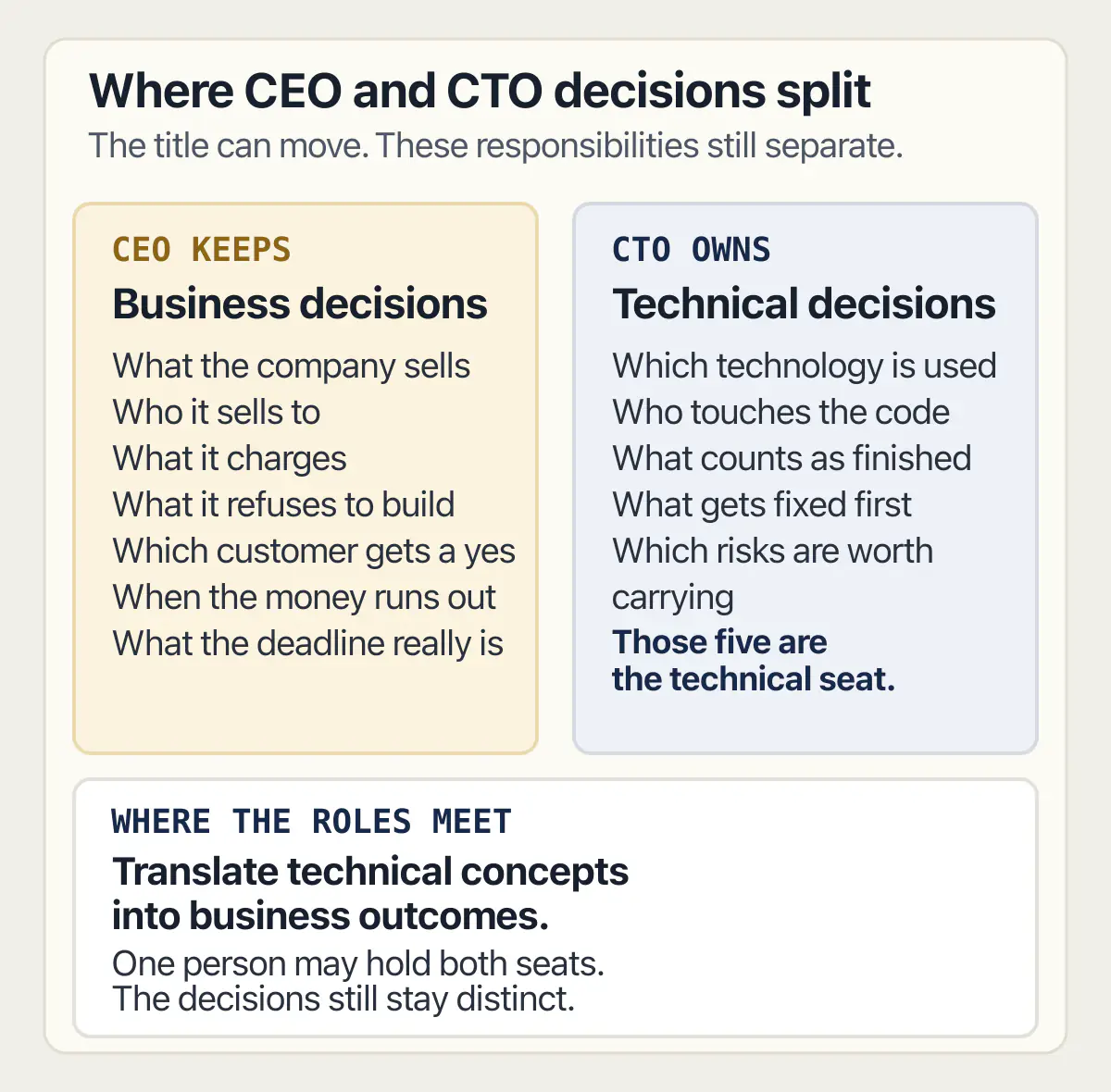
The ones that stay with the chief executive are the ones about the business: what the company sells and to whom, what it charges, what it refuses to build, which customer is worth saying yes to, when the money runs out, and what the deadline actually is. A CTO can tell you what a new feature will take. Only the CEO can say whether it is worth taking, because only the CEO knows what the same days were already promised to.
The ones that stop being the founder’s are narrower than they look: which technology is used, who touches the code, what counts as finished, what gets fixed before anything else, and which risks are worth carrying. Those five are the technical seat. A founder who hands over the title and then keeps overruling the fifth one has not actually handed over anything.
The two roles meet in the seventh part of the job. Splunk’s article, quoted above, says the job “includes translating complex technical concepts into business outcomes” for the people it names: chief executives, investors and board members. In a company with three people the translation runs in both directions and mostly happens in the same conversation, which is why the split matters more than it sounds: when the same person holds both jobs, the technical answer and the business answer arrive already merged, and nobody in the room can tell which one is driving.
There is a version of this that never resolves cleanly. Plenty of small companies run for years with one person holding both seats and no plan to separate them, and the honest thing to say is that this works until the technical answers start costing money the business answers cannot see.
Can AI replace a CTO in a small company?
Parts of the job have moved and parts have not. A generator now writes code that runs, which takes a share of the building work. Judging whether what it wrote is sound, accepting a risk on the company’s behalf, and answering to a customer or an investor are still held by a person, because somebody has to carry them.
The search itself is worth reading before the argument. On 2 September 2026, every result on the first page for “can ai replace a cto” that was not a community thread was published by somebody who sells the role, staffs it, coaches it or interviews the people who hold it: elitebrains.com, which sells CTO hiring and contractor management, datatrends.net, an IT services company whose page ends in a sales call to action, fractionus.com and amazingcto.com, both selling versions of the role, bigtechnology.com, a technology newsletter built on interviews with people in the job, plus a post on a professional network. The highest-ranking article answer publishes its verdict as a score on a scale of its own invention. None of those pages is linked here and the score is not quoted, because a number published by a company that sells the role is a marketing device rather than a finding.
Run the seven parts instead, which is a duller exercise and a more honest one.
The third part, how the system is shaped, has already moved for a large number of small companies. The stack, the database, the folder layout and the framework were chosen by a tool, and they were chosen competently enough that the app runs. That is a real transfer of a real decision, and pretending otherwise is how a page ends up arguing with its own reader’s experience.
Part of the first has moved with it. Turning “we need a way for users to reset their password” into working code no longer needs a person who knows the framework, which is the whole reason the reader of this page has an app at all.
The fourth part has not moved, and the reason is structural. Judging whether what exists is sound means reading code that a generator wrote and deciding what it does under conditions nobody has tried yet. A model can help read it. It cannot be the party that says “this is fine, ship it”, because when that judgment is wrong somebody has to be answerable for the consequence, and the model is not available for that conversation.
The sixth and seventh have not moved either, for the same reason. Accepting a risk is an act of ownership. Explaining a technical situation to an investor or a customer is a conversation with a person who wants to know who is responsible, and answering it with a summary from a tool does not satisfy the question being asked.
Which parts of the list move next is genuinely open, and this page has no way to know. What can be said today is that the parts a generator has taken over are the parts that produce something you can look at, and the parts that remain are the ones where somebody carries a consequence.
The doors people buy this job through
Four doors lead into this job, and this page recommends none of them, because which one fits depends on facts about your company that no page can see.
The first is a full-time hire, which is the right answer when there is enough technical work to keep somebody busy full time and enough money to pay for it, and the wrong answer surprisingly often for a company whose app already runs. What a full-time person in this seat is paid, and what it costs to find one, is counted where those figures belong.
The second is part-time. Buying a slice of this job by the month has its own name and its own market, and what that arrangement actually covers is set out separately. The same slice of the job is sold under half a dozen different titles, and the names it goes by are sorted out elsewhere.
The third door hands the seat to somebody who joins as an owner rather than as a hire, which changes the terms of the arrangement rather than the contents of the job.
The fourth is the one most three-person companies are already using without naming it: the parts stay split across the people who are there, the founder keeps the decisions they are already making, and the one part nobody can hold gets bought as a piece of work rather than as a person. The arrangements people actually use to keep an app alive after launch are set out where that choice gets made.
Whoever takes the technical seat needs a specific set of things on day one, and what to give somebody who takes it is listed elsewhere. The list is longer than most founders expect, and assembling it is a good test of how much of this job was already being done quietly.
Common questions about what a startup CTO does
What does a CTO do all day?
In a company with a technology department, the day goes on decisions and people: what gets built next, what gets bought, who does the work, and which problems are worth stopping everything for. In a three-person company whose app already runs, the same day is mostly answering the questions nobody else can answer, wedged between support messages and sales calls.
What is a CTO in a company?
The CTO is the officer answerable for the technical side of the business. Wikipedia’s entry describes the role at corporate scale, as an officer managing an organisation’s technical operations and advising the chief executive. In a small company the title means one person who decides how the software is built, judges whether it holds up, and answers for it when it does not.
What are the main responsibilities of a CTO?
Splunk’s published account files them under six headings: technology vision and strategy, product and platform leadership, team building and leadership, cybersecurity and compliance, stakeholder communication, and resource allocation. Reordered by when the work actually arrives in a small company, they come to seven parts, and the first one to bite is usually judging whether what already exists can be trusted.
Does a three-person startup need a CTO?
It needs the job done, which is not the same as needing the title. Most three-person companies with a working app already have somebody holding six of the seven parts, and that somebody is the founder. The real question is which part has no owner at all, and whether the unowned part is one that gets expensive quietly.
What is the difference between a CEO and a CTO?
The CEO decides what the business is for: what it sells, to whom, at what price, and what it will not do. The CTO decides how the software delivers that, and answers for whether it holds up in front of users. In a company of three the same person often holds both, and the decisions still separate cleanly enough to be listed on two sides of a page.
Does a startup CTO have to be a cofounder?
No, and the two words measure different things. Cofounder is a statement about who owns the company. CTO is a statement about who holds the seven parts of the technical job. One person can carry both, either, or neither: somebody can own a share of the business and hold none of the parts, or hold all seven having been hired last month.
Does a CTO write the code themselves?
Sometimes, and it depends on the size of the company more than on anything about the person. At the smallest end the two published accounts on this search both assume the person in the seat is writing the product. At a company with an engineering team, writing code is usually the part that goes first, because the decisions expand to fill the week.
Can a founder who cannot read the code do this job?
Most of it, yes, and most of them already are. Six of the seven parts are decisions rather than code: what gets built next, what gets bought, how the system is shaped, who does the work, which risks are accepted, and who explains the technical side to people who are not technical. The one that is left over, judging whether what exists is sound, needs somebody who can read what the generator produced, and that is a reading somebody able to do it does first as a baseline, then repeats when the app changes, a dependency moves or something fails in front of a user.
What happens to an app when nobody holds this role?
Nothing, for a while, which is the difficult part. The app keeps serving users, the bills keep going out, and the parts with no owner stay invisible until one of them produces a consequence: a dependency that stopped receiving updates, a permission that was never checked, a bill that grew, or a fault that a user finds before anybody else does.
Owning an app means being able to run it, change it and recover it without guessing. The sprint below leaves you with the runbooks and documentation to do that.
Built it with AI. Now it has to hold up for real customers.
The Production Hardening Sprint takes the app you already have and builds the production foundation underneath it. Authentication and access rules, payments that stay consistent, error handling, monitoring, backups, automated tests and a documented handover. Our engineers work inside your existing codebase for ten working days. All 123 deliverables are included, and you get the evidence for each one.
See the Production Hardening Sprint →  $2,500 fixed price · 10 working days · One codebase