A micro SaaS here means one small software product sold by subscription that already has paying customers and one owner, not an entry on somebody’s list of ideas to build. The difference matters from the first sentence, because almost everything published under this phrase is written for somebody shopping for an idea, and almost none of it for somebody who already has customers.
So take the owner. The product exists. Cards get charged while you are asleep. Somebody emailed yesterday about a login that will not accept their password, and somebody else wants an invoice with their company name on it. You built the thing with an AI tool, or paid somebody who did, and you cannot read what it is made of. You are past the question of what to build. What sits in front of you now is who does the work, and which of it you have to pay for.
One owner posting publicly about their own project drew that line without naming a tool:
I am working on a vibe code project making a specific cloud based app for my business that is more than a weekend project …
Everything below comes from reading, on 2 September 2026, the whole first page of Google for both phrases this article is named after, the raw HTML of every ranking page that answered a request, one named publication’s account of dropping a paid subscription product, and the pages this site has already published about each job named here. Nobody was hired, nothing was built, integrated, installed or run for it, no product was signed up for, no code was written or looked at, and nothing here describes work done on any reader’s own product.
Micro SaaS development for an owner who cannot read code splits three ways. One pile the builder tool keeps doing on its own, one pile the owner can keep doing without writing anything, and one pile that needs a person who can read the code. Which pile a job sits in is the whole decision.
What micro SaaS development means once real customers are paying for it
On 2 September 2026 the first pages of Google for micro saas development and for micro saas developer returned fourteen organic results between them. Every single one is an idea list, a definition page, a personal build story, a community thread about what to build, or a walkthrough for somebody who can already write or check code. Not one of the fourteen is written for the person who owns a small subscription product and cannot read what it is made of. That shape is the reason this page exists, and it shows up most clearly in where each of those pages stops.
Start with the definitional one. PayPro Global’s answers page on micro-SaaS, updated 23 March 2026, is the piece that most reliably ranks for the phrase. It runs six named content sections, covering what micro-SaaS is, its defining characteristics, whether it is viable for small businesses, the key differences from traditional SaaS, common marketing methods, and a conclusion. Across all six of those sections, read entire on 2 September 2026, none of them names who does the technical work after launch. The page says a great deal about the shape of the product and nothing about the person holding it up.
The no-code platform Knack publishes a longer answer and stops at the same place. Its own “Checklist for Launching a No-Code Micro SaaS”, read entire on 2 September 2026, runs five named phases: Ideation, Development, Testing, Launch and Post-Launch. Under the Post-Launch Phase heading it prints exactly two bullets, “Iterate Based on Insights” and “Plan for Scaling”. Neither one is a technical upkeep job and neither one names a person. The section is at knack.com/blog/no-code-micro-saas-ideas/, named here rather than linked.
The third pattern is the one to know about before you read any agency’s guide. A product agency publishes a seven-step section headed “How to Create a Micro-SaaS Product?”, running from selecting the niche and identifying a market gap through market research, building an MVP, constant iteration, validating and testing, and ending at launch and marketing. The section immediately after that step list is the company’s own “We Build High-Performance Micro-SaaS Products for You”. The steps end where the customers begin, and the next thing on the page is an offer to do the whole thing for you. That guide is at denovers.com/blog/a-complete-guide-to-micro-saas-to-build-profitable-businesses, named here and not linked, because the company publishing it sells the work.
So the published version of micro SaaS development is a build path with a launch at the end of it. The version an owner with paying customers is living in starts the day after that, and it sorts into three piles.
The first pile is what the builder tool genuinely keeps doing on its own, which is more than people expect on some jobs and much less on others. The second pile is what you can keep doing yourself without writing a line, which is larger than most owners believe. The third pile is the work that needs somebody who can read the code, and it is small, specific, and the only part of this that reliably costs money.
Another owner drew the line between the first two piles from the inside, describing a product that was not what the room around them was building:
Most of the conversation here is about building apps with nocode, which makes sense. But I’ve been quietly using it for something completely different … My SaaS product itself is coded.
That is the sentence that decides which pile most jobs land in. A product assembled inside one tool and a product that is written code with services attached break differently, get fixed differently, and need different people. The jobs themselves, the bill that arrives every month and the things that fail first are the operating side of the same product, and they are worth reading about separately once you know who is holding each one. Getting a product like this built at all, and how much of it an AI builder can finish before anybody has to read a line, belongs to a different page and a different question.
What the builder tool keeps doing on its own
The clearest published statement of where a builder tool stops comes from a builder vendor’s own guides page, and it is clear because of how the page is laid out rather than what it argues. Lovable’s guide to micro-SaaS ideas for solopreneurs, read on 2 September 2026, splits one block two ways.
Its “For Developers” paragraph names autonomous development with independent codebase exploration, proactive debugging and automated problem solving, a backend database and user management, subscriptions and payments, code ownership through repository sync, and the ability to extend or customise anything. Its “For Non-Developers” paragraph is two sentences: describe what you want in plain language and get working applications, and click to modify interface elements directly without writing prompts.
Read that split as a capability map rather than as marketing. The vendor is telling you, on its own page, that the deep half of what the tool does is addressed to somebody who can read the codebase it explores and judge the debugging it proposes. The half addressed to you is description and direct editing of the interface. Both halves are real. They are not the same size, and the boundary between them is roughly the boundary between the first and third piles in this article. The guide is at lovable.dev/guides/micro-saas-ideas-for-solopreneurs-2026, named here and not linked, because the rest of it is an idea list.
There is an honest limit on that fact, and it is worth stating plainly. A vendor describing what its tool does is evidence about that tool’s published capabilities on one date, and about nothing else. Your own product was generated at a particular moment, has been edited since, and carries whatever the tool chose on the days it was worked on. The only way to know which half of that split your own product sits in is for somebody to look at it. The page also does not say which recurring duties, hosting, database upkeep, backups and dependency updates, the tool performs on its own and which stay with the owner; until the product is inspected, treat every one of them as unknown rather than automatic.
The definitional page has the same shape of problem in reverse. PayPro Global’s micro-SaaS answers page, updated 23 March 2026, prints a comparison table under the heading “Key Differences Between Micro-SaaS and Traditional SaaS Solutions”. Under Operational Aspects its Maintenance row reads “Simplified operations” for micro-SaaS against “Complex operational requirements” for traditional SaaS, and its Support Needs row reads “Minimal support requirements” against “Extensive support infrastructure”. The same page’s small-business section states that micro-SaaS tools “can be developed and maintained with fewer resources than traditional SaaS”.
Every one of those claims is true in the sense the page means it. Fewer resources than a company with an engineering department is a low bar, and simplified relative to a hundred-person product is still not zero. The word doing the work in all three rows is the comparison, and the comparison is with something enormous. The page never says the remaining operations are nobody’s, because it never raises the question of whose they are.
One owner summed the arrangement up in a single line: one AI tool produced their subscription product, and a different one was what got the faults out of it. Both of those tools did real work. Neither of them noticed that the faults were there, and neither of them decided which ones mattered.
What the owner can keep doing without writing anything
This is the pile people underestimate, usually because the published advice jumps straight from launch to hiring. A large part of running a small subscription product is judgement about the business rather than instructions to a computer, and none of it needs code.
Deciding what a complaint actually is, for a start. A customer writes “it’s broken”. That sentence covers a card that was declined, a password that was typed wrong twice, a feature that never existed, and a genuine defect, and telling those apart is mostly a matter of asking the right two questions and reading the answer. Nobody who can read code will do that better than the person who knows what the product is for and who the customer is. Doing it badly is expensive in its own way, because it sends somebody you are paying looking for a defect that was never there.
Talking to the customer while it is unresolved is also yours. So is deciding what the product does next, which requests to refuse, and which customer is worth changing the product for. So is keeping a written record of what happened and when, which sounds like housekeeping until the day somebody who has never seen the product needs to understand it in an hour.
The accounts are yours too, and this is the one worth being stubborn about. Everything the product runs on wants to sit in the business’s name, with anybody you pay invited in rather than holding it. Sorting that out needs no technical skill and one unhurried afternoon, and it is much harder to undo later than to do now.
There is also a checkable pile of standing technical jobs sitting between your pile and the third one, work that arrives on a schedule and often needs no code to deal with. Which of those recurring jobs a non-technical owner can genuinely do alone, and which need no code at all, is set out one job at a time elsewhere, and it is the better of the two places to start, because most of what is on it costs nothing but attention.
What you cannot do from here is the part that requires reading what the product actually does when nobody is watching. That is the next section.
The jobs that need somebody who can read the code
Four kinds of job arrive because a product bills subscriptions and holds customer accounts. They are not the only work a developer ever does on a small product, but they are the ones an owner cannot resolve from the outside, and they are the ones that turn up as soon as there is a second paying customer.
| The job that arrives once the product bills | What it looks like from the outside | Where it is answered |
|---|---|---|
| A charge that went wrong | A customer says they paid and still cannot get in | In the code that runs after the payment, not on the payment provider’s screen |
| A second customer’s account | Somebody sees a row that belongs to somebody else | In the rules about which account may read which record |
| The screen nobody built | You ask a person to look something up for you every time | In the part of the product nobody generated, because no customer asked for it |
| Anything that moves money | A refund, a discount, a plan change, a cancellation | In the code that decides the number before anything is charged |
Each of those has a mechanism, and this page deliberately does not explain any of them, because explaining one badly is worse than routing it. What changes once a product built this way is running for real, and who owns what after launch, is set out in the guide to vibe-coded apps in production, and reading it first will save you a conversation with whoever you find.
What is worth spending words on here is the cost of leaving one of them, because it is usually invisible from the owner’s side and completely visible from the customer’s.
The Pragmatic Engineer published an account, on 29 January 2026, of being on the other end of exactly this. The author had been a paying customer of a small subscription product for four years and logged in perhaps once a year. On the last login, in the publication’s own words, “the billing section was broken, so I emailed support and they sent me a broken link instead of the invoice”. The customer left, and rebuilt their own use case instead.
Read what the piece then says about why leaving was possible. It states that the product “has 10x or more features, like adding quotes from 10 different platforms, authentication, billing (which didn’t work for me), and more”, and that “A SaaS that doesn’t give ongoing value is at risk of being replaced by customers”. Features were never the problem here. What lost the customer was one broken screen they needed once a year, and a support reply that did not fix it. That whole sequence is in The Pragmatic Engineer’s account of leaving a small subscription product.
That is the real argument for the third pile. A customer who cannot get an invoice remembers it for a year, and then does something about it.
What a micro SaaS developer does that the owner cannot
One finding on the second phrase is worth stating on its own. The phrase micro SaaS developer is not a hiring search. On 2 September 2026 the first page for it held no hiring guide, no staffing marketplace, no job board, no directory and no agency service page. Seven results, and they are idea listicles, a personal money-and-speed story, the same definition page, a community thread, a named engineer’s published account and a developer’s build walkthrough. People typing that phrase are being handed build-it-yourself content, whatever they meant by it.
So the work is easier to describe by what it is than by who sells it.
The work is reading code that somebody else, or something else, wrote, and forming an opinion about what it does when a real customer uses it. Knowing which change is safe to make on a product with live customers, and which one needs a copy to try it on first. Proving a change worked rather than reporting that it should have. Translating “a customer says they paid and cannot get in” into the specific place where the account is supposed to be marked as paid, then finding out that it never got marked. Keeping the versions and the platform requirements from going stale underneath a product nobody is touching.
Every one of those is the same skill: holding an accurate model of a system you cannot see all of, and being willing to check rather than assume. The publication quoted above makes the same case from the customer’s end. Its author says that having to verify an AI tool’s code output before shipping it “might be a dealbreaker for someone not comfortable with” it, and that “A non-developer could probably figure all this out, but it would take longer”. That is a fair description of the boundary, written by somebody with no reason to flatter either side of it.
Finding the person, and telling the four routes apart before you write to any of them, follows an order of its own and has a point where it stops, and it is worth doing deliberately rather than left to whoever answers first. Whether to put somebody on a standing monthly arrangement instead of paying for one named job whenever one comes up is a separate decision, and what settles it is how quickly your own list of changes grows back. And what this work costs varies more than anything else in this territory, which is why the figures each kind of seller publishes sit on a page of their own rather than in a paragraph here.
How to tell which pile a job is in before you pay anybody
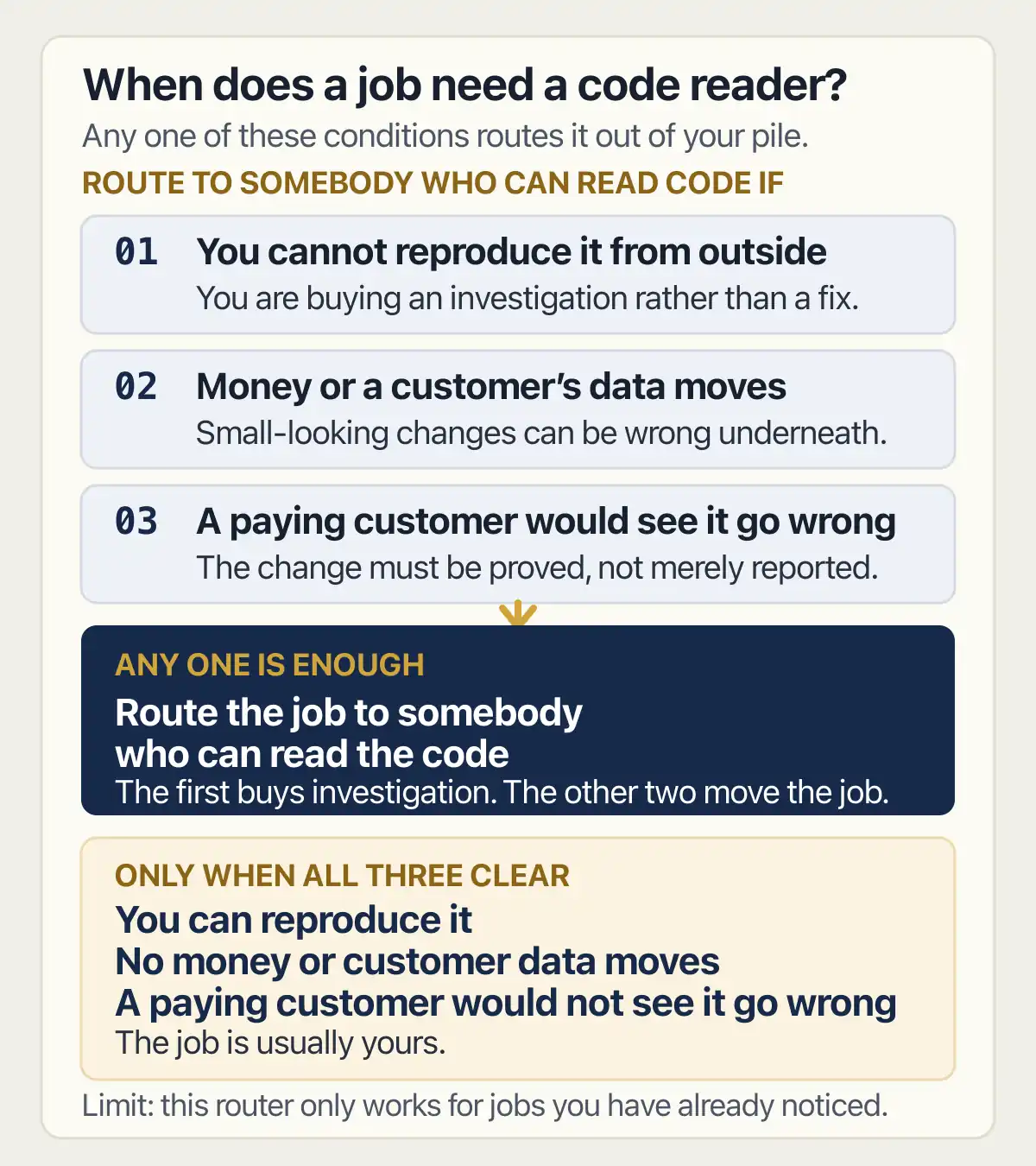
Three questions sort almost every job into a pile. Can you see the thing that is wrong from the outside. Does money or a customer’s data move when it happens. Would getting it wrong be visible to a paying customer. A no to the first, or a yes to either of the others, moves the job away from your own pile.
Take them one at a time, because they do different work.
The first is whether you can see it from the outside. If you can reproduce the problem yourself, in the product, as a customer would, then it can be written down in one sentence anybody can act on, and half the work of the first paid job is already done. If the only evidence is one customer’s screenshot and you cannot make it happen again, you are buying an investigation rather than a fix, and those are priced differently and take longer. Either is a fine thing to buy. Knowing which of the two you are asking for is the point.
The second is whether money or data moves, and it decides whether a job is genuinely yours to try. Changing a heading is not the same class of act as changing what happens after a payment, even when both are one edit in the same tool. Anything that touches a charge, a refund, a plan, an account boundary or somebody else’s record belongs in the third pile by default, regardless of how small the change looks in the interface.
The third is whether a paying customer would see it go wrong. Internal mess costs you time. Customer-visible mess costs you the customer, and the account earlier in this article is the whole argument for that. When the answer is yes, the job wants somebody who can prove the change worked rather than report that it should have.
Whatever the answer, do not let the first job be the one that also transfers the keys. What a developer needs in front of them on the first morning is preparation of its own, and doing it once makes every later job cheaper, because nobody has to work out where things live before they can start.
One thing this page cannot sort for you: the job you have not noticed yet. Nobody with paying customers has a complete list of what is wrong with their product, and the pile-sorting above only works on things you already know about. That is an argument for somebody reading the product once, on purpose, rather than only when something breaks.
Common questions about micro SaaS development
Do I need a developer to run a micro SaaS?
Not continuously, and most small subscription products do not need one on a standing arrangement. You need somebody who can read code for a specific class of work: charges that went wrong, one account seeing another’s data, anything that moves money, and the screens nobody generated. Everything else, including customer judgement, the accounts, and deciding what the product does next, stays with you.
Is a micro SaaS different from any other small app to look after?
Yes, in two ways that matter. It bills people on a schedule, so a defect in the part that decides who has paid affects money and access at the same time. And it holds more than one customer’s data in the same place, so the rules about which account may read which record are load-bearing from the second customer onward. A single-user tool has neither problem.
How do I tell whether a job needs somebody who can read the code?
Ask three questions. Can you see the thing that is wrong from outside the product. Does money or a customer’s data move when it happens. Would a paying customer notice if it were done wrong. If the answer to the first is no, or the answer to either of the others is yes, it belongs with somebody who can read the code. The rest is usually yours.
Is one micro SaaS enough work to keep a developer busy?
Rarely, and the three piles are the reason. On a product that has settled, most of what arrives in a normal quarter lands in the owner’s pile or the tool’s, and the pile that needs somebody who can read code refills slowly. What changes that is a product still growing features, or one customer’s problem now costing you the customer. Both are visible from your side before you buy anything.
Who fixes a subscription charge that went wrong?
Somebody who can read what your product does after the payment succeeds. The payment provider’s own dashboard will tell you the money arrived, which is the part that usually works. What goes wrong is the step after that, inside your product, where the account is supposed to be marked as paid and the customer let in. That step is code, and reading it is the job.
Can I do this work myself if I have never written code?
Some of it, genuinely. Reproducing a problem, describing it precisely, deciding what matters, holding the accounts, answering customers and keeping a record of what changed are all yours and all valuable. What is not realistic is judging whether a change to billing or to account boundaries is safe, because the evidence for that is in code you cannot read, and a change that looks fine in the interface can be wrong underneath it.
What should be agreed before anybody touches a product with paying customers?
Three things, in plain words, before any work starts. What specifically will be different when the job is done, described so you can check it yourself as a customer would. That the accounts stay in the business’s name with the person invited in rather than owning them. And what happens if the change breaks something else, including who looks at it and when. None of that needs legal language, and all of it prevents the argument that otherwise happens later.
Does paying somebody mean handing the accounts over?
No, and it should not. Somebody working on your product needs access to the places it runs, and access is a different thing from ownership. Each of those places can stay in your business’s name and be shared with a named person who can be removed again later. Arranging that at the start is one short conversation. Unpicking it afterwards can be a long one.
Owning an app means being able to run it, change it and recover it without guessing. The sprint below leaves you with the runbooks and documentation to do that.
Built it with AI. Now it has to hold up for real customers.
The Production Hardening Sprint takes the app you already have and builds the production foundation underneath it. Authentication and access rules, payments that stay consistent, error handling, monitoring, backups, automated tests and a documented handover. Our engineers work inside your existing codebase for ten working days. All 123 deliverables are included, and you get the evidence for each one.
See the Production Hardening Sprint →  $2,500 fixed price · 10 working days · One codebase