SaaS development, as this page uses the phrase, is the work of building and then running software that customers pay to use by subscription, held on somebody else’s machines, with paying accounts inside it. Three other things answer to the same letters and none of them is the subject below: a Scottish agency that pays student funding, an older expansion of the same letters meaning systems and application support, and a ticker symbol on an exchange.
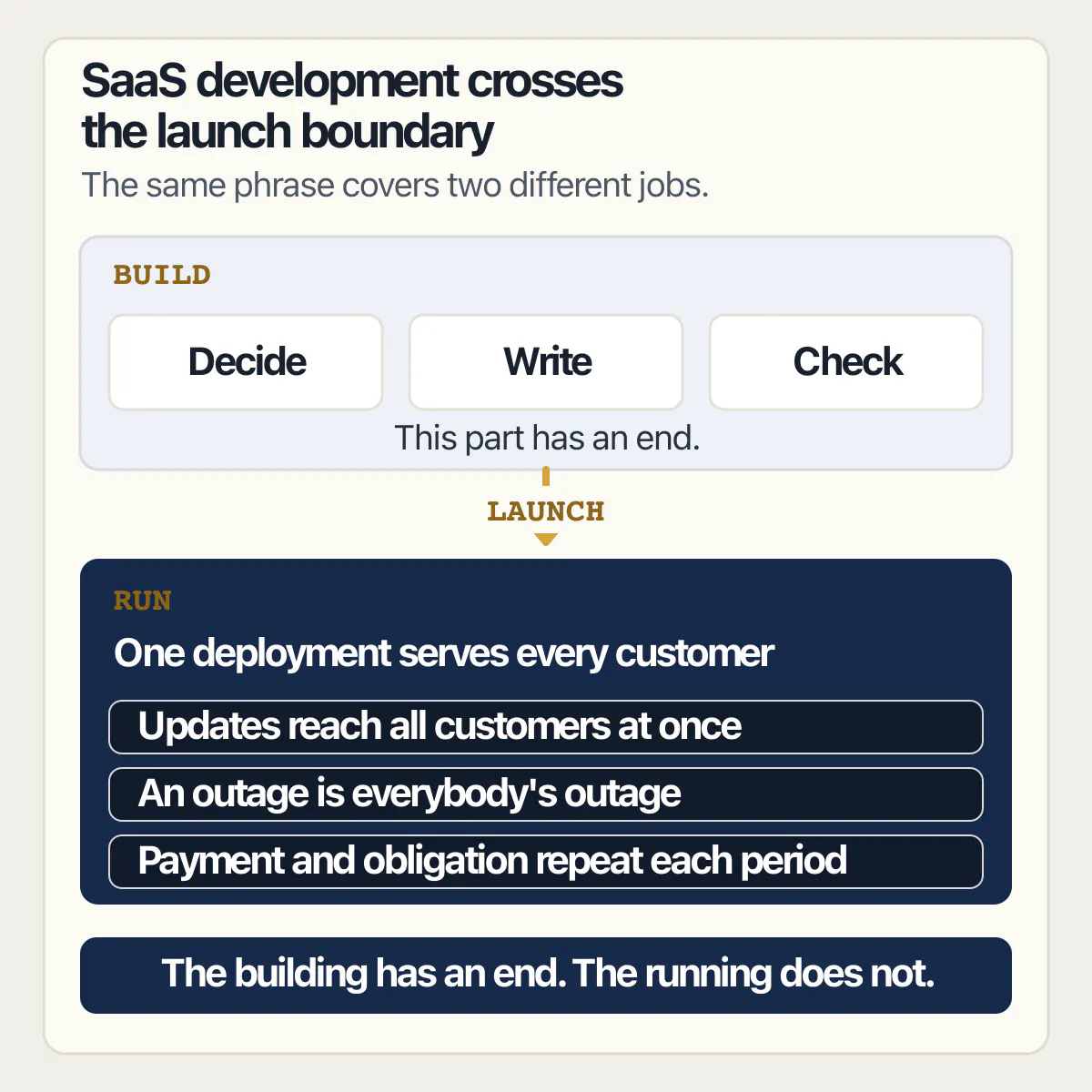
SaaS development is the building and the running of one piece of software that many customers reach over the internet and pay for by subscription. The building has an end. The running does not, because the payment repeats every period and the obligation behind it repeats with it.
Almost everything the search returns for the phrase is written for somebody who has not started. If you already have a product that charges people for a subscription, you are standing outside the first step of every list on that results page, and not one of those pages turns around to face you.
None of this was built, run, maintained, integrated or tested by anybody here. What was read: the results Google returned for two phrasings of this question on 2 September 2026, the pages those results point at, opened in their raw form the same day, and the pages here that already answer the neighbouring questions. No company on that search is rated, ranked or recommended, and where a seller’s own words are used they are named and dated.
What SaaS development means
SaaS development covers two jobs the phrase treats as one: writing the software, and operating it for everybody who has paid. The published definitions put the second job on the provider. If you own the product, you are the provider in those sentences, and every clause of them is a job with your name on it.
Start with the plainer half. Building a subscription product uses the same skills as building any other piece of software: somebody decides what it should do, somebody writes it, somebody checks it. What separates SaaS from software a customer installs comes after the writing: where the thing runs from then on, and who is on the hook for keeping it running.
The reference pages say this clearly, and all three of them say it from where the customer sits. Microsoft Azure’s cloud computing dictionary entry for software as a service, read on 2 September 2026, defines it as “a cloud-based software delivery model where individuals or organizations subscribe to applications rather than purchasing and installing them locally”, and adds that customers reach the software over the internet “while the cloud service provider manages the underlying infrastructure, security, maintenance, and updates”. Wikipedia’s entry on software as a service, read the same day, calls it “a cloud computing service model in which a provider delivers application software to clients while managing the required physical and software resources”, and states that by 2023 it had become the primary method by which companies deliver applications.
IBM puts the split between the two sides in one pair of sentences. Its topic page at ibm.com/think/topics/saas, read on 2 September 2026, states: “The SaaS provider is responsible for operating, managing and maintaining the software and the infrastructure on which it runs. The customer simply creates an account, pays a fee and accesses the software.”
Read that as the person paying, and it is a description of convenience. Read it as the person who owns the product, and it is a job description nobody handed you. Operating, managing and maintaining sit inside the definition of the category, which makes them part of what the word covers rather than extras a well-run product gets around to later. That is the inversion at the centre of this phrase, and it is the reason a definition written for the buyer of software leaves the owner of software with nothing to read.
Two nearby phrasings mean the same thing in practice. SaaS product development is this work with the product decisions attached: what the thing is for, who pays for it, what ships next and what never ships. Saas in development, as people type it, usually means a subscription product that is being worked on rather than a distinct kind of work. The phrasings saas program and saas programming get used both for writing the code and for a company’s programme of subscription software, which is why neither of them gets a section here.
Four different things page one calls SaaS development
Page one is not one answer. Two pulls were run on 2 September 2026, one for the head phrase and one for the process phrasing, and the sixteen organic results between them carry three separate meanings of the phrase plus a question nobody on the page answers. Sorting them is most of the work.
The first meaning is the delivery model. Microsoft Azure, IBM and Wikipedia all rank for a search containing the word development, and none of them defines development at all. They define SaaS: how software gets to a customer and who runs it. Three of the eight results for the head phrase are that.
The second meaning is a service you can buy. Intellias, at intellias.com/saas-development/, and ScienceSoft, at scnsoft.com/software-development/saas, both rank on the head phrase with a page selling the making of a subscription product to a person who has not made one. An agency guide from Netguru at netguru.com/blog/saas-development sits on both results pages with an engineering audience and the same starting assumption. On these pages, saas development services names the seller’s catalogue rather than the work itself, which is why the phrase and the plain phrase pull apart.
Third, one vendor on that page uses the phrase for something genuinely different. Salesforce’s page at salesforce.com/saas/application-development/, read on 2 September 2026, uses “SaaS application development” to mean building applications on top of a SaaS platform it sells, and its argument is about what such a platform saves you: no infrastructure to stand up, no backup and recovery to set up, no development tools to install. That is a description of a place to build, not of the trade of building. The same page still carries a prediction about what would happen by the year 2020, which is worth knowing before treating it as current.
The fourth thing on the page is the question itself, unanswered. The result ranking first for the head phrase on 2 September 2026 is a public forum thread titled “What exactly is a SAAS from a technical point of view?”, which the results page dates to three years ago with more than ten comments. Nothing inside the thread is used here and it is not linked; the title and the description printed on the results page are the whole of the evidence. A question from three years ago holding the top slot is itself a finding about how settled this phrase is.
| What the phrase means on that page | Who the page is written for | What it leaves out |
|---|---|---|
| A way software is delivered and paid for (Azure, IBM, Wikipedia) | Somebody deciding whether to subscribe | The work of running one |
| A service you buy so a product gets built (Intellias, ScienceSoft, Netguru) | A founder with an idea and no product | A product that already has customers |
| Building on a vendor’s own platform (Salesforce) | A company picking a platform to build on | Anything not built on that platform |
| The question, still open (the top forum thread) | Developers asking each other | Any settled answer |
If you want examples rather than a definition, the kinds of product are easier to name than the trade. IBM’s page lists entertainment platforms, email and communication tools and project management tools among the SaaS applications people use daily. What they have in common sits outside their feature lists: nobody installs them, nobody patches them, and everybody pays for the period they are in.
What makes it different from software a customer installs
One deployment serves everybody. That single fact produces almost every difference that matters: updates arrive for all customers at once, an outage is everybody’s outage, and the person who owns the product carries the running of it rather than shipping a copy and moving on.
IBM describes the arrangement in one clause on the same page: a single instance of a software application serves multiple tenants, with each tenant’s data kept separate from other customers’. In this page’s sense a tenant is one customer company inside your product, not a person renting property. That clause is here to fix the word, and the work of arranging it belongs on pages that deal with accounts and permissions rather than on a definition.
Netguru’s guide states the consequence in its own words: “SaaS development is the practice of building software that runs on shared cloud infrastructure and is delivered to users over a network, with the vendor operating the application rather than the customer installing or hosting it”, and, further down the same page, that one codebase and one deployment for many customers “shifts security, data isolation, and upgrade responsibilities from the customer to the development team”. Both sentences were read on 2 September 2026. Notice which direction the shift runs. Everything the customer used to do for themselves is now done by whoever holds the product.
Then there is the money, which changes the shape of the obligation rather than its content. Somebody who bought installed software owned the copy they had, and could keep using it while ignoring you. Somebody who subscribes is paying for the next period, which means they are paying for your continued attention. Software that is finished and software that is earning are two different states, and only one of them has a customer waiting.
The stages sellers publish, and where they start
Every ranking answer to the process question is a company describing its own numbered sequence. Eight organic results came back for the process phrasing on 2 September 2026 and not one was an encyclopedia entry or a neutral reference; four carried a stage or process label in the title. The sequences differ from each other, and they all begin in the same place.
Rishabh Software publishes eleven numbered steps at rishabhsoft.com/blog/saas-product-development, read on 2 September 2026. Step one is market research and problem discovery. Product strategy and roadmap planning is step two, design is step three, and the eleventh and last is scalability and maintenance. ScienceSoft’s list of SaaS services on the page named above opens at idea productization and brand design, where its consultants analyse competitors and define what makes the product different; support and maintenance is the eighth of the eleven lines it names, and cloud migration and API development come after it. Intellias, on its own page, opens its sequence with an instruction to consult its experts so that, in the page’s words, “your ideas and concepts result in a business-savvy solution”. Read on 2 September 2026, that is the first thing its process asks of a reader.
Line one of all three is a decision about a product that does not exist. Market research, brand design, turning ideas and concepts into a solution: those are all answers to the question of what to make. Somebody with a running product answered that question already, in the worst possible way if the answer came out of a generator, but answered it. They are outside the sequence at its first line, and the pages that publish these sequences have nothing to say to them until roughly step eight.
This is where the lifecycle vocabulary comes from too. The SaaS development process, life cycle, stages or model, under whichever of those names a page uses, is one of these published sequences, usually the seller’s own. No rival sequence is offered here in their place. For a product that is already taking payments the honest version is not a sequence at all: it is a list of what is already true, a list of what has to change, and an order that comes out of comparing the two rather than out of a diagram.
What the work is once customers are already paying
The work does not stop at launch; it changes shape. Three shapes of it turn up on every subscription product regardless of how the thing was built, and a stage list gives them at most a closing line, support and maintenance or cloud migration, because a stage list assumes an empty screen and these all assume a full one.
The first is that every change now has to land without breaking the people already inside. Adding a feature to a product nobody uses is arithmetic. Adding one to a product with paying accounts in it means the existing accounts, their data and their half-finished periods all have to survive the change, and the test of whether they did is a customer not writing to you. What owning a live app commits you to has a page of its own that works through the whole of it. The responsibilities that arrive with a live product, and who has to carry each one, are named there and are not repeated here.
Next comes property. Once customers are paying there is an account that collects the money, a database holding records that belong to other companies, a domain, a place it runs, and a set of logins that let somebody change any of it. On day one those were configuration. Once customers are paying, they are property with consequences attached. Running one of these without a developer on call has a list of its own, naming each standing job and which of them nobody can skip, and that list lives on a separate page.
Failures also arrive by a different route. During a build, something broken shows up as an error in front of the person building it. After launch, it shows up as an email from a customer who could not do the thing they pay for, often hours after it started, and often about the one path nobody thought to check. That gap between when it breaks and when you hear is a property of the product, not of the person, and it can be closed on purpose.
Underneath all three sits a cost that only appears later. What a change costs later, when nobody has read the code the tool wrote, is measured on its own page. It is the reason the same small change can be quick on one product and slow on another with the same feature list, and it is invisible right up until the first time somebody has to touch a part of the code that no human has ever read.
Who does which part
The phrase says nothing about who does the work, which is why page one fills up with companies happy to answer it for you. Four separate questions hide inside it, and each one has a different answer.
Choosing between a company, a small team and one person for a product that already bills is a different decision, and it has its own page. What the person doing this work is actually hired to do, once there are paying accounts to protect, is answered separately. What sellers publish for this work, and what a seller is actually pricing when it names a figure, is a price question with an answer of its own. Getting a first version of one of these built from nothing is a different path, and it is walked through elsewhere.
There is a fifth door that people arrive at with the word AI attached rather than the word SaaS. Companies selling an AI build describe the work as a catalogue of capabilities, and what that catalogue leaves out has already been read in one place.
No company is named as a recommendation anywhere on this page, and no list of the best or biggest SaaS companies appears here. Putting suppliers in rank order without having bought from any of them is a sales exercise wearing a table, and who to buy from is a different question from what the phrase means.
Common questions about SaaS development
Is SaaS development different from ordinary software development?
The building part uses the same skills, and the difference shows up afterwards. One deployment serves every customer, updates reach all of them at once, and the published definitions put operating, managing and maintaining the software and its infrastructure on the provider rather than the customer. Software a customer installs hands most of that back to the customer.
What are the stages of SaaS development?
There is no standard set, only the sequences individual sellers publish. Read on 2 September 2026, one publishes eleven numbered steps beginning at market research and problem discovery, another opens its list at idea productization and brand design, and a third begins by asking the reader to consult its experts about the idea. All of them start before the product exists.
What is SaaS product development?
The same building and running work, with the product decisions attached: deciding what the thing is for, who pays for it, and what gets built next. On the pages that rank for both phrases the two are used interchangeably, and no page read on 2 September 2026 drew a line between them.
What is a SaaS development model?
The phrase carries two senses and they are worth keeping apart. The first is the delivery and deployment model: software reached over the internet and paid for by subscription, run by the provider, as opposed to software installed and operated by the customer. The second is the way a particular supplier organises a build. Say which one you mean and the conversation gets shorter.
Is ChatGPT considered SaaS?
The test is the definition rather than the product. Software that runs on the provider’s machines, is reached over the internet and is paid for by subscription rather than bought and installed is SaaS under the definitions Microsoft Azure, IBM and Wikipedia publish, whatever the software happens to do. A hosted assistant used that way fits the model. No page belonging to any AI vendor was read for this article, so nothing here is claimed about any particular plan.
Is Netflix a SaaS or PaaS?
SaaS, by the split IBM publishes on its own topic page, read on 2 September 2026: it names entertainment platforms such as Netflix and Spotify among SaaS applications, and describes platform as a service as a cloud-based platform for developing, running and managing applications. A subscriber gets a finished application rather than a place to build one.
Does SaaS development stop when the product launches?
No. The definitions the highest-ranking reference pages publish put operating, managing and maintaining the software and its infrastructure on the provider, with no end date attached, and the subscription that pays for it renews. Launch moves the work from making the thing to keeping it working for people who have paid for the period they are in.
Does SaaS always mean software sold by subscription?
Subscription is the common shape and the definitions lean on it, but it is not a rule. One agency guide on the same results page lists more than one way of charging for a subscription product, from a fee per user to charging by usage, and the part that holds constant is that the provider runs the software rather than the customer. The letters themselves are not reserved either: a Scottish student funding agency answers to them, so does an older support term, and so does a ticker symbol, and none of those has anything to do with software you own.
The word doing the most damage in this market is development itself, because it names the half that ends. The half that does not end has no agreed name, no numbered diagram and no page of its own on the front of that search, which is a strange gap for a category that has been the main way software reaches people since 2023.
If you have a working app built with these tools and need it ready for real customers, this is what we do.
Built it with AI. Now it has to hold up for real customers.
The Production Hardening Sprint takes the app you already have and builds the production foundation underneath it. Authentication and access rules, payments that stay consistent, error handling, monitoring, backups, automated tests and a documented handover. Our engineers work inside your existing codebase for ten working days. All 123 deliverables are included, and you get the evidence for each one.
See the Production Hardening Sprint →  $2,500 fixed price · 10 working days · One codebase