You already have a working first version. It was assembled in a builder or written by an AI tool over a few weekends, real people are signed in and using it, and somebody has now quoted you for custom MVP development. The number in front of you almost certainly prices a build from nothing, because that is what every page selling this work is written to price.
Custom MVP development is sold as three different jobs: a build from nothing, new code underneath the screens you already have, or a small piece of code beside the no-code app. Which one you need depends on which part of your product is giving out, not on how big the quote is.
Those three jobs replace different things and cost very different amounts, and the one most owners at this stage actually need is rarely the one they are quoted for. How the whole business of getting a first version built now fits together is set out in one place. This page covers a single decision inside it.
What the pages ranking for custom MVP development actually price
Nine pages rank for custom MVP development, and two would not open to an automated read. Every one that did prices building a product from nothing, on a clock measured in months rather than days, and six of the nine are guides rather than service pages. Not one is written for somebody whose product already works and already has customers.
Every price and every claim about what a seller sells here was read off that seller’s own published page on 1 September 2026, one page at a time, with nothing bought and nothing commissioned, and any page that would not answer an automated read is recorded that way, with nothing inferred from it.
Codevelo’s guide, dated 28 December 2025, sorts the work into three named plans and prices the top one, the Complex Plan, at $60k to $100k+. The plan name is doing the pricing. What separates that plan from the two cheaper ones on the same page is a list of feature words, not anything a buyer has told them about their own product.
DevCrew I/O’s guide, dated 23 December 2025, skips the plans and gives one range. Its wording is “The cost to develop MVP typically ranges from $15,000 to $60,000.” Software Development Hub sells named packages instead of ranges, and the one its page marks most popular, the Acceleration MVP Package, is priced on its package cards at $35,000 to $80,000. That page shows no date to a reader anywhere, so the only date that can honestly be attached to its figure is the day somebody read it, which was 1 September 2026.
The clock is the more revealing number. Codevelo’s timeline section says most custom MVPs are built within 8 to 16 weeks, and the phase breakdown underneath it starts with a discovery period for deciding what the product should do. That sequence only makes sense for somebody who has not built the product yet. If you have customers using yours, the discovery period has already happened, in public, with real users, and you paid for it in a way no seller here is pricing.
The phrase bespoke MVP development services turns up across the same field and buys the same thing. Bespoke there describes the seller’s process, not anything about what you already own.
Codevelo’s page concedes the gap in a single sentence, noting that founders now use AI or no-code tools for early validation before moving to custom development, and then prices a build from zero anyway. DevCrew I/O has a one-line answer on the same choice and does the same. No page on this search that opened to a read prices the move itself, which is the only thing a person with a working product is actually buying.
Away from the sellers, the same decision turns up stripped of vocabulary. One post on a programming community in July 2026 carried the whole thing in its title: “I need to build an app but don’t know what to use”. No plan, no phases, no clock. Nobody ranking on this search answers that version of it either.
Two pages on this search would not open. As of 1 September 2026, Phenomenon Studio’s custom MVP page did not return a readable response to an automated read, so nothing about what it holds or charges appears here. The result at position nine is a general-publisher article whose whole subject is the no-code against custom choice; its presence on page one is a fact about the search, and its contents are not quoted, because that publisher refused an automated read on the same day. DevCrew I/O’s guide refused the fetch tool and returned in full to a plain read of its HTML on 1 September 2026, and its figure above comes from that read. On the related search for no code MVP, the second result is a community thread arguing against no-code for first versions; that site serves no automated read either, so it is recorded from the search result alone and nothing in it is quoted.
The three source pages are codevelo.io/blog/custom-mvp-software-development, devcrew.io/develop-custom-mvp-software and sdh.global/mvp-software-development-for-startups, with the unread one at phenomenonstudio.com/custom-mvp-software-development. None of the four is linked. Each one sells the work this page discusses to the person reading it, so each is credited by name and address, with no link on it.
What a no-code MVP actually cannot do
A no-code MVP holds up as a real product until the thing giving out stops being your code and starts being the platform. Three limits do almost all of that work: what the platform meters, what comes out through the exit, and whether the records survive the things people do to them.
The phrase gets written both ways, no code MVP and no-code MVP, and it means one thing: a first version assembled inside a builder rather than written in code. That is a real product. Customers cannot tell how it was made, and for a long stretch it does not matter that they cannot. What ends the stretch is rarely a feature request. Three walls end it, and all three belong to the platform rather than to the app.
The meter runs before the code breaks
The first wall is the one you are billed for. Builder platforms sell capacity, and a product that more people use spends that capacity faster, in a curve nobody watching the signup chart is looking at. Why a no-code app spends its metered allowance faster as it grows is a separate question with a separate answer, and none of it is a code problem. The nearer relative of the meter is the limiter: a platform slowing your app down on purpose because the traffic pattern is heavier than it allows. Owners read that as the platform failing under load, which is usually the wrong reading. What one builder’s own documentation says about its limiter is read out in full elsewhere, and it describes something more fixable than the reputation suggests.
The difference matters because the two walls have different bills attached. One owner ended up paying a firm to build the thing over again, because the platform underneath it would not hold the number of people who turned up. That is the expensive version of the mistake, and it starts with reading a meter as a rebuild.
Low code MVP development is the phrase sellers use for the middle option, where a platform does the plumbing and a developer writes the parts the platform refuses. On a seller’s page it usually appears as a cheaper column set beside the headline one. The cheaper column some of these sellers publish beside their headline one is read properly somewhere else.
Not everything comes out through the export
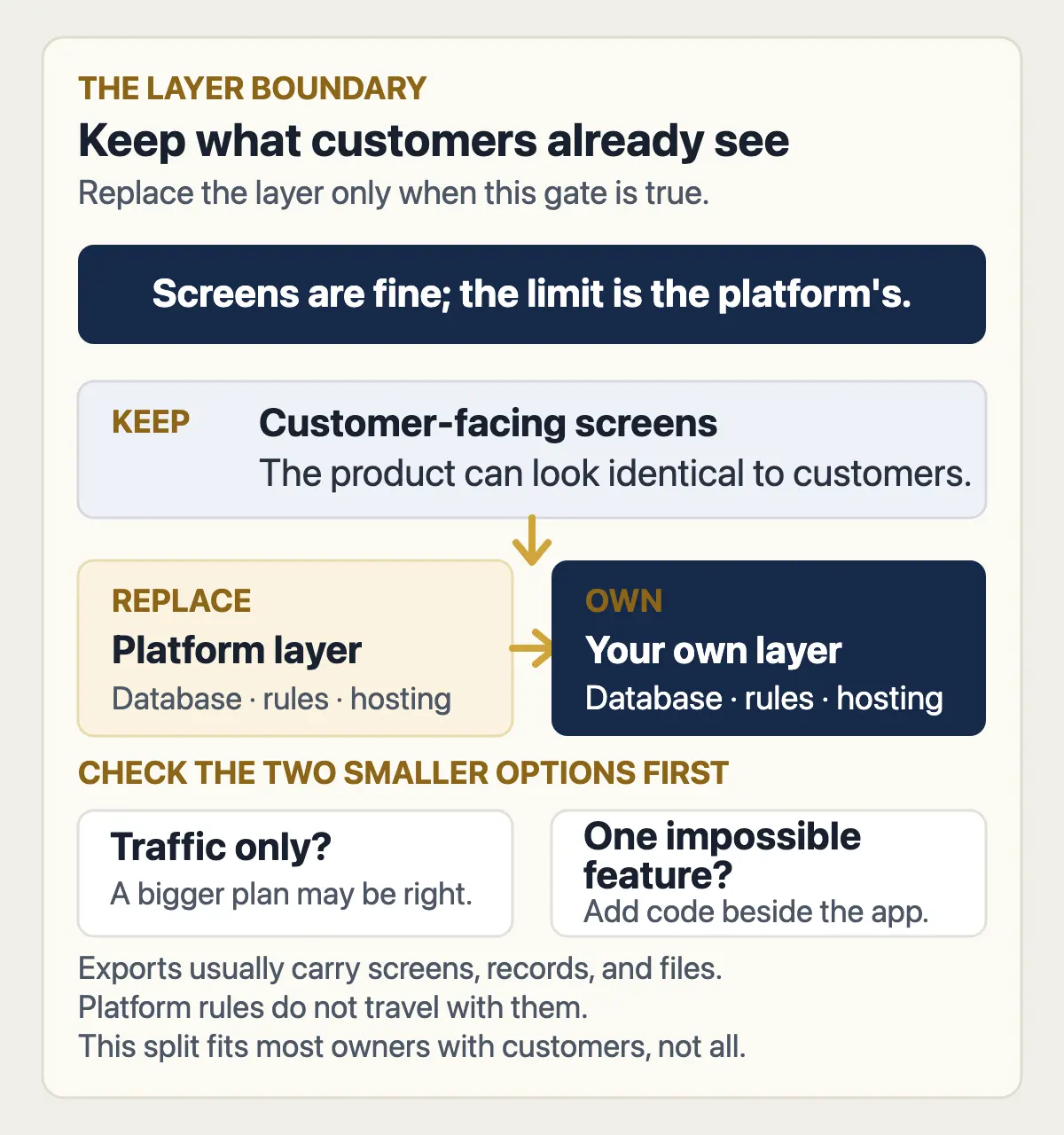
The second wall is the door. Every builder has one, and what comes through it is never the whole product. Screens, records and files usually travel. The rules do not: who is allowed to see which rows, what happens automatically when somebody cancels, which fields the platform was quietly filling in. Those live in the builder’s own settings, and a copy of your data on your own laptop does not contain them.
That gap is the reason an exit costs more than an export button suggests. Which exit fits your reason for leaving a builder is decided on the page about leaving that platform, and so is the question of what stays behind when you go.
The app working and the records surviving are two different things
The third wall is the quietest, and it is the one a working demo is least able to show you. An app can pass every click you give it and still be one bad afternoon away from losing something it cannot get back: a delete that takes more than it should, a refund written into a field that rounds, a restore nobody has ever rehearsed. Nothing on the screen reports that state.
AxonBuild audited 26 real applications in June and July 2026: 5 were the founder’s own and the other 21 belonged to other people, and every finding was read out of a confirmed-finding ledger rather than a scanner’s raw output. In that ledger the data-safety findings are kept as individual cases rather than as a rate, because that is all the evidence supports: absent backups, restores nobody has rehearsed, and deletes that reach further than anyone meant them to. What twenty six audited applications had in common is set out there with the method in full.
None of that says anything about your app in particular, and buying something on the strength of it would be a poor reason. What it does say is narrower: this is the part of a first version nobody is watching once real customers are inside it. The screens got all the attention, and the screens were never where that risk sat.
When keeping the no-code MVP is the right answer
Keeping the no-code MVP is the right answer whenever the thing that changed is the number of people arriving and nothing else. More traffic on a metered platform is usually a bigger bill, and a bigger bill is usually a plan change rather than evidence that the product needs writing again in code. Check the meter first, though: an unbounded list, a query that runs once per row, a duplicated call or plain abuse can drive the same bill and the same throttling from inside the app, and those are fixed in the builder, not by a bigger plan.
This is the half nobody selling custom development writes down, so it is worth being blunt about it. If your app does what it should, the screens are fine, no feature has turned out to be impossible, and the only new fact is that more people showed up, then the honest recommendation is to pay the platform more and go back to work. That decision takes an afternoon. The alternative takes a quarter.
Whether another year of the subscription beats paying somebody once is a sum with a crossover in it, and that sum is worked out where it belongs. None of it says anything about the quality of what you built.
There is a version of this reader who is not at any wall yet, and it is worth recognising them, because sellers on this search will happily quote them anyway. One owner of a small team, writing in a business community with no route chosen, described the moment like this:
I manage a small team and we’re currently keeping a lot of customer information and follow-ups across spreadsheets, email and WhatsApp. It’s starting to get messy as the number of customers grows…
Nothing in that calls for custom code. It calls for one tool, chosen once, that holds the thing the spreadsheets are failing to hold. The custom question arrives later, and it arrives from the product, not from the mess.
The three shapes custom MVP software development is actually sold in
Custom MVP software development covers three separate purchases plus one non-purchase, and the sellers on this search only price the most expensive of them. The table below is the whole decision: read across from the sign you actually recognise, and the row you land on is what you should be asking to buy.
| What is being bought | What it replaces | The sign that this is your one |
|---|---|---|
| A build from nothing | Everything, including the screens that already work | You are changing what the product is, not how it runs |
| New code underneath, same screens | The platform’s database, rules and hosting | The screens are fine and the limit you keep hitting is the platform’s |
| Code beside the no-code app | Nothing: it adds the one part the platform cannot do | One feature is impossible and the rest is comfortable |
| Nothing yet, a bigger plan | Nothing | The only thing that changed is how many people arrived |
The first row is the one being quoted at you. It is the right purchase when the product itself has to change, which usually means you learned something from your customers that the current shape cannot express. Whether to repair the app you have or pay for a new one is a sum with a break-even in it, and that sum is not this page’s: the sum that decides between repairing what you have and paying for a new one is worked out separately. Paying for the whole product to be produced again, rather than for the layer underneath it, is priced by a different set of sellers and is counted up elsewhere.
The second row is the one most owners with customers actually need, and it is the one nobody on this search names. The screens stay. What gets written in code is the layer under them: your own database, your own rules about who may see what, your own hosting. From the outside the product does not change at all, which is exactly why it is a hard thing to sell and an easy thing to buy well. What moving the data and the rules onto your own database actually involves is a mapping job with its own walkthrough, and the rules are the part that takes the time.
The third row is the cheapest and the least talked about. The builder does everything except one thing, so somebody writes that one thing as a small service the builder calls out to, and the no-code app stays exactly where it is. Payment logic the platform will not express, a document the platform will not generate, an integration nobody has built: each of those is a piece of code beside your app rather than a replacement for it.
The fourth row is the one no seller on this search will ever write, which is why it is in the table.
What changes about the price once the product already works
The published figures on this search all price a product that does not exist yet, and a working app with customers has already paid for the parts that come first. Deciding what to build, drawing it, and finding out whether anybody wants it are done. What is left is a narrower question, and it prices differently.
This page puts no number of its own on that narrower question, because the answer depends entirely on what the running app already does. What changes is how the conversation goes. Instead of a plan and a clock, you are asking somebody what it costs to replace one named layer of a product they can open and read. A person who has read the code can answer that. Nobody can answer it from a phase list.
What one person’s time costs across the routes that sell it is priced properly on the page that does nothing else, route by route, and it is the closest thing to a floor under any of this. What the whole AI route costs before anybody is hired, tool bill included, has a page that totals it. Systems a company builds for its own staff are quoted from a different market, by different publishers, and this page does not price them.
How to decide, in order
Four steps, in this order, get you to a row in the table above. Skipping to the last one is how people end up buying the first row when they needed the second, which is the single most expensive mistake available at this stage.
- 01 Name the thing that is actually giving out. Write one sentence describing what stopped working and when. If the sentence contains a bill, a slowdown or a limit, you are at the platform's wall. If it contains a feature the builder refuses to express, you are at the third row. If it contains a sentence about what the product should be instead, you are at the first.
- 02 Check whether a plan change answers it. On a metered platform this is a settings page and a card, and it is worth doing before anything else, because it either solves the problem for a year or proves the problem is not capacity.
- 03 Find out what does not come out. Ask the builder's own documentation, not a seller, what leaves through the export and what stays behind. The rules about who may see which records are the ones that stay, and they are the bulk of the work in row two.
- 04 Ask for a price on one named layer, not on a product. Give whoever quotes you access to the running app and ask what replacing that specific layer costs. A seller who answers with a plan, a phase list and a clock is quoting the first row at you whatever you asked for.
Step four is where most of the money is decided, so it is worth stating plainly who publishes this page and what they sell, given that it sits next door to the decision. The call is a discussion, not a written assessment.
Common questions about custom MVP development
What is custom MVP development?
Custom MVP development is building a first version of a product in written code rather than assembling it in a builder, usually bought from a firm that sells it as a project with phases and a delivery date. On this search it almost always means beginning from an empty folder.
Is a no-code MVP good enough to launch with?
Yes, for launching and for a long stretch afterwards. Customers cannot tell how an app was built, and a no-code MVP that does its job is a real product with real revenue. Where it struggles is surviving growth quietly, because the platform starts charging or slowing you down long before your own code becomes the problem.
When should a no-code MVP move into custom code?
When the limit you keep hitting belongs to the platform rather than to your app, you have measured which limit it is, and a bigger plan has stopped fixing it. That is a narrow test on purpose. Slow screens, a feature you have not built yet, and a competitor with more polish are all reasons to keep working inside the builder, not reasons to leave it.
How much does custom MVP development cost?
Every published figure on this search prices a product that does not exist yet, on a plan that begins with deciding what to build. If most of your product already exists and works, none of those figures describes your purchase, and the honest answer is that a price for replacing one named layer of a running app can only come from somebody who has read that app.
Can you keep part of a no-code MVP and replace the rest?
Yes, and it is the most common shape at this stage. The usual split keeps the screens and replaces what sits under them, so the product looks identical to customers while the database, the rules and the hosting become yours. The reverse split also exists: keep the whole builder app and add one small piece of code beside it for the thing the platform will not do.
What does low code MVP development mean when a seller says it?
It means a platform does most of the assembly and a developer writes the parts the platform cannot express, so the buyer gets some code of their own without paying for all of it. Sellers usually present it as a cheaper column next to their main offer. The word describes how the work is done, not how much of the product ends up belonging to you.
Does going custom mean starting again from nothing?
Only if the product itself has to change. If the screens are right and the problem is the layer underneath, the work is a replacement of that layer, and everything a customer sees can stay exactly as it is. Sellers quote a fresh build because that is the product they sell, which is a fact about the seller rather than about your app.
Who does the work when a no-code MVP moves into code?
Somebody who can read a running app and write the layer that replaces the platform’s own, which is a narrower brief than the phase lists on this search imply. The work is reading what exists, replacing one layer, and moving the records without losing the rules attached to them. Having done it before matters more here than having a large process around it.
If you have a working app built with these tools and need it ready for real customers, this is what we do.
Built it with AI. Now it has to hold up for real customers.
The Production Hardening Sprint takes the app you already have and builds the production foundation underneath it. Authentication and access rules, payments that stay consistent, error handling, monitoring, backups, automated tests and a documented handover. Our engineers work inside your existing codebase for ten working days. All 123 deliverables are included, and you get the evidence for each one.
See the Production Hardening Sprint →  $2,500 fixed price · 10 working days · One codebase