FlutterFlow costs $0 a month on Free, $39 on Basic, $80 for the first seat on Growth and $150 for the first seat on Business. Enterprise has no published price. Seats are only one line of the bill, because three separate credit meters run on top of the plan.
Prices and plan limits here come from FlutterFlow’s public pricing page and its accounts and billing documentation, checked on 17 August 2026, not from a paid account. One of those three meters, Test Pilot, has a published allowance and a published top-up price; AI generation has a published allowance and no top-up price. The third, a row the pricing table labels Lite, is granted on every plan and defined nowhere in the documentation checked here.
How much does FlutterFlow cost per month?
FlutterFlow costs $0 on Free, $39 a month on Basic, $80 a month for the first Growth seat with $55 for the second, and $150 a month for the first Business seat with $85 each for seats 2 to 5. Enterprise is quoted rather than listed. Prices checked 17 August 2026.
| Plan | First seat per month | Each extra seat | Projects | Editors | Branches | Code download | Push to GitHub |
|---|---|---|---|---|---|---|---|
| Free | $0 | not offered | 2 projects | 1 | 1 (main only) | no | no |
| Basic | $39 | not offered | Unlimited | 1 | 1 (main only) | yes | no |
| Growth | $80 | $55 for the second seat | Unlimited | Up to 2 | Up to 2 (+main) | yes | yes |
| Business | $150 | $85 each for seats 2 to 5 | Unlimited | Up to 5 | Up to 5 (+main) | yes | yes |
| Enterprise | Custom pricing | not published | Custom | Custom | Custom | yes | yes |
Two things in that table get read wrong more often than the rest. Growth is not $80 per seat. FlutterFlow prints it as “$80 1st seat/mo, $55 2nd seat”, so two people on Growth is $135 a month, not $160. Business prints as “$150 1st seat/mo, $85 seats 2-5”, so a five-person team is $490 a month.
The other one is the code download row. On Free you cannot download the Flutter project or the APK at all. That single row is the most consequential paywall on the page, because it decides whether the thing you built is portable. Everything else on the Free plan is a limit you can live with while you learn. That one is a lock on the exit.
Enterprise appears on the plan comparison in FlutterFlow’s accounts and billing documentation as “Custom pricing”, and the one row on that table where Enterprise is ticked and every other tier is not is Activity Logging. The rest of what the tier adds is written as prose on FlutterFlow’s plans and pricing page rather than as table cells: single sign-on, version pinning, unlimited development environments and unlimited access to automated snapshot backups. No dollar figure is published on any FlutterFlow page checked here, so any Enterprise number you find elsewhere is not from FlutterFlow.
FlutterFlow plans: what each tier unlocks
Each tier buys a different thing. Basic buys portability, Growth buys a release process, Business buys a team. Free buys the editor and nothing you can take out of it. The plan comparison page displays “Last updated on Jun 9, 2026” and agrees with the pricing page on every figure below.
Free: $0 a month
Two projects, one editor, one branch, and up to 2 API endpoints. Firebase and Supabase integration are both included, as are Cloud Functions, the visual logic builder, live debugging and web deployment to up to 2 free subdomains. Automated snapshot backups reach “Up to 1 hour prior”.
What Free does not have is the list that matters. No code download, no APK download, no one-click store deployment, no custom domain, no watermark removal, no Test Pilot, no automated testing, no email support. AI generation is capped at “5 requests/lifetime”, and the Lite row grants 10 credits with no monthly reset.
Basic: $39 a month
Basic is the first plan that lets you leave. Code download, APK download and one-click store deployment all start here, along with watermark removal, one free custom domain with more purchasable, unlimited projects, Test Pilot access, the CLI, YAML editing, the project API, Swagger and OpenAPI imports, and the local run desktop emulator. AI generation rises to 50 requests a month and Lite to 100 credits a month.
What Basic still does not include is anything that resembles a release process. Push to GitHub, branching past main, real-time collaboration and automated testing are all absent, and there is still only one editor. A solo builder shipping one app to a store is the shape Basic fits.
Growth: $80 for the first seat, $55 for the second
Growth adds the four lines a second person and a release path need: push to GitHub, up to 2 branches plus main, real-time collaboration for up to 2 editors, and up to 1 additional development environment beyond the default. Automated testing appears here for the first time, at “1 test per project”. One-click localization, the VS Code extension, centralized billing and in-app support come with it.
The meter changes shape on Growth too. Lite credits move from a flat monthly grant to “200 credits/mo per seat”, so a second seat adds credits as well as a $55 line. AI generation goes to 200 requests a month.
Business: $150 for the first seat, $85 for seats 2 to 5
Business is priced for a team of three to five. It carries up to 5 editors, up to 5 branches plus main, up to 2 additional development environments, “Up to 3 tests per project” of automated testing, snapshot backups reaching 7 days prior, Figma frame import at 100 requests a month, custom typography presets and 400 Lite credits a month per seat.
A five-person Business team is $150 plus four seats at $85, which is $490 a month, or $5,880 a year at list. That number is worth writing down before the plan comparison page persuades anyone that Business is the $150 plan.
Enterprise: no published price
FlutterFlow lists Enterprise as custom pricing and routes you to its sales team. The documentation names version pinning, unlimited snapshot backups, SSO and activity logging, unlimited development environments, advanced accessibility features, and a term that no automatic right to use your logo is granted. Nothing on any FlutterFlow surface checked here converts that into a number, and no honest article can.
Is FlutterFlow free, and what does the free plan actually give you?
FlutterFlow is free to build in and not free to ship from. The Free plan gives you 2 projects, 1 editor, 10 Lite credits, “5 requests/lifetime” of AI generation, and web publishing to a FlutterFlow subdomain. It has no code download, no APK download, no store deployment and no watermark removal. Checked 17 August 2026.
There is a separate free window on top of that. FlutterFlow’s subscriptions documentation states that “The first paid plan you purchase will come with a free 14-day trial” and that “The 14-day trial applies only to your first paid plan”, so a second or third plan later does not get another one.
Two Free-plan rules are worth reading before you build four things and pick later. FlutterFlow’s plans and pricing page says that from 18 September 2025 all personal Free plan projects are archived until you actively select two to keep editable, and that “This selection is permanent and cannot be changed afterwards”. Archived projects stay on the dashboard, published apps stay live, and you cannot open, edit or republish them without upgrading. The same page describes the downgrade path in the same terms: on Free you can view, edit and run any 2 existing projects, while paid features, deployments and team seats are switched off.
So the free reading comes out like this. Free is a real editor with a real backend connection, and it is fine for learning FlutterFlow, prototyping a screen flow, or deciding whether the visual model suits you. The first thing a project you care about needs is a copy of its own source code, and that is on the other side of the $39 line.
What FlutterFlow meters on top of the plan price
FlutterFlow runs three meters beside the seat price: AI generation requests, Lite credits, and Test Pilot credits. Test Pilot publishes both an allowance and a price, AI generation publishes an allowance only, and the third publishes an allowance on every plan and no definition anywhere in the documentation checked on 17 August 2026.
| Meter | What each plan grants | What more of it costs |
|---|---|---|
| AI Generation | 5 requests/lifetime (Free), 50/mo (Basic), 200/mo (Growth), 500/mo (Business) | no published top-up price |
| Lite | 10 credits (Free), 100 credits/mo (Basic), 200 credits/mo per seat (Growth), 400 credits/mo per seat (Business) | no published top-up price, and no published definition |
| Test Pilot credits | 5 free credits per project | $5 a month per pass unit, granting 100 credits per reset cycle |
Test Pilot credits, and the multiplication that catches people
FlutterFlow’s Test Pilot documentation is the clearest pricing page FlutterFlow publishes, and almost nobody quotes it. The unit is defined there first: “One credit represents one single test being run”. A starting allowance follows: “Each project gets 5 free credits, which equals 5 single-test runs”, and the paid step after that is “Passes start at $5/month for 100 credits”. The pricing section adds “$5/month” per pass unit, that “Each unit grants 100 credits per reset cycle”, and that you can buy multiple units, with “10 units cost $50/month and grants 1000 credits” as the worked example.
The part that changes the arithmetic is that a run multiplies. FlutterFlow says credit usage is based on the number of tests, devices and brightness modes in the run, and gives the example directly: “if a test run includes 3 tests, runs on 2 devices, and uses both light and dark mode, it uses 3 * 2 * 2 = 12 credits.”
One of those three factors has a published ceiling. FlutterFlow says the run dialog supports up to 3 selected devices, so a run can widen to 3 devices and 2 brightness modes at most, and the only factor left with no stated cap is how many tests you put in the group.
Run that against a suite anyone would actually keep. Five journeys, two devices, light and dark is 5 × 2 × 2, which is 20 credits per full pass. The five free credits per project buy a quarter of one run of that suite. One $5 pass unit buys five runs of it a cycle. FlutterFlow shows the cost of a run before you start it, which is a fair piece of design. The budget line still lands per test group, per device, per brightness mode, and never per month.
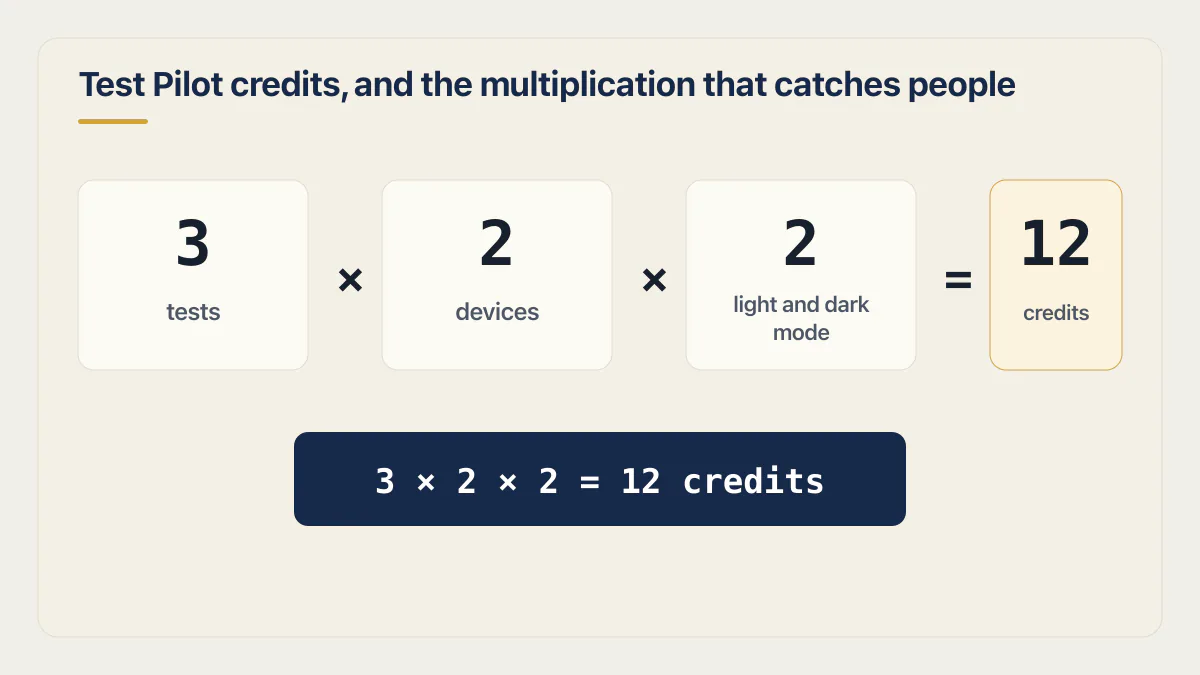
Two things the Test Pilot page does not say. As of 17 August 2026 it does not state whether unused credits roll over, only that each unit grants 100 credits “per reset cycle”, so there is no documented answer either way and this page does not supply one. And a pass assignment is permanent: the documentation says you cannot manually clear, update or transfer a pass while the assigned project still exists.
Lite credits: a unit FlutterFlow bills against and does not define
The pricing page’s comparison table carries a row labelled “Lite”, sitting between the AI Generation row and the Data and Integrations group. Its four values are 10 credits on Free, 100 credits/mo on Basic, 200 credits/mo per seat on Growth and 400 credits/mo per seat on Business. The Free plan card repeats it as “10 Lite credits”.
As of 17 August 2026, the term does not appear on FlutterFlow’s plan comparison page, its plans and pricing page, or its Test Pilot page. No FlutterFlow surface read for this article says what a Lite credit buys, what spends one, or what happens when they run out. The allowance is real, it scales per seat on two plans, and it is the one number on the pricing table a buyer cannot convert into anything. If FlutterFlow documents it later, that paragraph stops being true, which is the point of dating it.
What a second person costs, and the $15 way around a seat
A second person on FlutterFlow costs $55 a month on Growth or $85 a month on Business. A person who only needs one project can instead be added with a Single Project Collaborator Pass at $15 a month, up to 4 passes on Growth and up to 10 on Business. Prices checked 17 August 2026.
The seat arithmetic first, because it is what people budget wrong:
- Growth, two people: $80 + $55 = $135 a month, or $1,620 a year at list.
- Business, five people: $150 + (4 × $85) = $490 a month, or $5,880 a year at list.
Between those two sits an add-on that neither the pricing page headline nor most write-ups mention. FlutterFlow’s plans and pricing documentation says that on Growth or Business you may purchase Single Project Collaborator passes, which grant another paid user access to a single project without adding them to the full team, and that “Each pass is $15/month and can be reassigned to different collaborators or projects as needed.” The pricing page carries the same limits in a row called Single Project Collaborator Add-Ons, at “Up to 4 (purchasable)” on Growth and “Up to 10 (purchasable)” on Business.
Read the eligibility line before you plan a budget around it. The same documentation says “This collaborator must also be on a paid plan to be eligible to be a single project collaborator.” The $15 buys project access, not that person’s subscription.
The $15 collaborator pass buys access to one project, not a subscription. FlutterFlow’s documentation requires that collaborator to be on a paid plan of their own.
So the honest shape of it is this. A contractor who already pays for their own Basic plan and needs to touch one of your projects is $15 a month to you instead of $55 or $85. A person with no FlutterFlow plan of their own is not eligible, and a full seat is the only route. That distinction is the difference between a $135 month and a $95 one, and it turns on a sentence in a documentation FAQ rather than anything on the pricing page.
Above five people there is a third path. The same page describes an Agencies Expansion package available to verified FlutterFlow Expert Agencies, under which you “Continue to purchase additional seats beyond the 5 included in Business at $85/seat/month”. The same package also lets an agency keep inviting paid users to individual projects on collaborator passes without making them team members, so the two routes past five people stack. No ceiling on either count appears on that page, so how far above five seats an agency can go is not published. That page displays “Last updated on Oct 31, 2025”, an older stamp than the plan comparison table it sits beside, so both the $15 and the $85 figures were re-read there on 17 August 2026. Both still stand.
What the FlutterFlow price does not include
FlutterFlow’s plan price covers the editor, the seats and the meters. It does not cover your backend, the two app store developer fees, extra custom domains, or any paid API your app calls. Those are billed by other companies and none of them shrink when you upgrade FlutterFlow.
The backend is the big one. FlutterFlow connects to Firebase or Supabase and does not bill for either. Firebase publishes two plans, a “No-cost (Spark plan)” tier and a “Pay as you go (Blaze plan)” tier with no monthly base fee, so the Blaze bill is whatever your usage comes to. Supabase publishes its plans as starting from $0 a month on Free and from $25 a month on Pro, with compute charged per project on top. Both of those pages were read on 17 August 2026 and both move on their own schedule rather than FlutterFlow’s, so re-read them rather than trusting the date on the FlutterFlow prices above. Any single monthly backend figure you see attached to FlutterFlow was estimated by the page printing it, including a range, so budget for a variable line rather than a fixed one.
Then the two store fees, which are the same on every builder. Apple charges 99 USD per membership year for the Apple Developer Program, and Google charges a one-time US$25 registration fee for a Play Console developer account. Both checked 17 August 2026. Paying them is the easy part. What publishing a builder app to the App Store actually takes runs well past the money, into signing, store metadata and the review loop.
Smaller lines sit under those. Every paid plan includes “1 free, more purchasable” custom domains and Free includes none, so a second product on a second domain is a purchase. Payment providers, mapping, email, SMS and any model API your app calls bill you directly, and FlutterFlow’s plan price does not move when they do.
The last one is easy to forget because it looks like a feature rather than a cost. Code download starts on Basic, so the cheapest way to hold a copy of your own Flutter project is $39 a month for as long as you want to be able to take it.
What a year of FlutterFlow actually costs: three worked totals
A year of FlutterFlow at list price is $468 for one person on Basic, $1,620 for two people on Growth, and $5,880 for a five-person team on Business. Add $99 a year to Apple, $25 once to Google, and a backend bill FlutterFlow does not charge. Figures checked 17 August 2026.
The arithmetic below is AxonBuild’s, and it is the part of this page you can check line by line. Every FlutterFlow input comes off a FlutterFlow page, every store fee comes off Apple’s or Google’s own page, and the backend line is deliberately left as a vendor bill rather than a made-up range.
| Line | One person on Basic | Two people on Growth | Five-person team on Business |
|---|---|---|---|
| FlutterFlow plan, 12 months at monthly list | $468 (12 × $39) | $1,620 (12 × $135) | $5,880 (12 × $490) |
| Test Pilot, one pass unit for 12 months (optional) | $60 | $60 | $60 |
| Apple Developer Program, first year | $99 | $99 | $99 |
| Google Play registration, one time | $25 | $25 | $25 |
| Backend | billed by Firebase or Supabase | billed by Firebase or Supabase | billed by Firebase or Supabase |
| Year one, excluding backend | $652 | $1,804 | $6,064 |
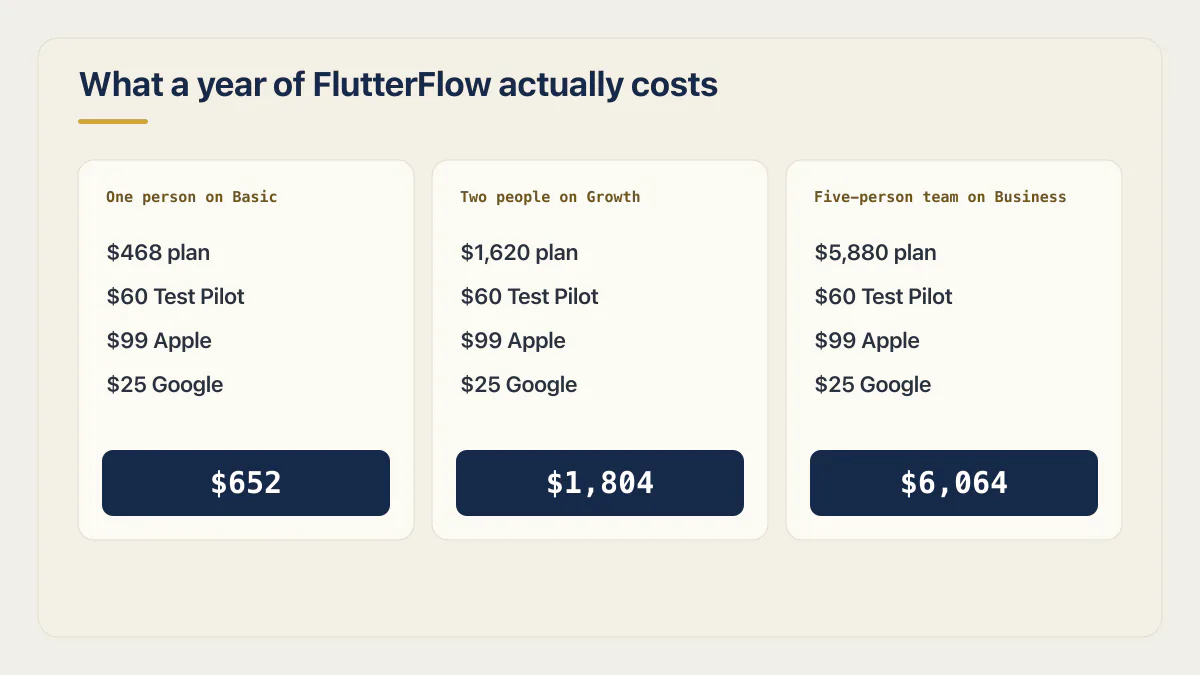
Four notes on how to read that table honestly.
The plan rows are monthly-billing list prices multiplied by twelve, which is the high reading, because paying annually cuts every plan row below the figure shown. FlutterFlow states that discount as a policy rather than a price, so no annual list total is printed here. The Test Pilot row is one pass unit at $5 a month, which is the smallest paid step, and it is optional. Teams running larger suites multiply it. Apple’s fee recurs every year and Google’s does not, so year two drops $25 from each column. And the backend row stays a range-free line on purpose, because a Supabase Pro organization and a busy Firebase Blaze project are different orders of magnitude and neither is a FlutterFlow charge.
The reason to run this arithmetic before you commit is that the year-two number is the one that decides things. A $5,880 plan line for five people is a salary conversation, not a software one, and it is the point at which the bill becomes a reason to move off a builder rather than a line item inside it.
Annual billing, regional prices and the Education plan
FlutterFlow’s annual discount is published as a policy of “typically around 25%” rather than as annual list prices. Regional pricing exists and INR rates are published in full. The Education tab on the pricing page carries no terms in what the page serves, so no education price is stated here. Checked 17 August 2026.
On annual billing, the plans and pricing documentation answers the question directly. It says FlutterFlow will continue offering “a meaningful discount on all new plans when billed annually instead of monthly”, quantifies that as “typically around 25%”, and adds that the discount “remains available regardless of your location or currency and reflects 12 months of service at a reduced monthly rate.” The pricing page’s own toggle reads “Annual Billing (Save ~25%)”. Neither surface prints an annual list price per plan for a logged-out reader, so the only defensible thing to say is that the discount is stated as approximate. Multiplying a monthly price by 0.75 and calling the answer FlutterFlow’s annual price would be inventing a number.
One exception is published. The Test Pilot page states that Test Pilot Credits Passes carry no regional discounts and an annual discount of approximately 25%.
Regional pricing is real and documented. The same plans and pricing page publishes INR rates: “₹1,300 INR per seat per month” for Basic, “₹2,650 INR for the first seat, and ₹1,850 INR for the second seat per month” for Growth, and “₹5,100 INR for the first seat, and ₹2,850 INR each for seats 2–5 per month” for Business, with Agencies Expansion seats at ₹2,850 INR a month. Those are list prices in their own currency rather than conversions of the dollar figures, and FlutterFlow says pricing for your region shows once you log in.
Education is where the trail stops. The pricing page carries an Education tab beside Individual/Teams and Enterprise, and as of 17 August 2026 the terms behind it are not in the content that page serves, so this article states no education price, discount or duration. Two FlutterFlow surfaces confirm educational accounts exist as a category without pricing them. The Test Pilot page says “Educational accounts get 5 free tests per project, and are able to purchase Test Pilot passes for further credits.” The plans and pricing page describes a Special Access status granted “through a community program, academic use, or other exception” and says holders keep their existing benefits outside the new plan structure. Students should read FlutterFlow’s Education tab or ask FlutterFlow directly, because a third-party page quoting a student price is quoting terms FlutterFlow does not publish on any surface checked here.
How FlutterFlow’s meter compares to the other app builders
FlutterFlow and Bolt Teams both price seats. The remaining rows use credits, token billing, or time-window allowances in at least one route. That difference decides which tool gets expensive for you: seat-priced plans grow with the team, while usage-priced plans grow with the work.
| Builder | What the subscription counts | Where a second bill starts |
|---|---|---|
| FlutterFlow | editor seats, priced per seat | three separate credit grants: AI generation, Lite, Test Pilot |
| Base44 | a plan allowance of message credits | integration credits your published app keeps spending |
| Bolt.new | Pro counts tokens; Teams charges per member and gives each member a token allotment | a higher token tier or another Teams member |
| Lovable | one credit balance for building, Cloud, and in-app AI | top-up credits after the balance and included grants run out |
| Rork | a monthly allowance of build credits | a larger credit plan or a wait for the monthly reset |
| Claude Code | plan usage windows or API tokens, depending on authentication | usage credits or API billing, depending on authentication |
Which of those to read next depends on who your bill counts. FlutterFlow and Bolt Teams charge by the person. Base44 splits message and integration credits. Lovable draws building, Cloud, and in-app AI from one workspace balance. Rork uses monthly build-credit allowances. Claude Code subscriptions use rolling session and weekly windows, while API and Console authentication bill token usage. Each vendor changes its own billing rules, which is why current first-party pages sit in the table above.
Where FlutterFlow lands in that field is specific. One person using the visual editor heavily pays a flat $39 for Basic, although AI generation keeps its published allowance. Five people each doing a little pay $490 a month between them. Bolt Teams also raises the bill with each additional member.
Which FlutterFlow plan do you actually need?
Three shapes cover most people. Learning costs $0, shipping one app you intend to own costs $39 a month, and a team that needs branches and review starts at $80 and climbs per seat. Nothing in the plan table makes one of those the right answer for the other two.
Someone learning the editor should stay on Free and accept that they are renting. Two projects, no export, no store deployment. Pick the two projects you keep editable carefully, because FlutterFlow says that selection is permanent.
Someone shipping one app they intend to own belongs on Basic, and $39 is a genuinely low floor for what it carries: code download, APK download, store deployment, unlimited projects and a custom domain. What it does not carry is a second person, a branch, or an automated test, so plan releases around a single editor working on main.
Once two or more people touch the project, the question turns into which of them needs a seat. Growth at $80 plus $55 is the entry point, and the $15 collaborator pass covers anyone who only needs one project and already pays for a plan of their own. Business at $150 plus $85 per seat is priced for three to five people and is where branching past two and the deeper backup window arrive.
Where the plan choice stops being a budget question is the release path. Branching, GitHub deployment and a saved test suite are the controls that decide whether a FlutterFlow app is production ready, and on Free and Basic those controls are a purchase rather than a setting. That is the one place where picking the cheaper plan changes what you are able to do rather than how fast you can do it.
Common questions about FlutterFlow pricing
Is FlutterFlow free or paid?
Both. FlutterFlow has a permanently free plan at $0 a month with 2 projects and 1 editor, and four paid tiers: Basic at $39 a month, Growth at $80 for the first seat and $55 for the second, Business at $150 for the first seat and $85 each for seats 2 to 5, and Enterprise at a custom price. Checked 17 August 2026.
The free plan is not a trial and does not expire. A separate 14-day trial applies to the first paid plan you buy, once.
Can I use FlutterFlow for free?
Yes, for building and for web publishing to a FlutterFlow subdomain. The Free plan gives 2 projects, 1 editor, 1 branch, Firebase and Supabase integration, 10 Lite credits and “5 requests/lifetime” of AI generation. It has no code download, no APK download, no one-click store deployment, no custom domain and no watermark removal.
That last group is why most people who take a project seriously end up on Basic. You can build a real app on Free. You cannot take it anywhere.
How much does FlutterFlow cost per year?
At monthly list prices, twelve months comes to $468 for Basic, $1,620 for a two-seat Growth team and $5,880 for a five-seat Business team. Add $99 a year for the Apple Developer Program and $25 once for Google Play if the app goes to a store, plus your own backend bill.
FlutterFlow states an annual discount of “typically around 25%” as a policy rather than publishing annual list prices for logged-out visitors, so the figures above are the monthly rate times twelve, not the annual rate.
Does FlutterFlow have a student or education discount?
FlutterFlow’s pricing page carries an Education tab, and as of 17 August 2026 the terms behind it are not in the content that page serves, so no student price, discount or duration is stated here. Its documentation confirms educational accounts exist without pricing them: the Test Pilot page says “Educational accounts get 5 free tests per project”, and the plans and pricing page describes a Special Access status covering “academic use”.
Ask FlutterFlow directly rather than trusting a third-party page. Student terms circulate widely in write-ups that cite no FlutterFlow surface at all.
Do I need a paid plan to download my FlutterFlow code?
Yes. Code Download and APK Download are both marked unavailable on the Free plan and available from Basic at $39 a month upward, on both the pricing page and the plan comparison documentation. Push to GitHub is a separate row and starts one tier higher, on Growth at $80 for the first seat.
If owning a copy of the Flutter source matters to you, that $39 is the real entry price of FlutterFlow, not $0.
What is a FlutterFlow Lite credit?
FlutterFlow does not publish an answer. The pricing page’s comparison table carries a row labelled “Lite” granting 10 credits on Free, 100 credits/mo on Basic, 200 credits/mo per seat on Growth and 400 credits/mo per seat on Business, and as of 17 August 2026 the term appears on none of the plan comparison, plans and pricing, or Test Pilot documentation pages.
That is a documented absence rather than a secret. The allowance is printed, scales per seat on two plans, and has no published definition of what spends it.
How much does a Test Pilot run cost?
A run costs one credit per single test, multiplied by devices and by brightness modes. FlutterFlow’s own example: “if a test run includes 3 tests, runs on 2 devices, and uses both light and dark mode, it uses 3 * 2 * 2 = 12 credits.” Each project gets 5 free credits, and a Test Pilot Credits Pass is “$5/month for 100 credits”.
A five-journey suite on two devices in light and dark is 20 credits a run, so one $5 pass unit covers five full passes in a cycle.
Does FlutterFlow have hidden costs?
Nothing is hidden, but four lines sit outside the plan price: the three credit meters, the seat price for each extra person, the app store developer fees of $99 a year to Apple and $25 once to Google, and your own Firebase or Supabase bill. FlutterFlow charges for none of the last two.
The one genuinely unclear line is the Lite credit row, which every plan grants and no FlutterFlow documentation page defines.
Can I cancel or downgrade a FlutterFlow plan?
You can cancel at any time and keep paid features until your next billing cycle date, and FlutterFlow’s refunds page states that “there are no refunds for cancellation”. Downgrading between paid tiers is not a one-click change: the documentation says to cancel the existing plan and sign up for the new one after it expires.
Upgrading works the other way and is prorated. FlutterFlow’s worked example has a Growth subscriber with 15 days left paying $110 rather than $150 to move to Business. If you hold several plans, each one has to be cancelled separately.
Built it with AI. Can’t get the last part right?
That’s the normal state of an AI-built app, and it’s fixable. I trace what the app actually does, explain what needs changing, and build it if you want me to.
Talk about your app →  Free 20-minute video call with Bilal.