MVP in software development stands for minimum viable product. That is the only sense of the three letters this page covers, not the most valuable player in sport, not the award Microsoft hands to community contributors, not Model-View-Presenter, the user interface pattern that shares the initials, and not the Minimum Viable Platform, which sat at position nine on the results page for this exact phrasing on 1 September 2026.
The term was invented to describe a starting position hardly anybody is in any more. It named the smallest thing a team could cause to exist so that real use would tell them something back, and causing it to exist was the expensive, slow part. That is not the situation of the person most likely to be reading this, who already has a working thing on a screen and is trying to work out what to call it.
A minimum viable product is a first release kept deliberately small, so that the people who use it settle whether the idea is worth continuing, and settle it early rather than late. The three letters carry that meaning and nothing more specific: no feature count, no quality bar, no method attached.
Six pages Google returns for these phrasings were opened on 1 September 2026, all of them against the raw markup rather than the rendered article, and every definition quoted below is taken from the page it sits on rather than from another page’s summary of it. What follows is what the letters stand for, who wrote them down first, where the published definitions contradict each other, and what the word is actually being used for now.
What does MVP stand for in software development?
MVP stands for minimum viable product. That is the full form in software, in software engineering, in product development and in every phrasing of the question that adds a field name to the end of it.
Minimum is the amount of product. Viable is the bar it has to clear to be worth releasing at all. Product is the part people forget: it has to be something a person can actually use, not a picture of one.
Viable is the word doing the work, and it is the one the short answers skip. A version can be minimal and useless, in which case releasing it teaches you nothing except that people do not like unfinished things. Viable means it clears the bar where somebody can get the point of the product and act on it. Where that bar sits is not fixed by the phrase, which is why two people can both use the term correctly about wildly different amounts of software.
It is also worth saying what the letters do not stand for, because the question gets asked in that form. There is no fixed number of features in an MVP, no maximum period it may take, no list of things it must include and no standard by which anyone certifies one. Rather than a stage in a named process that somebody owns, MVP is a description of intent: you released this early, deliberately, to find something out.
The three letters have a traceable history, and it does not run the way the top result says it does.
| Who | When | What they did |
|---|---|---|
| Frank Robinson | 2001 | Coined and defined the term |
| Steve Blank and Eric Ries | After Robinson | Popularised it |
| Eric Ries | In the article still circulating | Wrote the sentence everybody quotes |
That order comes from Wikipedia’s minimum viable product entry, read on 1 September 2026, which states that the term “was coined and defined in 2001 by Frank Robinson” and “then popularized by Steve Blank and Eric Ries”. The encyclopedia is quoted here for the record of who said what and when. It is not being treated as an authority on how to build anything, and the entry itself does not claim to be one.
Ries is the one whose wording travelled. His own account, published under his name at Lean Startup Co., a company whose business is training and coaching programmes, gives the definition like this:
the minimum viable product is that version of a new product which allows a team to collect the maximum amount of validated learning about customers with the least effort…
That sentence is in Eric Ries’s own article on what an MVP is, which states on the page itself: “This post originally appeared at Startup Lessons Learned, and was written by Eric Ries.” As of 1 September 2026 the page renders no date to a reader, and its own structured data gives 28 February 2024 with a modification on 1 April 2026.
Two things in his article get dropped in almost every retelling. The first is a warning: “MVP, despite the name, is not about creating minimal products.” The second is that he calls the definition “decidedly not formulaic” and says it “requires judgment to figure out, for any given context, what MVP makes sense”. The letters named a decision somebody has to make each time rather than a fixed amount of software.
Which brings up the first place the record has drifted. Atlassian holds the top organic slot for this phrase, and Atlassian’s minimum viable product page says, read against its raw markup on 1 September 2026: “Eric Ries, author of The Lean Startup, was first to introduce this product framework”. Wikipedia’s entry, read the same day, credits the coinage to Frank Robinson in 2001 and puts Ries among the people who popularised it afterwards. Those two sentences cannot both be right, and the one Google shows first is the one that skips Robinson.
What the published definitions actually say, and where they disagree
Six pages were opened and each one publishes a definition. Set side by side, they do not agree about the most basic question in the phrase: how finished the thing is.
| Source | The definition it publishes | Date, shown or in the markup | What it assumes |
|---|---|---|---|
| Wikipedia | ”just enough features to be usable by early customers” | Footer: last edited 16 Jul 2026 | Nothing about who builds it |
| Eric Ries, at Lean Startup Co. | ”the maximum amount of validated learning about customers with the least effort” | None shown; markup 28 Feb 2024, updated 1 Apr 2026 | A team is about to build it |
| Atlassian | ”the most basic version of a product that includes only the core features” | None shown; markup 13 Mar 2026 | You are about to start |
| GeeksforGeeks | ”the minimum features required to satisfy early adopters” | Shown: Last Updated 23 Jul, 2025 | No code exists yet |
| StoriesOnBoard | ”the least features necessary to satisfy early adopters” | None shown; markup 7 Nov 2025, updated 2 Dec 2025 | No code exists yet |
| ScienceSoft | ”a market-ready product with simplified functionality” | None shown; markup 23 Dec 2020, updated 29 Aug 2026 | You will hire someone to build it |
Read the second column downwards and the disagreement is plain. Four of the six describe something deliberately unfinished: the least, the minimum, just enough, the most basic. One of them, ScienceSoft, defines the same three letters as a market-ready product, which is close to the opposite claim, and ScienceSoft sells MVP development. And Ries, whose sentence the others are all downstream of, describes an amount of learning rather than an amount of software.
There is a second, quieter drift in the wording itself. Ries wrote “about customers with the least effort”. Atlassian reproduces that wording on its page. But the version circulating through seller guides swaps two words, and it reads “about users, with minimal effort” instead. Neither substitution is dramatic on its own. Together they turn a sentence about the people who pay you into a sentence about the people who log in, and a sentence about effort spent into a sentence about effort minimised, which is exactly the reading Ries wrote a caveat against.
Three of the six are cited here without a link, and the reason belongs in the open. geeksforgeeks.org/software-engineering/mvp-in-software-development-a-complete-overview/ is a general publisher whose page adds nothing the three linked sources do not already say. storiesonboard.com/blog/mvp-in-programming is published by a company selling user story mapping software, and the same page carries a free-trial invitation. scnsoft.com/software-development/mvp belongs to a company that sells MVP development, and sellers get named on this page and never linked. Their definitions count as evidence of what the field publishes. None of the three is a source to send a reader to.
The StoriesOnBoard page carries a date problem worth naming, because it is the sort of thing that makes a definition look older or newer than it is. The results page returns a date of 11 July 2024 for it. That string is a video upload timestamp sitting in the page markup. The article’s own structured data gives a published date of 7 November 2025 and a modified date of 2 December 2025, and no date at all is rendered to a person reading the page. All three of those numbers describe the same article.
What minimum viable meant when a first version took six months
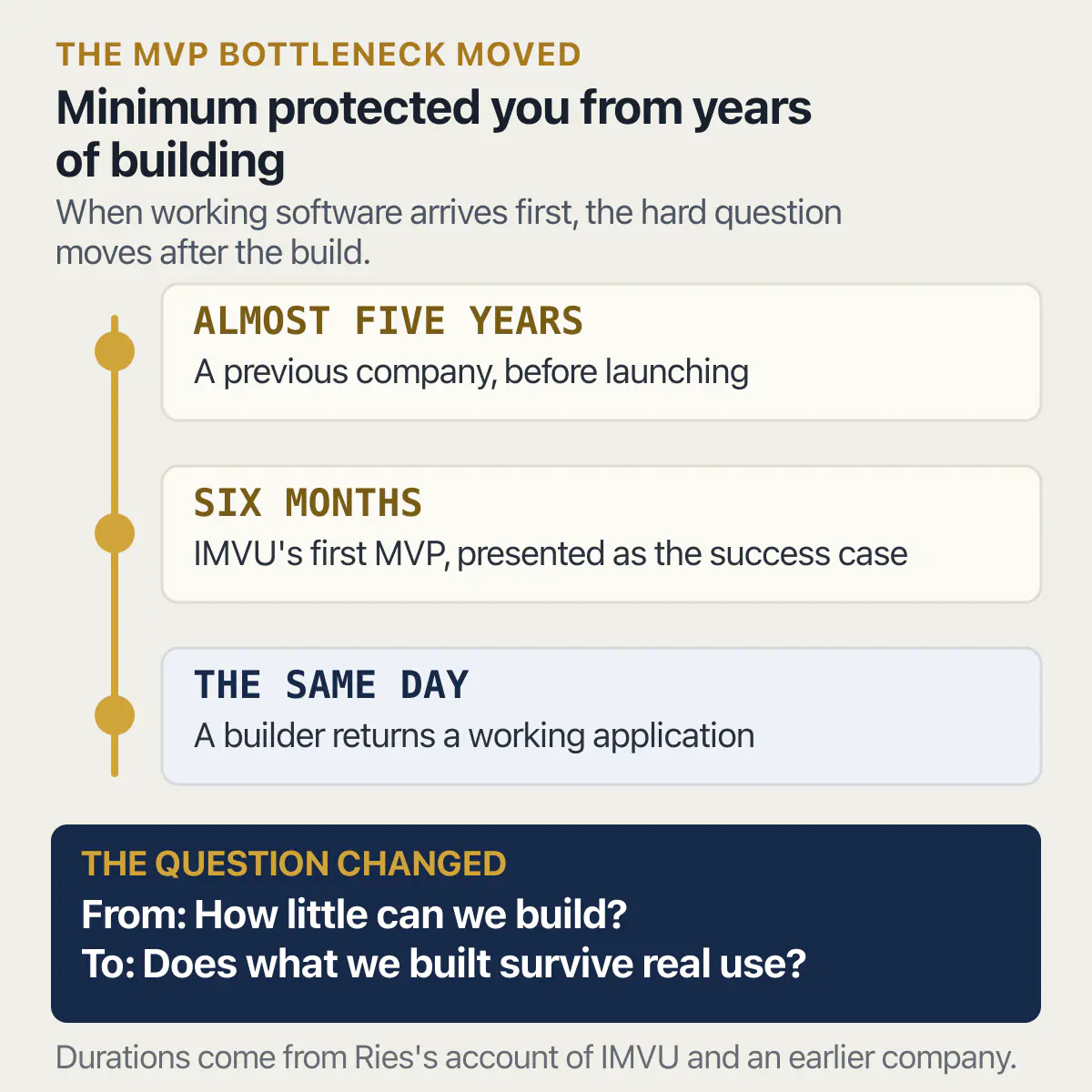
Here is the fact that none of the seller guides quoting Ries ever quotes, and it is in the same article as the definition they take. Writing about his own company, Ries says IMVU’s first minimum viable product “took us six months to bring to market”. He offers that as the success case. The comparison he draws it against is a previous company where, in his words, “we spent almost five years before launching”. The same passage records the case that went the other way, which the retellings drop too: “we spent two weeks building a particular feature that absolutely nobody wanted”, and of that he writes, “In retrospect, two weeks was way too long.”
Six months, presented as fast.
That is the world the definition was written for, and every assumption inside the word follows from it. If getting a usable version in front of anybody costs half a year, then the interesting question is genuinely how little you can build before you find out whether the idea is any good. Minimum is doing real work in that sentence. It is protecting you from spending years on something nobody wanted.
It also explains the one definition on the list that reads backwards. ScienceSoft, which sells MVP development, defines the term as a market-ready product with simplified functionality. That reading follows from where the seller stands. If you are the person being paid to produce a first version, market-ready is what you have to deliver for the word to describe something you can be hired to do. The seller’s definition and the originator’s definition are answering different questions: one is about what you get, the other is about what you learn.
Now read the six definitions again with that in mind. Every one of them is addressed to a person who has not built the thing yet. Atlassian’s page walks through identifying customer pain points and describing a competitive landscape before anything is made. GeeksforGeeks describes a technique by which a new product “is developed”. ScienceSoft’s guide is organised around sourcing the people who will do the building. The grammar gives it away: the reader is always about to cause the software to exist.
That is no longer the common case, and it is why the word now gets used for things the definition never described. Somebody types a description into a builder, gets a working application back the same day, puts it in front of people, and calls the result an MVP. Nothing in Ries’s sentence forbids that. But the sentence was written to justify restraint that was expensive to exercise, and restraint stops being the hard part when the building is nearly free.
One person writing in a small software community in 2026 used the word this way, and the tense is the part worth noticing:
I previously launched an MVP that attracted 10 paying users…
The MVP in that sentence is finished, launched, and in use by people who chose to pay for it. Under the definition as written it would still be a running experiment. In ordinary use it is a stage this person has already left behind, named in the past tense, on the way to describing something else.
So the word has kept its meaning and lost its difficulty. Minimum viable product still means the smallest release that will teach you something real. What changed is that producing one is no longer the achievement, which moves the whole question of whether a thing is finished somewhere else: away from how little was built and toward whether what was built survives contact with strangers. How long the thing people call a first version actually takes gets counted somewhere else, out of figures other publishers have put in print, and nothing here estimates it.
MVP in coding and programming: the product, not the pattern
Search MVP programming or MVP coding and there is a real chance you wanted Model-View-Presenter, which is a different thing entirely and shares only the initials.
Model-View-Presenter is a way of splitting user interface code into three parts so that each one can be changed and tested without dragging the others along. The Model holds the data and the rules that operate on it. Its View is the screen: buttons, lists, fields, and nothing that decides anything. The Presenter sits between them, takes what the View reports, asks the Model for what it needs, and tells the View what to display. The point of the arrangement is that the Presenter can be tested without a screen at all, because it never touches one directly. If that is what you came for, this page is not it, and the term to search is the full name rather than the initials.
Everything else here is about the product sense, and one dated observation is worth recording, because it is not what the field assumes. On 1 September 2026, a search for MVP programming returned no result about the presentation pattern anywhere in the organic results of a depth-ten pull. The top organic result was Wikipedia’s minimum viable product entry. The single result on that page dedicated to the phrase MVP in programming, published by StoriesOnBoard, defines the three letters as minimum viable product and never mentions the pattern at all. Neither, read the same day, does Wikipedia’s entry, whose only note about another meaning of the phrase points at a television episode.
The pattern still exists. What has happened is that search traffic for these phrasings has resolved, at least for now, onto the product meaning, and a page answering MVP in coding that spends half its length on the presentation pattern is answering a question hardly anybody is asking. Whether these three letters name a role that people actually hire for is a question about the job title rather than about the word.
There is one more collision inside software itself, and it is newer. The Minimum Viable Platform is a platform-engineering usage: the smallest internal platform a team can stand up and still have other teams get value from it. A video with that phrase in its title held position nine for this page’s own head phrase on 1 September 2026, which is a fair sign that the four letters are now doing four jobs in one industry.
What MVP means in startups, entrepreneurship and everywhere else
In startups and entrepreneurship the word means the same thing it means in software, with a different emphasis. An entrepreneur saying MVP is usually talking about evidence rather than engineering: the smallest thing they can put in front of a market to find out whether anyone will pay, and therefore whether the business is worth starting. Wikipedia describes the approach as analogous to experimentation in the scientific method, applied to validating business ideas, which is the entrepreneurship reading exactly.
That emphasis has a practical consequence. An entrepreneur’s MVP is allowed to contain almost no software at all, because the question being tested is whether people want the thing rather than whether it can be built. A sign-up page that describes a product nobody has written yet, a spreadsheet operated by hand behind a form, a service delivered manually while pretending to be automatic: all of those get called minimum viable products by people using the word in that sense, and none of them would satisfy any of the six software definitions above. That is the same word used by someone whose risk is demand rather than delivery.
In agile work, the word arrived from the same place and picked up a schedule. Teams working in sprints treat the minimum viable product as the first release worth putting in front of users, and the backlog behind it becomes the argument about what waits until after. The word keeps its meaning there and acquires a delivery rhythm and a set of ceremonies around deciding what goes in.
In business generally, and in a project plan specifically, MVP has drifted furthest from the software sense. It gets used for the first version of anything a company is trying: a service, a process, a pilot in one region. The useful part survives, which is the idea of a deliberately small first attempt whose purpose is to produce information. What gets lost is Ries’s caveat that the point is learning rather than smallness, which is how MVP ends up meaning “the cheap version” in a plan.
Then there is everything outside software, and this is where searches go wrong. Most Valuable Player is the oldest and largest sense of the three letters by far. Microsoft’s MVP award goes to community contributors and has nothing to do with products. Gaming ranks use the letters too, which is why a question about how expensive MVP++ is turns up in the same harvest of questions as a question about what MVP stands for in programming. When these letters come back with an answer that seems to be about something else, this is usually why.
If you have arrived at the word MVP because an AI builder or a tutorial used it without explaining it, the same thing tends to happen with several other words in the same week. What the word deploy means is the other one people meet without a definition and have to work out from context.
What an MVP is not
The confusion is rarely about the definition. Four neighbouring words get used as though they meant the same thing.
A demo is a controlled performance: one person, clicking in a known order, avoiding the parts that do not work. It is built to be watched. An MVP is built to be used by somebody who has no idea which order you had in mind.
A proof of concept settles one narrow technical question for an audience of engineers, and nobody minds if it goes in the bin afterwards. An MVP answers a question about demand, and it has to survive being handed over.
A prototype represents the product. It can be clickable, convincing and entirely hollow underneath. The line is whether the thing does the job for real when a stranger uses it, and that line is harder to see than it used to be, because a builder now produces something that clears it by accident. Proof of concept and prototype are the two labels people reach for just before this one, and telling them apart is a page of its own.
A second three-letter label gets set beside this one for the release you can actually charge money for, and the two are compared on their own page. A warmer version of the phrase swaps the middle word as well, and whether that swap changes anything gets argued separately.
Wikipedia’s entry records the standing criticism of the approach, and it is worth reading before adopting the word as a plan. It notes that an early release “may hurt a company more than help” where a competitor can copy the idea and no other barrier exists, that negative feedback on an MVP “can negatively affect a company’s reputation”, and that products which do not meet an expected minimum standard of quality “are inferior to competitors that enter the market with a higher standard”. That last one is the sharpest in 2026, when the competitor entering the market with a higher standard may well have been generated the same week you generated yours.
What to actually do next, once you have decided the version on your screen is the one, is a plan rather than a meaning. Who does this work, what it involves, and what happens after the first version exists all belong to the wider subject of MVP development, which has a page above this one.
Common questions about what MVP means
What is an MVP in simple words?
The smallest working version of something you can put in front of real people, released on purpose before it is finished, so that what they do with it tells you whether to keep going. That is the whole idea. Everything else attached to the term is argument about how small is small enough.
Is MVP an acronym, and what does it stand for?
It is an initialism, spoken letter by letter rather than as a word, and it stands for minimum viable product. The full form is the same in software development, in software engineering, in product development and in startups. Only the emphasis moves between those settings.
Who came up with the term MVP?
Frank Robinson, in 2001, according to Wikipedia’s entry read on 1 September 2026, which states that he coined and defined it and that Steve Blank and Eric Ries popularised it afterwards. Ries is the one most people name, because his wording is the one that spread, and at least one major vendor page still credits him with introducing the idea rather than popularising it.
What is an MVP with an example?
A booking tool released with one venue, one payment method and no admin screen, put in front of twenty people to find out whether anybody books anything, is an MVP. What makes it an MVP is that releasing it in that state answers a question you could not answer any other way, and the feature count has nothing to do with it.
What does MVP mean in agile?
The same thing it means anywhere else in software: the first release small enough to be worth putting in front of users, and complete enough that using it produces real information. Agile teams give it a rhythm rather than a new meaning, planning it into sprints and treating everything cut from it as a decision to revisit rather than a decision to forget.
What does MVP mean in business rather than software?
In business and in project plans it means the first deliberately small attempt at anything: a service, a process, a pilot in one location. The purpose is still to produce information before committing. In practice the word often decays into “the cheap version”, which is precisely the reading Eric Ries warned against when he wrote that the term “is not about creating minimal products”.
What is considered an MVP once a builder has already made one?
The word still applies, but it stops describing an achievement. When producing a working version takes an afternoon, the interesting question moves from how little you built to whether what came out survives real use: whether the numbers stay right when two customers act in the same second, whether a failed payment leaves a mess, whether one account can open what belongs to another.
Is an MVP the same as a prototype?
No. A prototype represents the product and is allowed to be hollow underneath. An MVP is the product, in its smallest honest form, doing the job for people who are not being supervised. The distinction used to be obvious because prototypes looked like prototypes, and it is less obvious now that generated first versions arrive looking finished.
Telling a prototype from a proof of concept from a first version is a comparison with a page to itself.
What else can MVP stand for?
Most Valuable Player is the biggest sense outside software. Microsoft’s MVP award is a recognition for community contributors. Model-View-Presenter is a user interface pattern. Minimum Viable Platform is a newer platform-engineering usage. Gaming ranks use the letters as well. Inside software specifically, the product and the pattern are the two that collide most often.
If you have a working app built with these tools and need it ready for real customers, this is what we do.
Built it with AI. Now it has to hold up for real customers.
The Production Hardening Sprint takes the app you already have and builds the production foundation underneath it. Authentication and access rules, payments that stay consistent, error handling, monitoring, backups, automated tests and a documented handover. Our engineers work inside your existing codebase for ten working days. All 123 deliverables are included, and you get the evidence for each one.
See the Production Hardening Sprint →  $2,500 fixed price · 10 working days · One codebase