On this page, lovable is an adjective. Everywhere else on this site it is the name of an AI app builder, and the two senses turn up in the same sentences often enough that the separation is worth making in the first line: a minimum lovable product is a term from product management, and has nothing to do with the tool that wrote your code.
The reader this is written for already has a working first version, usually one an AI builder produced from a prompt, and has since been told that what they should have aimed for was a minimum lovable product instead. Every page ranking for the term is written for the other person, the one still deciding what to build.
A minimum lovable product is a first version built to be liked. An MVP is a first version built to find out whether the idea works at all. The MLP label was coined in 2013, when a polished product was expensive to make, and the MVP label is older still. If a builder wrote your first version, choosing between the labels settles nothing.
What a minimum lovable product is, and who named it
The MLP, or minimum lovable product, has one origin and it is not disputed. Aha!, the roadmapping software company, publishes its minimum lovable product guide and states in it that its co-founder and CEO Brian de Haaff first introduced the concept in 2013, then expanded on it in his 2017 book Lovability. The guide, stamped “Last updated: September 2024” as read on 1 September 2026, defines an MLP as “an initial offering you build with the intent of delighting customers from the start”, and says it “goes beyond what is required to make a product functional”.
For contrast the same guide gives the plain version of the older term. Aha! treats an MVP as a functional floor: the smallest release that is still usable, and still viable in the market. It also states the relationship between the two openly, calling the MLP a concept that “builds on the concept of the Minimum Viable Product, while simultaneously rebutting it”. That is the whole definitional story, and it is a short one. Readers who want the base term on its own, with no second label beside it, are better served by the page that only defines it.
The rebuttal is the interesting part, because it tells you what the MLP was arguing against. Aha!‘s guide describes the MVP approach as being “more about getting to market quickly and cheaply before other alternate solutions emerge”, with a hazy problem and a plan to increment later. The MLP was proposed as the corrective: do the thinking about the customer first, and ship something people are glad to use rather than something they will tolerate while you learn.
MVP vs MLP: what is each label asking you to pay for?
An MVP asks you to pay for evidence: build the least you can and find out if anyone wants it. An MLP asks you to pay for the feeling: interface, wording, the moments that make somebody stay. The second idea was proposed in 2013 as a rebuttal of the first, and they have been paired ever since.
Put the three labels on this page side by side and the useful column is the last one, because it is the one that has aged. SLC is the third, and it gets its own section below.
| Label | The question it asks | What it assumed you would pay for |
|---|---|---|
| MVP | Does anybody want this at all? | The smallest build that answers that question |
| MLP | Will anybody choose this over the next tab? | Interface, wording, the parts that make it pleasant |
| SLC | Is this small thing finished enough to use? | Doing one job properly instead of half of three |
Every one of those third-column answers is a statement about where the work went in the year the label was invented. In 2013, the interface was the expensive column. Choosing MLP over MVP meant agreeing to spend real time on the part of the product a customer sees, instead of shipping something rough and promising to come back to it.
Anyone typing MLP vs MVP, or just MVP MLP, into a search box lands on the same handful of pages, and they all treat the choice as a decision you make before you build.
Whether what you have has moved past a first version into something ready to sell is a different comparison with a different answer. The two words people reach for before this stage, the rough build and the thing that only had to run once, get mixed up on their own terms. This page stays on the labels for a first version, and stops there.
MVP vs SLC, and why complete has aged better than lovable
The third label in that table came from a different direction. In 2017 Jason Cohen published his SLC essay, under the title “Your customers hate MVPs. Make a SLC instead.” Its structured data carries a publication date of 22 August 2017 and a modified date of 7 May 2025, so it is a nine-year-old argument that somebody is still maintaining.
SLC stands for simple, lovable and complete, and Cohen’s objection to the MVP is blunter than Aha!‘s. “MVPs are too M and rarely V”, he writes. “Customers see that, and hate it.” He also names the mechanism most teams would reach for to make a product lovable, and this is the sentence that matters most for anybody holding a generated app: “The current-in-vogue way is through design: Elegant UX combined with delightful UI.”
Of the three words, complete is the one that reads differently in 2026. Simple and lovable both describe how a product presents itself, and a builder now presents things well by default. Complete describes whether the thing actually finishes the job it started, including the times it cannot. Cohen’s own line for it is that “products are supposed to accomplish a job”, and he sets the bar in one sentence: “Customers want to use a v1 of something simple, not v0.1 of something broken.” That test survives the arrival of free polish. The other two mostly do not.
One thing to be clear about: SLC and MLP are separate coinages by separate people with separate arguments, not two names for one idea. They overlap on the word lovable and diverge everywhere else, and Cohen’s version carries a completeness requirement that the MLP literature does not.
What changed when the polished part started arriving first
Two publishers wrote the same observation down in early 2026, and this page is not the first to make it, so they get credited before anything gets added to it.
ProductLed, a training publisher, put out its guide to building a minimum lovable product on 16 February 2026, written by Wes Bush. Read against the page source on 1 September 2026, it states: “AI collapsed the cost of building. No-code widened access.” It states “Working software is table stakes” in both its summary and its body, and frames the shift as one of purpose, in two consecutive lines: “Minimum Viable Products optimize for proof”, then “Minimum Lovable Products optimize for preference”.
Eleven days later, Elena Verna published The Minimum Lovable Product Era, dated 27 February 2026 on the page itself, which says that “dev costs are collapsing” and that software functionality is becoming a commodity. As of 1 September 2026, that post reads only as far as its opening section to a plain automated fetch before a subscription gate closes it, so the four words above are the only run quoted here and the rest is described rather than reproduced.
Both of them stop at the same point. Working software is table stakes, therefore aim for lovable instead. The advice has a gap in it, and the gap is specific enough to name.
The polished part is the part the builder produces. Prompt for an app and what comes back first is the interface: consistent spacing, a navigation bar that works, empty states that render, copy that reads like a product. Cohen’s “elegant UX combined with delightful UI” is now the cheapest thing in the build, and it arrives before anything else. Telling somebody in that position to invest in lovability is telling them to spend where they already got the work for nothing.
The publishers ranking for the comparison do not help either. On 1 September 2026, three of the eight results returned for MVP vs MLP carried three or four acronyms in the titles the search itself returned, from reenbit, upsilonit and impalaintech, with softteco, liveplan and userpilot on the two-acronym version. Those titles are named here from the search results rather than from the pages, and none of the publishers is linked, because most of them sell the work their guides describe. Stacking acronyms is what a service page needs in order to rank for a whole family of terms, and that is a very different job from what a person holding a working app came for.
The part of lovable that a builder does not produce
The example below is one application rather than a count, because a count would not show you the mechanism.
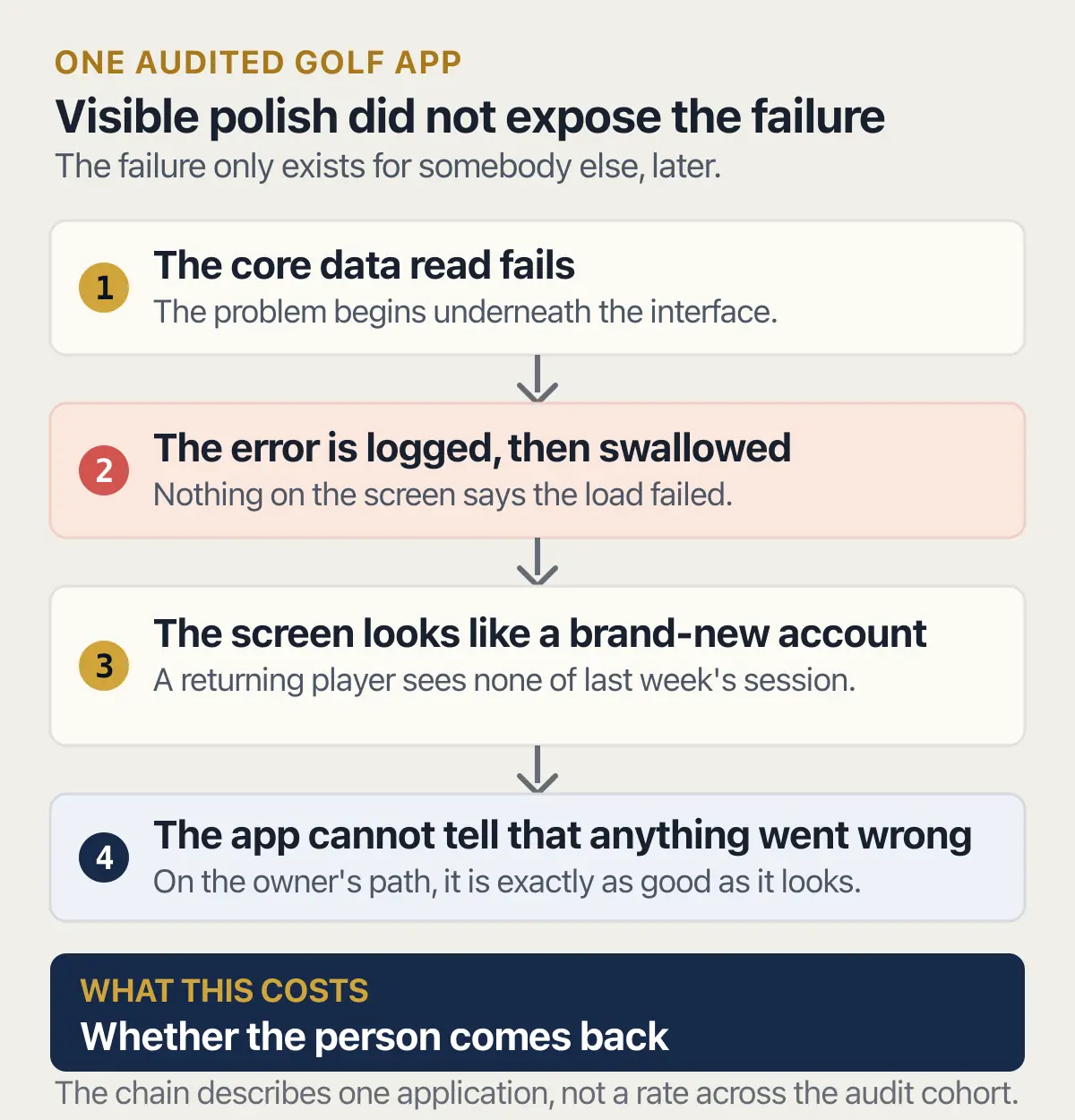
One of the 21 third-party applications in AxonBuild’s fixed set of 26, audited in June and July 2026, was a golf app. A player uploads the shots from a practice session and the app charts how far each club went. The fixed set of 26 audited applications is the same cohort every statistic on this site comes from, and this application was one of the better-behaved ones in it, with no confirmed critical finding anywhere.
Its core data reads logged their errors and then swallowed them. When a load failed, nothing on the screen said so. The page rendered exactly the way it renders for somebody who has just signed up and uploaded nothing, so a player coming back to look at last week’s session saw an account with nothing in it, and the application itself had no idea anything had gone wrong. There was no error boundary above the interface either, so a single thrown render blanked the screen instead of that one panel.
Nothing about that is visible in the version the owner shipped. On the path the owner walks, with their own data, on their own machine, the app is exactly as good as it looks. The failure only exists for somebody else, later, on a worse connection, and what it costs is the thing the MLP literature is actually about: whether the person comes back.
That is the shape of the gap. Everything the delight advice tells you to invest in is the part the prompt already delivered. The part that decides whether a person opens the app a second time is the part no prompt asks for, because nobody writes “and tell me when the data fails to load” into a request for a golf tracker.
Minimum lovable product vs MVP: which should you aim for now?
Neither label is the thing to aim for. The label you pick describes the product after the fact, and the people using it decide which one it was. With a generated first version the useful next move is checking the parts a prompt never asked about, starting with what your app does when a read fails.
Somebody in an assistant community put the whole argument into two sentences without meaning to:
I made an ai guest concierge for my wedding in May… The most consistent bit of feedback I got was that everyone really hated the pink UI.
Nobody wireframed that. A version got generated, it ran, real people used it, and the feedback that came back was about how it felt rather than whether it worked. That is lovability measured the only way it can be measured, which is afterwards, by the people using the thing. No acronym chosen up front would have produced it.
So the honest answer to which label to aim for is that the choice is not available to you any more, and that is fine, because the checks underneath it still are. Four things you can look at this week, on the app already open in the other tab:
- Open the screen that shows your data with the network turned off, and see whether it looks any different from a brand new account.
- Sign in as an account you have never used, and read what the empty states actually say.
- Watch somebody who has never opened the app try it once, without telling them where to click.
- Ask the two or three people who have already used it what they remember about it, rather than what they think of it.
The first two are about completeness, in Cohen’s sense: whether the product finishes the job or only appears to. The last two are about lovability, in Aha!‘s. None of the four asks you to read code, and none depends on which acronym you decided you were building.
If those checks come back badly, the question stops being a vocabulary question. Whether the app holds up under other people is a separate matter with what production ready actually means as its own subject, and it is the half of this that has evidence attached to it.
How a first version gets built in the first place, and who ends up owning each piece of that work, is a wider question than the one this page answers. Paying somebody to close the gap between what you have and what you meant is a purchase with its own shape, and naming the ending you want is the part that decides it.
Where these three labels come from and how they were checked
The three labels on this page were taken from the pages that first published them and from the results ranking for them on 1 September 2026, each read in the page source; what a generated first version does under real use comes from AxonBuild’s own audit set, not from anything built for this article.
One thing this page could not settle: a fourth acronym, MAP, turns up in the same search family, and no source read on 1 September 2026 gave it a settled expansion. Rather than invent one, this page leaves it alone.
Common questions about the minimum lovable product
What is a minimum lovable product?
A minimum lovable product, or MLP, is a first version built to delight the people who use it rather than only to prove the idea works. Aha! defines it as “an initial offering you build with the intent of delighting customers from the start”, and credits its co-founder and CEO Brian de Haaff with introducing the term in 2013.
What is the difference between an MVP and an MLP?
An MVP is built to answer a question: does anybody want this. An MLP is built to answer a different one: will anybody prefer this. The MVP accepts a rough product as the price of a fast answer, and the MLP argues that a rough product costs you the customer you were trying to learn from.
Is an MLP the same thing as an SLC?
No. They are separate coinages with separate arguments that happen to share one word. The MLP came from Aha! in 2013 and is about delight. SLC came from Jason Cohen in 2017, stands for simple, lovable and complete, and adds a completeness requirement the MLP literature does not have.
Does lovable mean more features?
Fewer, if anything, and both original sources say so directly. Aha! keeps the word minimum in the term on purpose and describes lovability as something that grows over time. Cohen’s argument is that products doing less but loved beat products with more features that are disliked, and his examples are the early versions of WhatsApp, Twitter and Slack.
Is the AI app builder called Lovable related to a minimum lovable product?
No. Lovable is the name of an AI app builder that generates web applications from prompts, and the minimum lovable product is a product-management term coined in 2013, years before that tool existed. The overlap is the word, and nothing else. An app built with any builder can be an MLP or fail to be one.
If a builder generated the interface, is what I have already lovable?
Not established either way, because the generated interface only proves the product looks considered on the path you walked. Lovability shows up in the parts a prompt does not cover: what the app does when something fails, what a returning user sees, and whether anything explains itself without you standing next to it.
Which should I aim for with a first version I already have?
Neither, as a target. The label is applied after the fact by the people using the product, so with a working version in hand the useful move is checking the moments a generated build tends to skip. Failures that show nothing, empty states that lie, and first sessions nobody has ever watched are the three worth starting with.
How do I find out whether people actually like it?
By watching somebody use it who has no stake in it. Self-testing tells you the app works on the path you already know, which is the one path a generated build is most likely to handle. What you want is the opening moments of somebody else’s session, and the specific point at which they hesitate.
The organised version of that is putting it in front of people who did not build it as a deliberate round rather than an occasional favour.
If this checklist left you with more open items than you expected, the sprint below works through all of them in ten working days.
Built it with AI. Now it has to hold up for real customers.
The Production Hardening Sprint takes the app you already have and builds the production foundation underneath it. Authentication and access rules, payments that stay consistent, error handling, monitoring, backups, automated tests and a documented handover. Our engineers work inside your existing codebase for ten working days. All 123 deliverables are included, and you get the evidence for each one.
See the Production Hardening Sprint →  $2,500 fixed price · 10 working days · One codebase