You raised, or people are already paying, and the next thing on the list is finding somebody to take the software the rest of the way. The phrase the market hands back is MVP development for startups, and what it returns is almost entirely firms selling that work plus their own guides to it.
Seven of those pages were read for this census on 1 September 2026, and six of them publish a sequence you can count end to end. The one question put to each was where that sequence stops. Not one of them ends at a working product with customers already inside it. One ends at full-scale product development, as the eleventh stage of eleven. One ends in a continuing arrangement with the same team that built the product, billed over years. One sells version two, version three, infrastructure growth and continuing upkeep once the launch step is behind you. The buyer every one of them addresses is described by the round being raised rather than by what already runs, and every horizon starts before there is any software to start from.
The startup qualifier buys a longer arrangement rather than a different first version, sold to a buyer described by funding stage instead of by what already exists. Every readable sequence on this search starts before your product does, which is why none of them ends where you are standing.
What the startup phrasing actually returns
Two pulls on 1 September 2026, one for the plain phrase and one for the services variant, returned nine organic results each. Every result on both is a firm selling this work, a firm’s own guide to it, or one of three exceptions: an encyclopedia entry for the term, a forum thread from two years ago asking what an MVP even is, and a guide published by a tool vendor. There is no buyer account, no comparison written by somebody who paid for this, and nothing whose starting point is a product that already runs.
Every statement below about a seller comes from reading that seller’s own page on 1 September 2026 with a single question in hand: where does the sequence it publishes stop. Reading those pages is the whole method. No seller heard from anybody here, nothing was bought from one, and no running app went under a reader’s eye to produce any of this.
Nothing here links to any of them, and the reason is worth stating plainly: each one is trying to sell the reader the same work. The addresses are printed instead, unlinked, for anyone who wants to go and look. Vention at ventionteams.com/services/startup/mvp, dev.family at dev.family/services/mvp-development, OpenSource Technologies at ost.agency/services/startup-and-mvp-services/, SDSol at sdsol.com/mvp-development-services/, Blackthorn Vision at blackthorn-vision.com/mvp-development-services/, Rishabh Software’s guide at rishabhsoft.com/blog/mvp-development-for-startups, and Desino’s guide at desino.be/en/blog/mvp-app-development-for-startups/.
Two things on the search were deliberately left closed. One is a ranked list of best MVP development companies, published by a firm that competes in the market it is ordering, which is not evidence about anything and is neither opened nor quoted here. The other is Vention’s cost question, which its page answers by pointing at a calculator that asks for your details before it answers. That the page routes the question rather than printing an answer is itself a fact about the page, and it is the only part of it recorded here.
One name on the search could not be read at all. Freshcodeit, at freshcodeit.com/services/mvp-development-for-startups, is the only address that turns up both here and on the unqualified version of this phrase, and two attempts on 1 September 2026, one plain and one carrying a browser’s own identification, both came back refused. It is left out of the count below rather than guessed at.
Two other things about the result set are worth recording before the count, because they change how much weight any of this deserves. The first is that the search has no incumbent. Difficulty on the primary phrase sits at 14 and the strongest variant at 25, and page one is a scatter of firms and their own guides rather than anybody who owns the question. The second is that the startup qualifier genuinely changes the results. Of the six firms censused on the unqualified phrase by the page that covers buying this work as a service, two turn up across the two pulls read here, and one of those two only on the services variant. Two phrasings, two largely different sets of sellers.
Where each MVP development services for startups sequence stops
Six firms publish a sequence you can read end to end. Here is the last stage each one names, in its own words where it has a name for it, and what the page says it sells once the launch step is behind you.
| Seller | Where its published sequence ends | What it sells after the launch step |
|---|---|---|
| Vention | ”Launch & feedback”, fifth of five | A separate service for moving older software to a newer stack |
| dev.family | ”Test, improve and scale”, fifth of five | Growth, folded into that last step |
| OpenSource Technologies | ”Operate and evolve”, fourth of four | A continuing arrangement with the team that built it, billed over years |
| SDSol | ”Launch & Feedback”, fourth of four | Version two and beyond, infrastructure growth, continuing upkeep |
| Blackthorn Vision | ”Full-scale product development”, eleventh of eleven | Three further stages after the launch stage |
| Rishabh Software | ”Testing and Validating your MVP”, fourth of four | Nothing named; the rest of the guide is advice |
Read the third column down and the pattern is hard to miss. These sequences do not end at launch. They pass through it.
Blackthorn Vision publishes eleven stages, and the launch one is the eighth. Three more follow it, ending at full-scale product development, which is the whole product rather than the smallest useful version of it. SDSol names four phases and then publishes a separate list of what happens afterwards, including “Development of v2, v3, and beyond” and “Ongoing maintenance and enhancements”. OpenSource Technologies names four phases and describes the last, “Operate and evolve”, as an arrangement running for years with the same team that built the product, with monthly check-ins and quarterly business reviews. Vention’s five steps end at launch, and its answer to what comes next is a different service on the same site, for taking older software onto a newer stack. Rishabh Software’s guide stops one step earlier than everybody else, at testing and validating, and never names anything after it.
So the horizons vary, and they vary in a direction that has nothing to do with you. Some sellers stop at launch, some run past it for years, and the ones that run furthest are the ones selling the longest arrangement. What none of the six horizons contains is a starting point. Every sequence begins at a product that has not been made, which means every one of them is priced, staged and timed for somebody at the front of that line.
That is the whole finding, and it survives the obvious objection. You could say a seller who runs to year three is offering you more, and in a sense that is true. The trouble is that the extra is all on the far end. Nothing in any of these six sequences is a stage you can enter at, and nothing in them is shorter because you arrived with software already running.
There is a second reading of the same table that is worth having, because it explains why the sellers are shaped this way rather than badly intentioned. A published sequence is a pricing instrument as much as a plan. It lets a firm quote before anyone has looked at anything, by naming the whole walk instead of the specific work, and it lets the firm keep the buyer for the length of the walk. Both of those are reasonable when the walk is genuinely the product. They stop working the moment a buyer turns up holding most of the walk already, because there is now no honest way to subtract the part that is done. Two of these six pages solve that by extending forward instead: the arrangement simply continues past launch, for years, with the same team. That is a coherent business and it is also the clearest evidence in the table that the seller’s unit is time rather than result.
Three more things follow from the column, and none of them is a criticism. The sequences that stop at launch are the shortest arrangement on offer here, which makes them the closest fit for a buyer with a plan and a deadline. The sequences that carry on past launch are selling continuity, which is worth real money to a company that will keep changing the product for years. And the one guide that stops at testing is a guide rather than a service page, which is a good reminder that a published sequence tells you what a firm sells, not what the work is.
Counting what is actually inside one of those bundles, one item at a time, is separate work, and the page about buying this as a service does it. How this work is actually done, in order, is a different question from what a seller has bundled it into. And which of two firms to pick, once you know where each one’s sequence stops, is its own decision.
What startup MVP development actually means on this search
The word startup is doing one specific job on these pages, and the job is narrower than it sounds. On every page read for this census it stands for a funding stage, and for a funding stage that comes before there is a product. Company size, working style and kind of product all turn out to be irrelevant to how these pages use it. dev.family says so outright. Its own stated goal for a client, printed at the top of its MVP page and read on 1 September 2026, is to “Grow your idea into investable MVP software and go from pre-seed to first company in 12 weeks.” Read that sentence for what it assumes. The starting point is an idea. The finishing point is a round. The product is the thing that moves you between them, and twelve weeks is how long the movement takes.
OpenSource Technologies publishes the same shape as a number rather than a promise. In the summary strip at the top of its startup and MVP services page, as that page stood on 1 September 2026, it prints a typical MVP timeline of 8-16 weeks. Rishabh Software’s guide, dated 24 February 2026 on the page, turns the same idea into a rule and calls it an “8-Week Hard Cap”, telling the reader to “Set Week 8 as a fixed ship date”. Three publishers, three different lengths, and all three measuring from nothing to a first shipment.
None of that is dishonest and none of it is useless. It is simply aimed. A firm whose page opens on pre-seed is describing a buyer whose evidence problem is still open, whose product is a plan, and whose next event is a raise. If that is you, the pages ranking on this search are for you and they are reasonably clear about what they do.
The buyers who write in about this work often describe something narrower than a stage. One founder advertised for one person, or at most a couple of them, to sit alongside them while the first working version got made. That is a request with a shape and a size in it, and not one of the six sequences has a line that answers it, because a sequence is not sized, it is entered.
What changes once you already raised or already have users
Everything, and in a direction the sequences cannot follow.
A pre-product buyer has one open question: is there something here worth building. Every early stage on every one of these pages exists to answer it. Market work, personas, a clickable version, a validation step. If you have already raised, or people are already paying you, that question is largely answered, by evidence stronger than anything a stage produces: funding shows investors believed it, and paying customers show it more directly. What stays open is which of your assumptions those customers have not yet tested.
What replaces it is a list. Not a category, not a phase, a list of specific things that have to be true before the product can carry what is about to arrive. Here is somebody standing exactly there, describing what is in front of them:
after a ridiculous amount of building, breaking things and rebuilding them, we’re onboarding our first venue tonight. I also got through Oracle PartnerNetwork approval, have the Simphony review pending and I’m working through the OHIP integration now.
Read what that person’s remaining work is made of. Every item on it is an outside commitment that only exists because the thing is real. An approval from a partner programme. A review pending with a vendor. An integration in progress with a system somebody else runs. None of those items could have been written down before the product existed, and none of them is a stage in anybody’s published sequence.
A pre-product sequence answers a question you already answered, in an order you already walked, at a price set by how long the whole walk takes.
The other buyers in the corpus describe the same inversion in fewer words. One founder’s whole request for paid help was that the early build already existed and what they needed now was somebody to take it up to the load it was about to meet. Another owner already had backers behind a first version that a builder had produced, and the next thing on their list was paying somebody to sort out how the thing actually ran.
Both of those name an ending somebody can be held to. Neither is a phase.
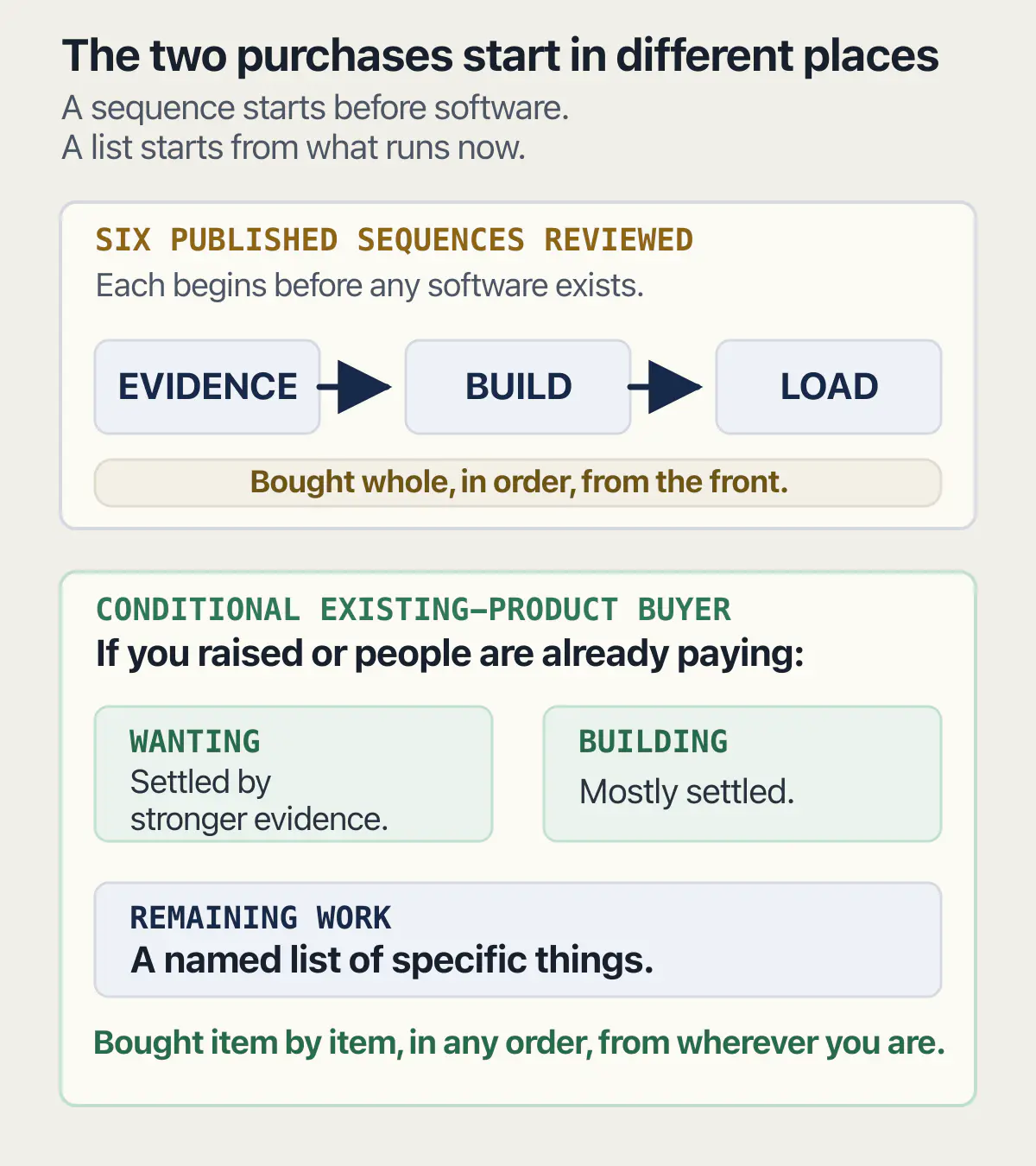
Notice what has quietly happened to the ordering. A seller’s sequence puts evidence first and load last: find out whether anybody wants it, then build it, then worry about what happens when they arrive. A founder who already raised or already has customers walks that in reverse. The wanting is settled as far as the evidence goes. The building is mostly settled. What is unsettled is the last item on somebody else’s list, and it arrived first. Every one of the six sequences censused above would have to be read from the bottom up to be useful to that person, and none of them is sold that way.
That inversion also explains a frustration that is easy to mistake for a pricing problem. The real trouble is where the bundle’s cheapest entry point sits. It sits at a stage you already finished at your own cost, so the first thing you would be buying back is a repeat, and a firm cannot easily discount that away, because the sequence is how it produces everything downstream of it.
And that is the mismatch worth naming plainly: the sellers on this search are organised around a sequence, and a buyer past the first version is organised around a list. A sequence is bought whole, in order, from the front. A list is bought item by item, in any order, from wherever you are. The vocabulary on this search has no word for the second thing, which is why the qualifier keeps handing you pages written for the first.
What is left over in an app that already has people using it
It is a fair objection that a list sounds vaguer than a sequence. In practice it is the other way round, and it is worth one story to show why.
AxonBuild ran a fixed study of 26 applications in June and July 2026, 21 of which other people had built, and the findings ledger drawn from those 21 carries a food ordering application where the amount charged for an order was settled on the customer’s own device, with the server accepting whatever came back to it. The application looked complete from the outside. Somebody had to read the code that handled the request to see it at all. Told as one application rather than as a rate, that is what “what is left” means once real money is moving, and the cohorts, denominators and method behind the full set of findings are recorded separately.
Now put that item inside any of the six sequences above. It has no stage. It is not design, not build, not testing in the sense those pages use the word, and not upkeep. It cannot be written into a plan in advance because nobody knows it is there until the code is read. That is the structural reason a published sequence cannot contain your list: the list is produced by reading, and the sequence is written before there is anything to read.
One line in the whole result set touches this directly. Rishabh Software’s guide, read on 1 September 2026, says of the tools most of these first versions now come out of: “No-code and AI tools help you move fast. They are rarely strong long-term foundations.” That is a seller making a point about the starting position rather than about the sale, and it is the only sentence on the search that assumes the reader arrived with something already built.
The practical consequence is small and awkward. Anybody who wants to quote your actual work has to read your actual code first, and that reading is the part no page on this search sells on its own.
What to buy when the job is finishing rather than building
For a good number of readers, one of the six firms above is the correct purchase and this page is not for them. With a plan, a round to raise and no software yet, a sequence is exactly the right shape, and those firms sell it competently.
If what you have is a product with users in it, the purchase you want is a named result rather than a stage, and the way to test any seller for it is to ask what the smallest thing they will sell on its own is. Name a specific job back and the seller is pricing results. Name the first phase of the sequence instead and the seller is pricing the sequence, with your list buried somewhere inside it.
Another buyer put out a request in a single line: they wanted somebody willing to finish what a previous person had started and stopped. That is the purchase, stated the way the buyer experiences it, and the reason it is hard to buy on this search is that it names an ending rather than a beginning.
Where to go from here depends on which part of it you are trying to price. Hiring one person to finish an app somebody left unfinished is the version of this where the unit is a person rather than a phase. Moving a running app across to somebody new is the version where the first problem is access and accounts rather than code. What finishing means once you can name the line, and who sells that as a unit, is answered where the phrase itself is the question. Whether the job needs a group at all, or one pair of hands for a short stretch, is decided on its own page. And what MVP development covers as a whole in 2026, with each of these questions placed against the others, is laid out in one overview.
Nothing on this page is a census row for AxonBuild, because there is nothing here shaped like the thing those six sell: no MVP build package, no sequence bought whole, nobody to assign.
Common questions about MVP development for startups
What is a startup MVP?
The smallest version of a software product that can be put in front of real people and learned from. In 2026 the phrase usually describes something that already exists, because a working first version now tends to come out of an AI builder rather than out of a team. On the pages selling MVP development for startups, though, the word still means the thing being made rather than the thing already made, and that gap is most of what makes the search confusing.
Does buying MVP development as a startup get you anything different?
Not a different first version. The startup qualifier returns a different set of sellers from the unqualified phrase, but what they sell is the same bundle described for a buyer at an earlier point: a sequence starting at an idea and ending somewhere past launch, sold whole. Adding the word changes who the page is addressed to, not what is inside the purchase.
What sits inside one of these bundles, item by item, is counted on the page about buying this work as a service.
How much does MVP development for startups cost?
It depends almost entirely on where the seller thinks you are starting, and the published figures on this search all assume you are starting at nothing. That is the honest short answer, and it is why no figure appears anywhere on this page: a number priced for a build that has not begun tells you nothing useful when most of the build is behind you.
Do investors expect to see an MVP?
The sellers say so, and it is worth reading their claim as a claim. Desino’s guide, dated 1 November 2025 on the page and read on 1 September 2026, puts it as strongly as anybody: “Investors love validation. A live MVP demonstrates traction, vision, and proof of execution far better than a slide deck ever could.” The same page calls it plainly: “An MVP is your most powerful fundraising asset.” That is a firm that sells MVP work describing the value of MVP work, which does not make it wrong, but does mean the evidence for it is not on the page.
Notice also what the claim implies about you if you have already raised. Once the money is in, the fundraising argument for the product has been made, and the reason to spend on the software becomes whatever it now has to survive.
How long does MVP development take for a startup?
Eight to sixteen weeks is the longest span anybody publishes here, and every published length on this search measures from an idea rather than from working software. OpenSource Technologies prints a typical MVP timeline of 8-16 weeks in the summary strip on its services page. Rishabh Software’s guide sets what it calls an “8-Week Hard Cap” and tells the reader to “Set Week 8 as a fixed ship date”. Both were read on 1 September 2026.
Can an MVP development company take over an app a builder already made?
Often yes, and almost never priced for it. The six sequences censused above all begin before your software exists, so a firm taking your app on is entering its own process partway through, which is a thing firms do informally and rarely publish terms for. The question to ask is not whether they will, but which of their stages they intend to bill your work as, and what comes off the price for the ones you have already walked.
Do I still need a development company if an AI tool already built my first version?
You need somebody who can read the code, which is a narrower requirement than a firm. A builder hands you a working surface with an unread set of decisions underneath it, and the value of a person on that work is almost entirely in the reading. Whether that person arrives as one contractor or as part of a larger firm matters far less than whether the arrangement lets you buy a named result rather than a stage.
What should a founder with paying customers ask a seller first?
Ask what changes about the price now that the idea is proven and the app already runs. The answer sorts the market in one move. A seller who names something specific that comes off is pricing your situation. A seller for whom nothing comes off is pricing a sequence, and you will be paying for stages performed on evidence you already generated yourself.
If you have a working app built with these tools and need it ready for real customers, this is what we do.
Built it with AI. Now it has to hold up for real customers.
The Production Hardening Sprint takes the app you already have and builds the production foundation underneath it. Authentication and access rules, payments that stay consistent, error handling, monitoring, backups, automated tests and a documented handover. Our engineers work inside your existing codebase for ten working days. All 123 deliverables are included, and you get the evidence for each one.
See the Production Hardening Sprint →  $2,500 fixed price · 10 working days · One codebase