Testing an MVP means testing a product’s first working version, the one already on your screen. It does not mean the sports award those three letters also stand for, nor the screen-layout pattern that borrows them, nor the blood test that fills the results when people look up the phrase’s meaning. With the near-namesakes out of the way, the phrase still covers two different questions, and almost nobody separates them.
Testing an MVP is two questions wearing one phrase. The first asks whether anybody outside your head wants the product. The second asks whether it holds up for the people who do. This page answers the first, for an owner whose first version already runs, and says plainly where the second one is answered.
That split matters now in a way it did not five years ago. Every method the ranking pages publish for this phrase was designed to spare you the cost of building. The reader typing it in 2026 has usually already paid that cost, in a weekend, to a tool that wrote the code. Sitting there working is the very thing the published methods tell you to fake, which changes what each of them is worth.
What each ranking page recommends was taken from opening those pages on 1 September 2026 and noting, method by method, whether the method needs a product to exist; one result is a community thread that returns nothing to an automated read, so only its position is used and none of it is quoted; and no method described below was run against anybody’s product, including AxonBuild’s.
Which of the two questions are you asking?
Two questions share the name. Demand asks whether people outside your head will use the thing and pay for it. Durability asks whether it holds up for people who did not build it, on evidence taken from the code. Different evidence, different repairs, different pages.
| The question | What settles it | Where it is answered |
|---|---|---|
| Does anybody want it? | What people outside the build do when nobody is watching, and whether any of them pays | This page |
| Does it hold up for them? | Named checks run against the code, and a round with outside users on their own devices | Two separate pages, linked below |
The second row is where most people arrive by accident, because the word testing pulls harder toward code than toward customers. If that is your question, take it somewhere that answers it properly. Whether one account can reach another account’s records, whether a payment event that arrives twice grants access twice, and what the app does with a failure you cause on purpose are settled by checks on the code, in order of what each one costs when it breaks. Finding people outside the build, giving each of them a specific thing to attempt, and knowing when the round has run long enough is a programme with its own steps, and it is written out for an app that was built by prompting.
Neither of those answers the demand question, and neither pretends to. Neither does this page answer theirs.
The two doors are easy to confuse because the same person meets both of them within a week. One builder said the tools carried them all the way to something people could try, and then very nearly kept them from putting it in front of anyone. The thing that ran was real. The nerve to show it to a stranger was the part the tools had not supplied, and no amount of further testing of the code was going to supply it either.
Which move comes before which, for somebody whose first version already exists, is a sequence rather than a test, and it is set out as one. Where in the order this test belongs, for an app a builder has already produced, is worked through as a set of moves in its own place.
What the pages ranking for this phrase mean by it
Eight results made up page one for this phrase on 1 September 2026, in one country, on one day. Six of them are product pages about minimum viable products and all six were read in full. One is a community thread that returns nothing to an automated read. The remaining result is a software vendor’s reference page on the term itself, which is a definition rather than a method list.
All six agree, and the agreement is the finding: testing an MVP means proving demand. Five of the six address a reader with nothing built, and the sixth, UXCam’s, a first version still being changed by its feedback loop; none of them addresses an app that already runs for paying users.
UXCam’s guide to MVP testing, published 24 June 2024, defines it as “the process of validating a minimum viable product through user feedback and iteratively improving it based on the results” and lists five methods under its best-methods heading: A/B testing, focus groups, surveys and questionnaires, user interviews, and usability testing. UXCam sells product analytics, and the page carries a free-trial call to action throughout, which is context worth having when a method list ends in analytics.
excited.agency/blog/mvp-testing, published 22 July 2025 and updated 30 June 2026, is the bluntest of the six. It defines the work as “the process of proving that your product idea has real demand, before you invest in building the full version of the product”. That single word, before, is the assumption the whole ranking set is built on. The page then names seven kinds of MVP, piecemeal, single feature, Wizard of Oz, concierge, explainer video, landing page and prototype, and four further strategies, crowdfunding, pre-orders and sign-ups, customer interviews, and ads. The publisher sells design and product work in this territory, so the address above carries no link.
www.turing.com/resources/strategies-to-test-your-minimum-viable-product was published 8 August 2022 and updated 19 February 2025. Its title promises six proven strategies and the page carries nine named method sections: customer interviews, explainer videos, paper prototyping, digital prototyping, single feature testing, hallway testing, Wizard of Oz, concierge, and piecemeal. Seven of those nine were designed to stand in for a product that does not exist, which is not the position this reader is in. The publisher sells development and quality-assurance services, which is why the address is printed and not linked.
www.future-processing.com/blog/mvp-testing/, published 14 January 2025 and updated 28 October 2025, lists six: user interviews, surveys and questionnaires, landing pages, a landing page test the publisher itself calls a smoke test, A/B testing, and usability testing. It also carries a section on the costs of MVP testing, which tells you what the exercise is understood to be for. That publisher sells discovery and prototype work, and its address is credited the same way, without a link.
First Round Review’s minimum viable testing process, published 14 September 2021 and updated 7 December 2024, argues against building an MVP at all and proposes a three-step process instead: find your value proposition, list your risky assumptions, test the atomic unit. Its author puts the position in one sentence:
I suggest you run MVTs and then delete the code (better yet, don’t use code at all!)
That is the honest end of the ranking set. It is also written for a person who has not written the code yet, and it is the sentence that shows how completely the whole category assumes that.
CRV’s guide to MVP testing, published 16 July 2026 and the freshest result on the page, names eight methods: customer discovery interviews, the minimum viable test, the concierge MVP, the Wizard of Oz MVP, landing page tests, pre-sales, letters of intent for business customers, and paid beta access or pre-order deposits for consumers. It names three measures of whether the thing worked: the retention curve, net revenue retention, and monthly churn. It carries a section headed “How Artificial Intelligence Has Changed MVP Testing”, it is published by an early-stage venture capital firm, and it still frames every method as work you do before committing engineering time.
That is the gap. The freshest page on the search has a section about what AI changed, and it still has no paragraph for the person whose app was written by an AI tool last month and is running right now.
What each published method is worth once the app already runs
Nine methods appear across those six pages often enough to be worth sorting. The sorting question is the same each time: what was this designed to spare you, and do you still need sparing?
| The method, as they name it | What it was built to spare you | What it is worth once the app runs |
|---|---|---|
| Customer interviews | Building the wrong thing | Worth more, not less. You can watch them use the real thing instead of describing it |
| Landing page test | Building anything at all | Weaker. You have the page it was standing in for. Keep it for a feature you have not built |
| Explainer video | Building the product to show it | Close to pointless. Show the product |
| Paper and digital prototype | Drawing screens before coding them | Pointless. The screens exist and respond |
| Concierge | Automating before anyone wants it | Inverts. Do the manual part behind an app that already runs, for the steps it does badly |
| Wizard of Oz | Building the expensive half | Narrows. Fake only the part you have not built, behind the part you have |
| Single feature | Building ten features | Becomes subtraction. You already have the ten, so the test is switching nine off |
| Pre-orders and letters of intent | Building before anybody pays | Unchanged, and the strongest signal left on the list |
| Paid beta access | Building billing before demand | Cheaper than the guides assume. The product works, so payment is the only missing piece |
Four of those nine are simulations of a product. Explainer video, paper prototype, digital prototype and, in its original form, the landing page test all exist to give a stranger something to react to when there is nothing to react to. You have something to react to. Running a simulation of it is a delay dressed as rigour rather than caution, and it produces a weaker answer than the real thing would.
Two of them get better. The concierge method, as the guides describe it, means a founder doing by hand what the software will eventually do. Once software exists, the same move becomes something else: you keep the app running and quietly do by hand the two or three steps the app does badly, for the first handful of users, and you watch which of those steps they actually care about. That is a cheaper experiment than it was, because the boring nine tenths are already automated.
Paid beta access improves in the same way. The guides treat charging as expensive because building the thing worth charging for is expensive. That part is done. What is left is a payment path and a decision about price, and the answer it buys you, that somebody handed over money for this specific thing in this specific state, is the only answer on this page that cannot be talked into existing.
One method is unchanged and it is the one most owners skip. Customer interviews were always the cheapest way to find out you were wrong, and having the product makes them better rather than redundant, because you can stop asking people to imagine and start watching them try. The question that spoils an interview is still the same one the guides warn about: asking somebody whether they would use this. They will say yes. Ask instead what they did the last time they had this problem, and what it cost them, and let them show you.
How to validate a startup idea when the app already exists
Validation frameworks assume the artifact is hypothetical. Yours is not. Two of the usual steps survive that change intact, one of them changes meaning entirely, and the rest were scaffolding for a building that already stands.
Somebody put the honest version of this into a title on a startup community in July 2026: “How to find Pilot Testers to validate an MVP?” The question is who to test with rather than how to test, and that is the part every framework treats as the easy step.
Take the three-step sequence First Round Review publishes and read it as somebody who already has the app. Find your value proposition survives untouched: you still have to be able to say, in one sentence a stranger repeats back correctly, what this does for them. List your risky assumptions survives too, but the riskiest assumption has moved. It has moved from “can this be built” to “will anybody change what they currently do in order to use it”. Test the atomic unit is the step that changes: the smallest unit of what you plan to sell used to be something you simulated, and now it is something you can hand over and watch. That is a better test than the framework was able to promise.
What does not survive is everything that exists to produce a description. Two free idea-validator products held page-one positions on that search on 1 September 2026, ideaproof.io and validatorai.com, and they are named here from those dated positions and nothing else, with no claim made about how either one works. The class has a limit worth stating plainly: a tool of that shape scores a written description of an idea. A description is the one artifact you no longer need to write. You have the thing itself, and the thing itself can be put in front of a person, which is a stronger move than having any system score a paragraph about it.
MVP development and testing get taught as consecutive stages for a reason, and the reason stopped applying when the build stopped taking a quarter. The stages now overlap: you are testing demand for something that already exists while deciding what else to put in it.
What counts as evidence when ten people have used it
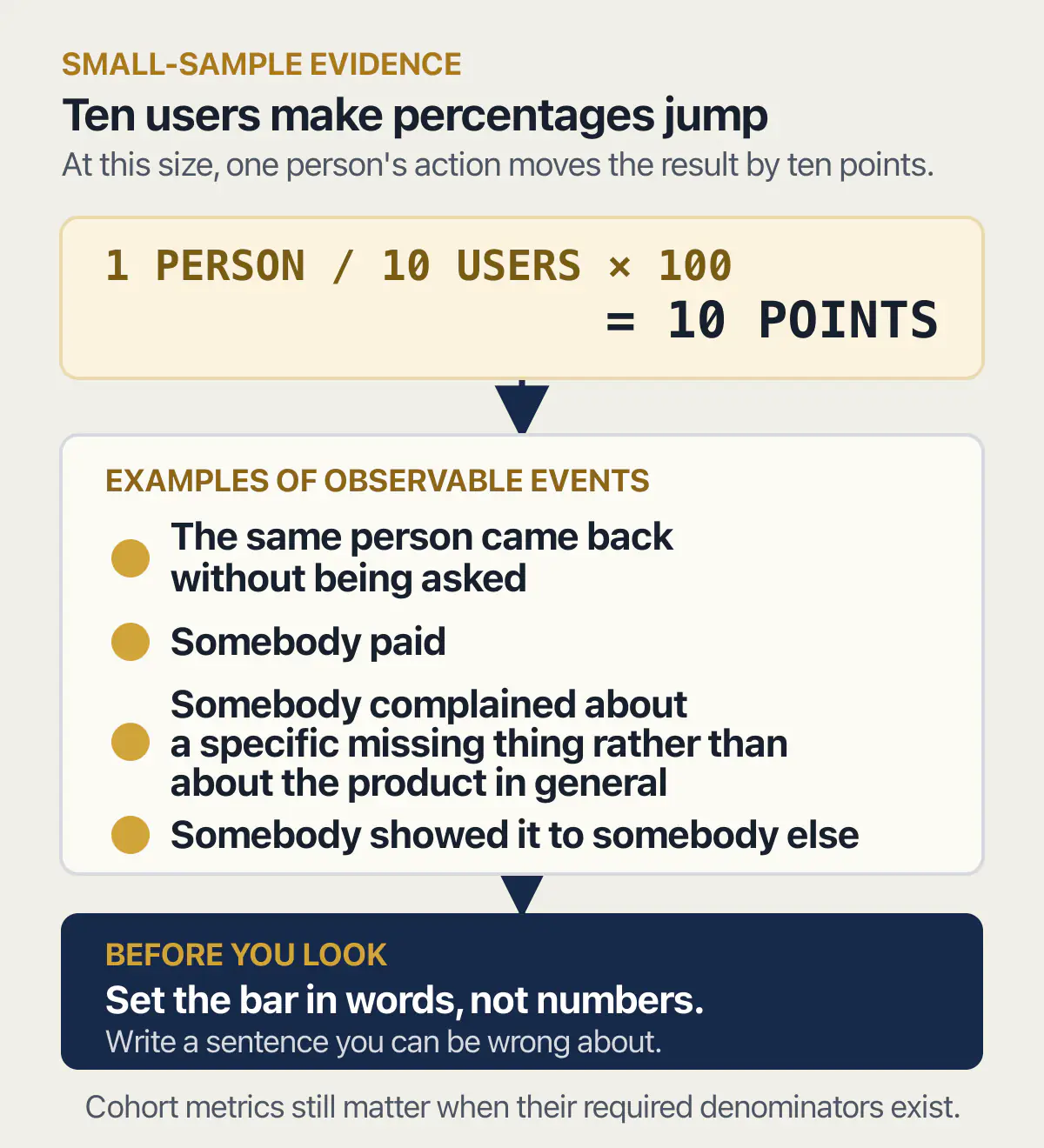
CRV’s three measures are the standard set, and all three need a denominator this reader does not have. A retention curve needs cohorts. Net revenue retention needs a book of accounts to retain revenue from. Monthly churn needs enough customers that losing one is a rate rather than an event. With ten users, each of those numbers moves by ten points when one person opens the app, which means it measures that person’s afternoon rather than your product.
What is available at that size is smaller and better: whether the same person came back without being asked, whether anybody paid, whether anybody complained about a specific missing thing rather than about the product in general, and whether anybody showed it to somebody else. Each of those is a single observable event. None of them averages, so none of them can be faked by a good week.
Getting any of them takes one thing the guides rarely say out loud, which is that people who are not paying you have no reason to answer. Somebody on a small-software community put the problem better than a framework could, and they were not asking as a beginner:
… I know everyone says talk to your users, paid, and trialling and get there feedback to dictate path. Curious how you’re getting this.
They had paying customers at the time and still could not get one of them onto a call. That is the actual difficulty in the demand question, and notice that no amount of testing the code touches it. The advice is universal and the mechanics of it are nobody’s subject. What works, in the accounts of people who get answers, is asking one specific question about something that just happened, in the place the person already is, rather than requesting a conversation about the product in general at a time to be arranged.
Set the bar before you look, in words rather than numbers, because a small number invites you to reinterpret it afterwards. Something like: three people who are not friends use it twice in two weeks without being reminded, and one of them pays. That is a sentence you can be wrong about, which is the only kind of test worth running.
What this cannot tell you
Wanting the thing and the thing working are independent, and finding out that people want it tells you nothing about the second. An app can be loved by twenty people and still fail every check that belongs to the other half of the phrase. Demand evidence does not touch any of that, and a page that implied otherwise would be selling you a comfortable answer.
The reverse is just as true and costs more. A first version can pass every check anybody runs against the code and still be a product nobody was waiting for. The two results are independent, which is precisely why the two questions need separate evidence rather than one exercise called testing.
What is still unbought between a version that runs and a version that can take money from strangers is a separate list, and it is priced one row at a time. The going-live sequence for one specific app, row by row, is written out separately, and it deliberately stops short of the question on this page.
Which of the questions that arrive with a first version belongs on which page is the map, not this page. The whole set of decisions a first version brings with it, and which page answers which one, is laid out one level up.
Common questions about testing an MVP
What does MVP mean in testing?
It means a product’s first working version, the smallest thing you can hand to a stranger and get an honest reaction to, and testing it means finding out whether they want it. Two other meanings crowd the same three letters in software, the presentation pattern used to separate screen code from logic, and the sports and loyalty senses that have nothing to do with products. A fourth is not software at all: searches for the phrase’s meaning currently return mostly medical results about mean platelet volume, a blood measurement whose initials are nearly the same, and that is a different subject entirely.
What is MVP testing?
MVP testing is finding out whether the first version of a product earns real use from people outside the build. On the pages that rank for the phrase it means proving demand before you commit to building, using interviews, landing pages, pre-sales and manual stand-ins for software. For somebody whose first version already exists, it means the same goal reached with the product itself instead of a substitute for it.
Which two aspects of a product do MVPs test?
Whether anybody wants it, and whether it holds up for the people who do. The first is answered by what people outside the build do with it and whether any of them pays. The second is answered by named checks against the code and a round of use on other people’s devices. They are independent: passing one says nothing about the other, and each one has its own evidence and its own repairs.
Is testing an MVP the same as beta testing?
No. A beta is one method rather than the question itself. Run unpaid on other people’s devices it feeds the durability half, and run as paid beta access it is demand evidence too, because a payment arrived. The programme for running one is set out in full on the page this one hands the durability half to. Testing an MVP, as the phrase is used on the search results, is the demand question in full, and it includes methods that involve no software at all.
Is testing an MVP the same as QA?
No, and confusing the two is the most common way this search goes wrong. Quality assurance asks whether the software does what it claims under conditions you choose in advance. Testing an MVP, in the sense the ranking pages use, asks whether anybody wants what it does. An app can be flawless and unwanted, or wanted and unsafe, so the two need separate evidence.
How many people have to use it before the answer means anything?
No threshold number exists, and a page that hands you one has invented it. With a very small group, ratios are meaningless because one person moves them; single observable events are what you have. Set the bar in words before you look, such as three unrelated people using it twice in two weeks unprompted with one of them paying, and treat the result as a real answer rather than a stage to be passed.
Do I still need to test the idea if the app already works?
Yes, and the working app makes it cheaper rather than unnecessary. What changes is the method: you can stop simulating the product and start handing it over. The methods designed to stand in for software, the explainer video, the paper prototype, the landing page pretending to be a product, are the ones you can drop. Interviews, pre-sales and paid access all get better.
Can an AI startup idea validator settle this?
No. Tools of that shape take a written description of an idea and return a score or a report on it. A description is the one thing an owner with a working first version no longer needs to produce, and no score of a paragraph outranks one stranger using the actual product and coming back the next day. Two such products held page-one positions for the validation question on 1 September 2026, which says the demand for reassurance is real and nothing about whether the reassurance is evidence.
What if the answer turns out to be no?
Then you found out for the price of a weekend rather than a year, and you still own the thing you built. You have a working application, a stack you now understand better than you did, and a piece of specific knowledge about the market that no framework was going to hand you. The people who lose most from this question are the ones who never asked it, kept building, and found out at the point where stopping had become expensive.
If you have a working app built with these tools and need it ready for real customers, this is what we do.
Built it with AI. Now it has to hold up for real customers.
The Production Hardening Sprint takes the app you already have and builds the production foundation underneath it. Authentication and access rules, payments that stay consistent, error handling, monitoring, backups, automated tests and a documented handover. Our engineers work inside your existing codebase for ten working days. All 123 deliverables are included, and you get the evidence for each one.
See the Production Hardening Sprint →  $2,500 fixed price · 10 working days · One codebase