When a Stripe subscription payment fails, the invoice enters retries and the subscription moves to past_due when Stripe charges automatically. Your app has to record that, keep or restrict access under a written rule, and wait for the outcome. Recovery needs five parts: retry settings, customer notice, a payment-update route, local billing state, and an access rule.
The key decision is broader than “retry or cancel.” A renewal can fail, recover on a later attempt, require customer authentication, or end after the configured recovery window. Your application has to recognize each outcome. Revoking access on the first decline can create churn; ignoring the whole sequence can leave revenue and entitlements out of sync.
What should happen when a subscription payment fails?
Record the failure, tell the customer, give them a route to update the card, and hold access under a written grace rule until Stripe’s retries either recover the invoice or the subscription ends. Do not revoke on the first decline, and do not treat a decline as a cancellation.
Stripe reports subscription activity asynchronously. Its subscription webhook guide lists separate events for a failed invoice, a paid invoice, customer action, subscription changes, and a subscription ending. One successful Checkout event cannot represent that later lifecycle. Every status a subscription moves through, and the access decision for each, is set out in the subscription lifecycle in Stripe.
For a renewal failure, the minimum state map is:
| Stripe event | What the event establishes | A bounded application response |
|---|---|---|
invoice.payment_failed | This payment attempt failed | Record the failed attempt, mark the account delinquent or in grace, and give the customer a payment-update route |
invoice.payment_action_required | The customer must complete authentication | Tell the customer what action is required; do not treat it as a final cancellation |
invoice.paid | The invoice is paid | Clear the delinquent state and extend or restore the paid entitlement |
customer.subscription.updated | Subscription status or cancellation timing changed | Synchronize the local status and scheduled end date |
customer.subscription.deleted | The subscription ended | Revoke access according to the product’s stated policy |
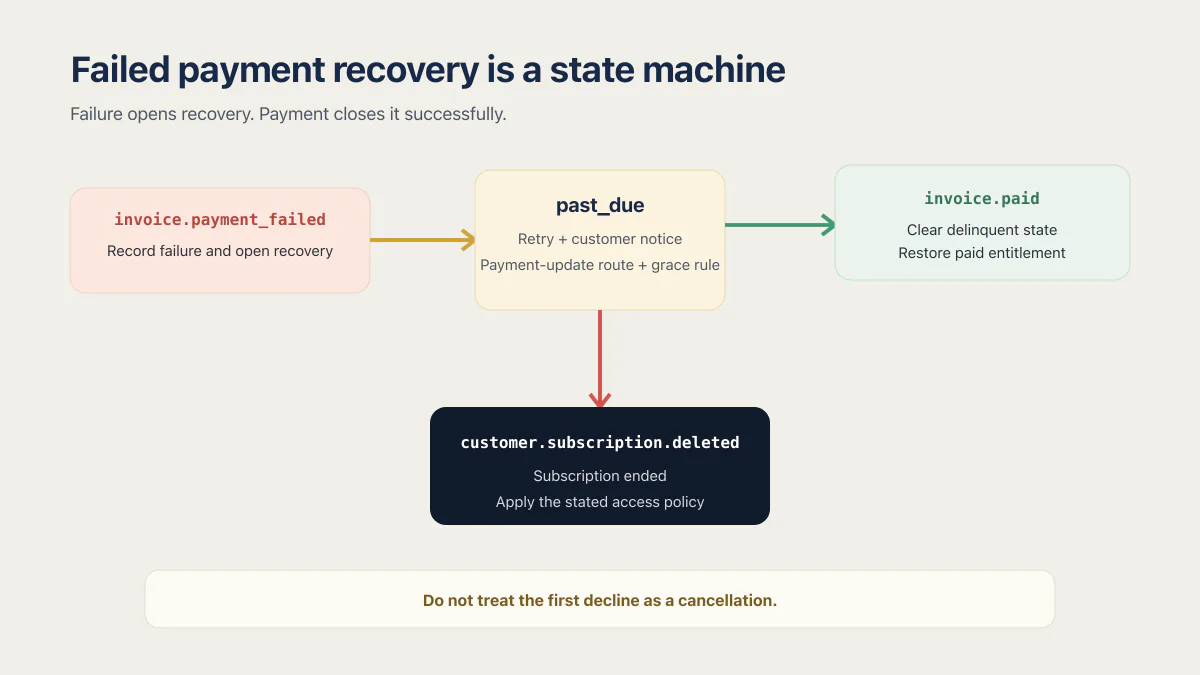
The grace period is a product choice. Some products keep access during retries; others restrict costly features while leaving exports and billing settings available. The unsafe choice is letting an unhandled event decide the policy by accident.
The baseline comes before retry optimization
Payment-recovery platforms optimize timing, card updates, communications, and recovery analytics. Those capabilities become relevant after the application has a reliable state transition for a failed payment.
| Recovery optimization assumes | A small SaaS must establish first |
|---|---|
| Retry timing can be improved | The application records that a payment attempt failed |
| A customer can be routed to an update flow | A working payment-update route exists |
| Recovery performance can be measured | Paid, past-due, grace, and ended states are distinguishable |
| Entitlements follow billing outcomes | Recovery restores access and a final end revokes it |
Stripe’s current revenue recovery documentation treats Smart Retries, customer emails, card updates, and automations as separately configurable controls. Smart Retries and custom schedules are configured in the Dashboard without a code change. That still leaves one application responsibility: Stripe can retry an invoice, but it cannot infer how your own database represents access.
What the fixed audit cohort can and cannot prove
The fixed AxonBuild research cohort and its methodology are useful here for mechanism, not an involuntary-churn percentage. Revenue and Billing was applicable to only three third-party apps, so the cohort does not support a prevalence claim about failed renewals.
It does contain a verified lifecycle omission. One B2B SaaS starter granted token-pack credits after payment but handled neither refunds nor disputes. A refunded customer could keep the spendable credits. That is documented from the money-leak side. It does not prove that the app missed invoice.payment_failed; it shows why “the first payment worked” is weak evidence for the events that follow it.
The customer-loss direction needs its own test: trigger a failed subscription renewal in a Stripe sandbox, then observe the application state, customer message, retry path, and eventual recovery or end. Stripe limits sandbox email delivery to addresses on a verified domain or active team members, so test the application notification separately when those conditions do not apply. A generic 200 response only proves that Stripe’s delivery was acknowledged.
Failed payment recovery is a state machine, not a retry switch.
A small-SaaS failed payment recovery flow
Start with configuration. Choose a retry policy in Billing settings, enable failed-payment emails where appropriate, and give the email a Stripe-hosted or application-owned payment-update destination. Stripe’s customer email guide documents both destination options.
That retry-and-notice sequence has a name: dunning. Stripe’s subscription status reference documents where it leaves the subscription. With collection_method=charge_automatically, a subscription becomes past_due when payment is required but cannot be paid, and once Stripe has exhausted its retry attempts the subscription becomes canceled or unpaid, depending on your subscription settings. A subscription sitting at unpaid attempts no further invoices: Stripe still creates them and then closes them immediately, so nothing recovers by itself until someone reopens and pays them. How to reduce involuntary churn is therefore mostly a question of what your application does while the subscription is past_due, before either terminal state arrives.
Then make the application state explicit. After signature verification and an idempotency check, a compact handler can route lifecycle events without revoking access on the first failure:
switch (event.type) {
  case 'invoice.payment_failed':
    await recordFailedInvoice(event.data.object);
    break;
  case 'invoice.payment_action_required':
    await recordCustomerActionRequired(event.data.object);
    break;
  case 'invoice.paid':
    await recordPaidInvoice(event.data.object);
    break;
  case 'customer.subscription.updated':
    await syncSubscription(event.data.object);
    break;
  case 'customer.subscription.deleted':
    await endSubscriptionAccess(event.data.object);
    break;
}
Those function names stand for product-specific state changes and customer communication. Use either Stripe’s configured email or one application notification path so the same event does not create duplicate notices. The important behavior is the sequence: failure opens recovery, payment closes it successfully, and a final subscription end applies the documented access rule. Decide the unpaid transition too, in writing: syncSubscription should treat a subscription that reaches unpaid the way your policy says, since no customer.subscription.deleted event arrives for it, and test that transition separately from cancellation and deletion. Stripe does not promise delivery order, so before applying a state from any of these events compare it with the subscription’s current status from the API, or keep local state monotonic so an older invoice.payment_failed arriving after invoice.paid cannot reopen recovery; test that by replaying the two events in reverse. Map the provider customer, exact subscription, and invoice to the local entitlement. A customer ID alone is insufficient when one customer can hold multiple subscriptions or products.
Test at least four paths in a sandbox:
- 01 A renewal attempt fails and the account enters the chosen delinquent or grace state
- 02 The customer receives a valid route to update the payment method or complete required authentication
- 03 A later successful invoice clears the failure state and restores the correct entitlement exactly once
- 04 An ended subscription revokes paid access while preserving any export or retention rights your policy promises
Two directions of the same missing lifecycle
A failed-payment path can lose a willing customer. The mirror failure gives away the product: a canceled or failed subscription never gets revoked, and the customer keeps free access indefinitely. These outcomes look opposite, but both come from treating billing as a one-event integration.
The safe rule is to derive local entitlement from verified billing events and a written grace policy. Do not infer “paid forever” from the first Checkout success, and do not infer “cancel now” from the first failed attempt. Recovery and revocation need separate transitions.
What involuntary churn is, and how it differs from voluntary churn
Involuntary churn is the loss of a subscriber because payment collection failed, even though the customer never chose to cancel. Voluntary churn is the other direction: the customer decided to leave and said so. The two look identical in a single churn number and need completely different responses.
| Question | Voluntary churn | Involuntary churn |
|---|---|---|
| What ended the subscription | The customer decided to stop paying | A payment attempt failed and never recovered |
| Where it starts | A cancellation the customer requested | A declined charge, an expired card, or an unfinished authentication step |
| What your application sees | A subscription update carrying a scheduled end date | invoice.payment_failed, then retries, then canceled or unpaid |
| What is still recoverable | The product reason, if you ask about it | The invoice itself, while the subscription is past_due |
| Who has to act | The customer | Your retry configuration, your notices, and the customer’s card issuer |
Vendor writing gives the same thing several names. Passive churn, delinquent churn and false churn all describe a subscriber lost to a failed payment rather than to a decision, and none of them is a separate phenomenon. Pick one term and use it consistently in your own reporting. The distinction that matters is whether a decision or a declined charge ended the subscription.
How you calculate customer churn decides whether you can see the involuntary part at all. One blended rate cannot show it, because it counts a cancelled account and a bounced renewal as the same loss. Split the numerator instead: count subscriptions that ended after a payment failure separately from subscriptions that ended because someone asked, and divide each by active subscriptions at the start of the period. Converting a monthly churn rate to an annual one is not multiplication by twelve either, because each month’s survivors are the next month’s base, so compound the monthly survival rate across twelve periods. An average churn rate for subscription services is a weak comparison for one small product, because price point, payment mix and customer base move that average more than product quality does.
How to know involuntary churn is happening
A handled decline is a business event, not necessarily an application error. Still, broken handlers can hide it. In the fixed cohort, 17 of 21 third-party apps record errors nowhere at all. That makes a failed state transition fit the silent-200 pattern: the provider sees a successful delivery while the account row never changes.
Track four counts by billing period: invoices that first failed, invoices recovered, subscriptions that ended after payment failure, and accounts whose local entitlement disagrees with the provider. Reconcile provider subscriptions against local account state on a schedule. The disagreement list is more actionable than a generic churn benchmark because it identifies customers your integration can still help.
Billing lifecycle evidence is one part of deciding whether an AI-built app is ready to launch. A sandbox test should prove the failed, recovered, and ended paths before real renewals depend on them.
Common questions about involuntary churn
What is involuntary churn?
Involuntary churn is subscriber loss caused by a collection failure or another payment problem rather than a deliberate cancellation. A temporary decline is not churn by itself. Churn occurs when the recovery path fails and the subscription relationship ends.
What is the difference between voluntary and involuntary churn?
Voluntary churn is a customer choosing to leave. Involuntary churn is a customer being dropped by a failed payment they may not know about yet. The first needs a product answer. The second needs a working recovery path, because the subscriber was still willing to pay at the moment the charge declined.
How much SaaS churn is involuntary?
Estimates vary by source and industry, but a commonly cited range puts involuntary churn at roughly 20 to 40 percent of total subscription churn. No single percentage is useful for every product, payment mix, and customer base, so calculate your own rate as subscriptions ending after a payment failure divided by active subscriptions at the start of the period. Also track both count recovery and revenue recovery: initially failed invoices later paid divided by invoices that initially failed, and recovered invoice value divided by initially failed invoice value.
Does Stripe retry failed subscription payments automatically?
Stripe Billing supports Smart Retries and custom retry schedules, but the account’s retry configuration determines the attempts and duration. Check Billing → Revenue recovery → Retries rather than assuming a universal schedule. Retry configuration does not update your application’s entitlement state.
How do I recover a failed subscription payment?
Record invoice.payment_failed, notify the customer, provide a payment-update or authentication route, and keep access under an explicit grace policy. On invoice.paid, clear the delinquent state. If the subscription ultimately ends, handle customer.subscription.deleted and apply the documented access policy, and apply the same written policy to the unpaid status through customer.subscription.updated, since that terminal state sends no deletion event.
If you have a working app built with these tools and need it ready for real customers, this is what we do.
Built it with AI. Now it has to hold up for real customers.
The Production Hardening Sprint takes the app you already have and builds the production foundation underneath it. Authentication and access rules, payments that stay consistent, error handling, monitoring, backups, automated tests and a documented handover. Our engineers work inside your existing codebase for ten working days. All 123 deliverables are included, and you get the evidence for each one.
See the Production Hardening Sprint →  $2,500 fixed price · 10 working days · One codebase