The most expensive usage-based billing mistakes happen before an invoice is created: the browser supplies the usage number, costly work runs before a cap is checked, retries create duplicate meter events, pricing logic loses its version, or nobody reconciles the invoice to the provider bill.
A trustworthy meter needs a server-observed event, an authenticated account, an idempotency identifier, a versioned price rule, and an enforceable limit. Usage-based billing software can aggregate and invoice those events. It cannot repair an untrusted event before your application sends it.
Mistake 1: you are metered but the customer is billed flat
A flat plan can work when the cost distribution is measured and the included allowance is enforced. It becomes dangerous when the upstream provider charges per token, minute, call, or job while the product promises unlimited use.
An illustrative example shows the boundary. A $9 plan wrapping a workflow that costs an average of $0.005 per run loses money once one customer crosses 1,800 runs, before other variable costs. That is not a live provider quote. It is the break-even calculation founders need before choosing an allowance:
included usage ceiling = plan revenue available for this feature ÷ measured cost per unit
| A flat plan that hides the meter | A bounded plan backed by evidence |
|---|---|
| Unlimited calls because average use looked low in testing | An included allowance based on real per-user usage distribution |
| One launch-day estimate for cost per call | A versioned rate table checked when models or providers change |
| The provider invoice is the first cost report | Per-account cost is visible before the billing period closes |
This article owns the meter: how usage becomes a trustworthy billable record. The separate COGS calculation begins after that record is reliable and asks what the measured cost does to gross margin.
Mistake 2: the browser reports its own usage
Do not accept a token count, duration, price, or billable quantity merely because the frontend sent it. The server should observe the completed work or read usage from the provider response, then attach it to the account from the verified session.
The fixed AxonBuild cohort and its methodology offer mechanism evidence, not a metering prevalence statistic. In 10 of 21 third-party apps, the server trusted important state supplied by the client. One food-delivery app accepted each order’s total from the customer’s browser instead of recomputing it from the catalog. That app had no usage meter. Its finding demonstrates the same boundary: a customer-controlled number cannot become financial truth without independent derivation.
If the customer can choose the number, the number is input, not usage evidence.
For an AI feature, take token counts from the server-side model response. For a file-processing job, derive pages, seconds, or bytes after the server accepts and processes the file. For an API product, count the authenticated request after it succeeds under the product’s billable-event definition.
Mistake 3: the limit is checked after the expensive work
Thirteen of 21 third-party apps in the fixed cohort had no rate limit on their most expensive endpoint. That figure covers paid AI, email, database, and quota-heavy routes; it is not a count of usage-billing implementations.
I found the same gap in my own translation platform, one of the projects I ran through the identical audit before I ever pointed it at a client. Two routes called Claude on the server, correctly, with the API key never reaching the browser, and one of them invoked paid web search on top; a third family of routes could start AWS translation jobs. None of them checked who was calling, and none had a rate limit, so anyone who found the URL could loop it, and every single call billed my own account. Nothing about the demo ever surfaced it, because in a demo I’m the only person clicking the button, once. Metering the completed calls would have measured the loss without preventing it.
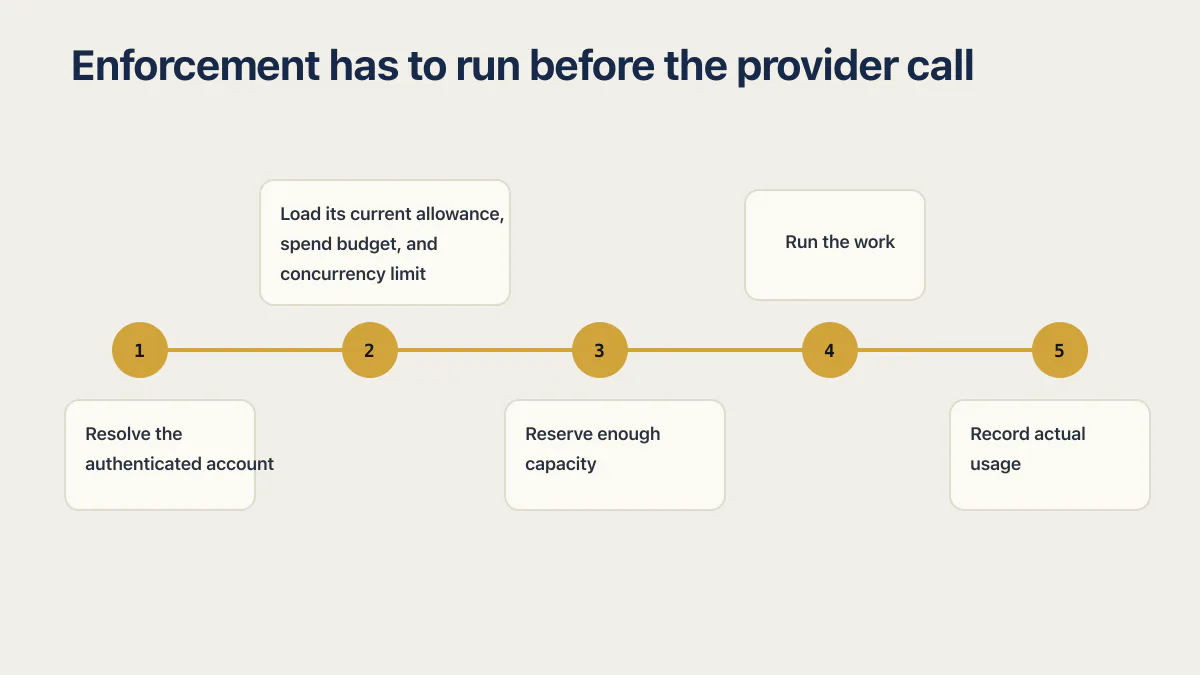
Enforcement has to run before the provider call:
- Resolve the authenticated account.
- Load its current allowance, spend budget, and concurrency limit.
- Reserve enough capacity for the maximum permitted job.
- Run the work.
- Record actual usage and release any unused reservation.
This is why a provider rate limit is not a customer budget. A provider limit protects shared infrastructure at account scale. Your application needs per-account policy at product scale. How to enforce plan limits on the backend covers the entitlement check that runs before every paid action.
Mistake 4: a retry becomes a second billable event
Networks retry. Workers restart. A customer can click twice. If each delivery writes a new usage event, the invoice overstates the work even when the feature itself ran once.
Stripe’s current meter-event documentation supports an event identifier for idempotency and notes that meter summaries update asynchronously. Its API reference guarantees identifier uniqueness only within a rolling period of at least 24 hours. Keep a durable internal usage ledger with a unique constraint on the completed job or provider request, then send each accepted ledger event through a retryable outbox. The Stripe identifier handles short delivery retries; it is not a permanent deduplication database.
A documented Stripe meter event has this shape:
curl https://api.stripe.com/v1/billing/meter_events \
  -u "$STRIPE_SECRET_KEY:" \
  -d event_name=llm_tokens \
  -d "payload[value]"=25 \
  -d "payload[stripe_customer_id]"="$STRIPE_CUSTOMER_ID" \
  -d identifier="$PROVIDER_REQUEST_ID"
The value 25 is only an example. Stripe meter values accept decimals, and decimal values are supported on invoices. Define the billable unit explicitly. Converting it to the smallest whole-number unit is optional and should reflect the pricing model, not an API constraint. In production, derive the value on the server from the completed provider response and resolve the Stripe customer ID from the authenticated account. Reuse the same durable identifier for delivery retries, and let the internal unique constraint prevent a delayed replay outside Stripe’s deduplication window.
Mistake 5: the meter, price, and invoice are never reconciled
Stripe separates usage ingestion, meter aggregation, pricing, billing, and monitoring. That separation is useful, but it creates several places for drift:
- the application records the wrong unit;
- the same unit is sent twice or not sent at all;
- a rate changes but old events are re-priced accidentally;
- the internal ledger and Stripe summary disagree while asynchronous events are processing;
- the customer invoice is correct but the upstream provider charged more than expected.
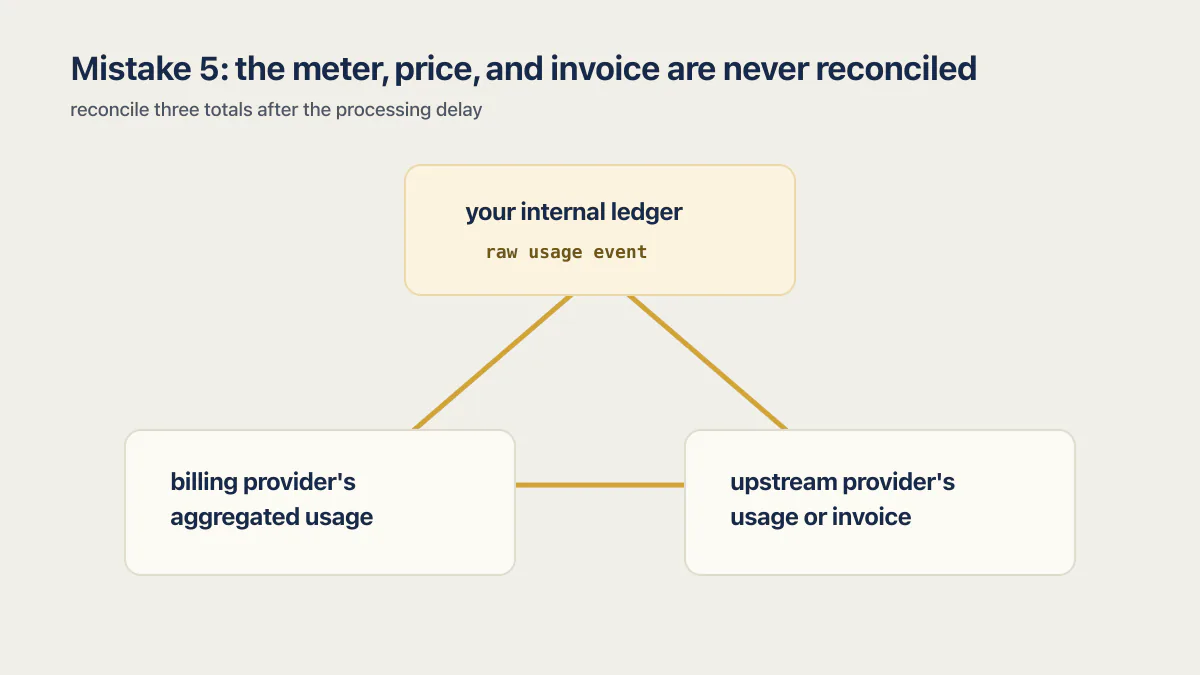
Keep the raw usage event, its account, durable identifier, unit, timestamp, source, and price version. Then reconcile three totals after the processing delay: your internal ledger, the billing provider’s aggregated usage, and the upstream provider’s usage or invoice. For the subscription rows themselves, how to keep Stripe subscriptions in sync with database records covers the reconciliation query and the weekly job.
Billing for AI API costs gets decided in the code, at the same route that makes the paid call, not on a pricing page. Some platforms meter that runtime for you instead of a provider invoicing you directly, which is how Base44 meters your app’s runtime.
- Define one billable event in plain language, including when it counts and when it does not.
- Derive the quantity on the server and attach it to the authenticated account.
- Enforce allowance and spend ceilings before costly work begins.
- Give every completed unit a durable idempotency identifier and enforce uniqueness in your own ledger.
- Store a price version and reconcile internal, billing, and upstream totals.
These controls connect usage to the broader question of whether an AI-built app is ready to launch. The same client-trust mistake also appears when a browser sets an order price, while uncapped cost becomes visible when traffic reaches the assumptions hidden during a demo.
Common questions about usage-based billing mistakes
What are the most common usage-based billing mistakes?
The core failures are client-reported usage, missing pre-call limits, duplicate events, unversioned pricing, and missing reconciliation. Each can produce a plausible invoice that is still wrong.
How do I meter LLM or API usage correctly?
Authenticate the account, enforce its allowance before the call, read the actual units from the provider response, and write one server-side event with a durable identifier. Send that event to the billing provider, then reconcile the result against both the internal ledger and provider usage.
How does usage-based billing work?
The application observes billable usage and sends meter events. A meter aggregates those events under a defined rule. A price converts aggregated units into an invoice amount, and the billing system charges the customer. Correct billing depends on the first event being trustworthy and every retry remaining idempotent.
Should a small SaaS use usage-based or flat pricing?
Either can work. Use a flat price when measured usage has a predictable distribution and a clear allowance protects the tail. Use metered or tiered pricing when cost varies materially with customer activity. Under either model, keep server-side usage evidence and an enforceable ceiling.
If you have a working app built with these tools and need it ready for real customers, this is what we do.
Built it with AI. Now it has to hold up for real customers.
The Production Hardening Sprint takes the app you already have and builds the production foundation underneath it. Authentication and access rules, payments that stay consistent, error handling, monitoring, backups, automated tests and a documented handover. Our engineers work inside your existing codebase for ten working days. All 123 deliverables are included, and you get the evidence for each one.
See the Production Hardening Sprint →  $2,500 fixed price · 10 working days · One codebase