Free trial abuse has two distinct forms. A trial-limit bypass changes state the browser controls. Repeated-trial abuse creates another account or identity after the first trial ends. Fix them in that order: make the server authoritative for trial and entitlement state, then add proportionate identity and abuse controls for new-account cycling.
Fraud detection cannot repair a trial clock stored only in localStorage. Server-side enforcement cannot, by itself, prove that two different accounts belong to the same person. The controls solve different problems.
Can someone reset a free trial?
Yes, if the browser owns the decisive trial value. Clearing local storage, changing a client-side expiry, or editing a client-supplied plan field can make a weak application believe the same account is new or paid.
If the server stores trial history and checks entitlement on every protected request, changing the displayed countdown should do nothing. The browser may display trial status. It should not establish the status that the API trusts. How paid access leaks in the first place, beyond trials, is the wider set of checks.
| Browser input or display | Server-owned decision |
|---|---|
| The user requests a trial for a plan | Whether this account is eligible for that trial |
| A countdown displays the remaining time | The authoritative trial start and end timestamps |
| The client asks to use a paid feature | Whether current entitlement permits the operation |
| The user submits an email or payment method | Whether trial history or risk policy links it to earlier use |
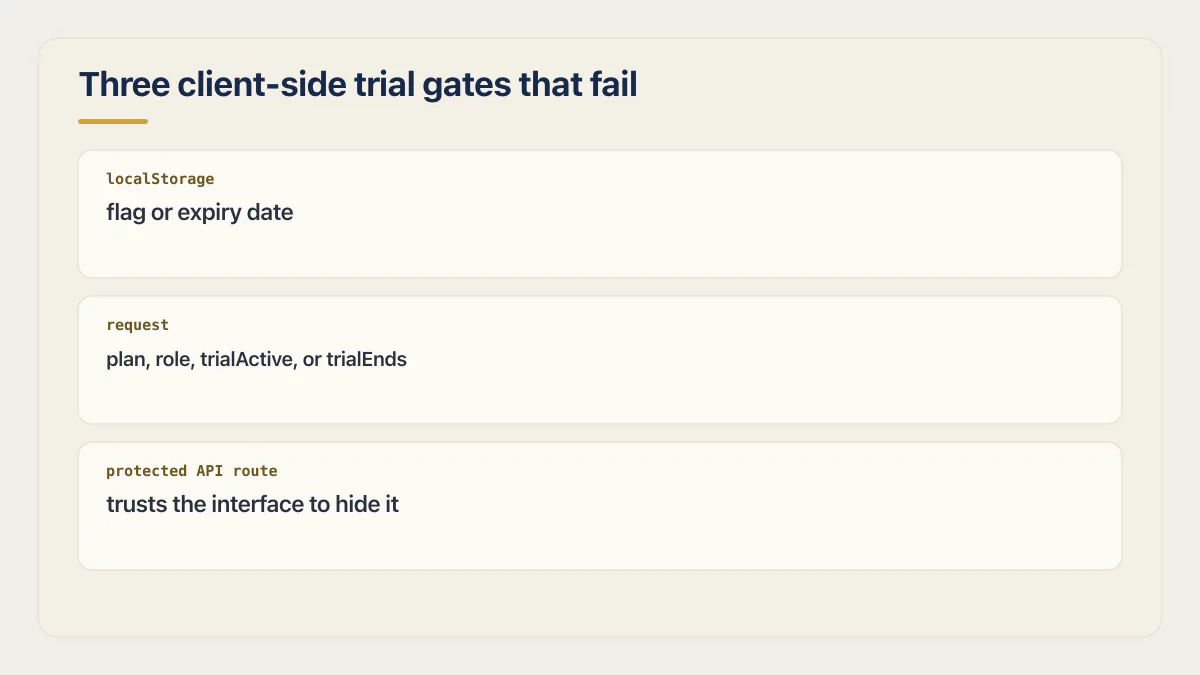
Three client-side trial gates that fail
The implementation should be treated as vulnerable when any of these values is authoritative:
- 01 A localStorage flag or expiry date that unlocks the paid interface after a client-side comparison
- 02 A plan, role, trialActive, or trialEnds field accepted from the request without a server-side lookup
- 03 A protected API route that trusts the interface to hide it instead of checking current entitlement
A typical browser-only check makes the failure visible:
const trialEnds = Number(localStorage.getItem('trialEnds'));
if (Date.now() < trialEnds) unlockPaidFeatures();
This can be acceptable for changing presentation. It cannot safely authorize an API call, model request, export, or paid dataset because the visitor can edit both the value and the code path.
What the 10-of-21 finding actually establishes
In the fixed AxonBuild cohort, 10 of 21 third-party apps let the client decide important state that the server should have derived or constrained. That is not a count of apps with free trials, and it does not establish a free-trial-abuse rate.
The examples establish the mechanism. In one food-delivery app, a new user could update their own role to customer, seller, or driver because the policy checked row ownership but never protected the role field. A CRM dashboard kept its entire dataset in browser storage with no server copy. Both show how polished interface state can become the product’s only truth.
A client-held trial uses the same architecture. The proper test is behavioral: change or delete every trial value visible to the browser, then call the protected server route directly. If access changes, the server does not own the gate.
A browser countdown can describe a trial. It cannot enforce one.
How to prevent a trial-limit bypass
Create and update trial state from a trusted server path. Stripe’s free trial documentation supports trial periods created through Checkout, the API, or the Dashboard and sends lifecycle events such as customer.subscription.trial_will_end.
After an atomic server-side eligibility check, reserve the one-time grant with a unique constraint before creating a Checkout Session. This prevents two concurrent requests from passing the same eligibility check. Reuse an active reservation for the same account, finalize it from a verified subscription event, and expire an abandoned reservation only under a written policy. A Checkout-based subscription can then create the trial with the account’s mapped Stripe customer:
const session = await stripe.checkout.sessions.create({
  mode: 'subscription',
  customer: account.stripeCustomerId,
  line_items: [{ price: priceId, quantity: 1 }],
  subscription_data: {
    trial_period_days: 14,
    trial_settings: {
      end_behavior: { missing_payment_method: 'cancel' },
    },
  },
  success_url,
  cancel_url,
});
Duration and missing-payment-method behavior are product decisions, and Stripe also supports pausing or creating an invoice at trial end. The security properties are the atomic grant reservation, server-created Checkout Session, allowlisted priceId, explicit end behavior, and durable mapping between the application account and Stripe customer. The server should synchronize subscription state from verified lifecycle events and check current entitlement before paid work runs.
Free trial abuse on Stripe: which states help, and which do not
Stripe gives you three useful things here, and none of them is enforcement. A subscription inside a trial period carries the status trialing. At trial end, the result depends on payment and the configured end behavior: successful payment can produce active, while a missing payment method can cancel, pause, or create an invoice that becomes past_due. Stripe’s subscription object reference documents the status boundaries. A customer.subscription.trial_will_end event arrives three days before the trial period ends, and fires immediately when the trial is shorter than three days. And Checkout collects a payment method by default; you only start a trial without one by passing payment_method_collection=if_required.
Requiring a payment method is the control most people mean when they ask about free trial abuse on Stripe. Stripe’s own free trial documentation warns that starting a trial without payment details can let spammers create large numbers of fake customers, usage and subscriptions, and suggests requiring an account and a captcha before the trial subscription starts. If you do run cardless trials, trial_settings.end_behavior.missing_payment_method decides the ending: cancel ends the subscription immediately, pause stops it cycling until someone adds a card, and create_invoice bills at trial end and moves the subscription into past_due when no payment method is present as that invoice finalizes.
What none of that does is stop the same person signing up again with a new email, and none of it is an entitlement check. trialing is Stripe’s view of a subscription, not your server’s answer to whether this request may run. Your application still reads its own trial history and current entitlement before paid work happens, and Stripe has no view of the account row that decides it.
If the product does not use Stripe
Use the same ownership model in your database:
- store
trial_started_at,trial_ends_at, and the source of the grant on the account; - keep an immutable or append-only history of prior grants;
- derive entitlement on the server from current time and account history;
- make protected routes check entitlement independently of page visibility;
- test expiry, conversion, cancellation, and repeated event delivery.
Moving these checks closes the dev-tools bypass only when every valuable server route enforces them. A hidden button is not enforcement.
Repeated-account trial abuse is a separate layer
Stripe defines trial abuse as customers cycling through trials without intent to convert and documents risk controls for repeated signup. This is the layer where account, payment, device, and behavioral signals become relevant.
Use a control only when its friction matches the loss:
- Verify the account identifier before granting costly trial work.
- Store trial history on the server and prevent the same account from receiving another automatic grant.
- Rate-limit signup and the expensive trial feature separately.
- Set a trial allowance or spend ceiling so one new identity has a bounded cost.
- Review repeated payment-method, device, or network signals as risk indicators rather than automatic proof that two people are the same.
Collecting stronger identity or payment signals can reduce conversion and create privacy obligations. Start from measured abuse: repeated accounts, feature cost, conversion, and false-positive impact. The right threshold for a high-cost generation product can be excessive for a low-cost collaboration trial.
Keep trial, payment, and entitlement ownership separate
A trial may expire, convert, pause, or end without payment. Each state needs a server-owned entitlement transition. What happens after a trial correctly converts to a paid plan, when entitlement drifts from what the account should have during a downgrade or a failed renewal, is a related problem, worth its own look and separate from this one.
The client-trust boundary also appears when a browser supplies an order price and in the broader reasons AI coding tools ship incomplete security boundaries. Trial enforcement belongs among the launch claims an AI-built app should prove.
The first fix is architectural and provider-independent: the clock, grant history, and entitlement live on the server. The browser receives the answer it needs to render. It does not create that answer. For a small SaaS, that closes the direct bypass before more expensive identity controls enter the decision. A free trial is usually straightforward to enforce once you know the clock belongs on your server and not on the visitor’s. On a metered builder platform the same open gate costs more than a seat, since what a stranger can spend on a Base44 free plan is counted in credits.
Common questions about free trial abuse
What is free trial abuse?
Free trial abuse is getting more free access than the trial was meant to give. It takes two forms: resetting a trial the browser controls, and creating fresh accounts or identities to start the trial again. Stripe defines the second form as cycling through trials without intent to convert. The first is an implementation defect; the second is a policy and risk decision.
How do developers prevent free trial abuse?
They first enforce trial eligibility and paid features on the server. Then they track repeated signup, cap costly trial activity, and add payment, device, or identity signals only where measured abuse justifies the friction.
Can I stop multiple-account signups?
No single signal proves that two accounts belong to one person. You can make repeated abuse harder and less profitable with verified accounts, server-held trial history, usage caps, signup limits, and carefully evaluated risk signals. Measure false positives because shared devices, networks, and payment methods can be legitimate.
Does moving the trial check server-side fix free trial abuse?
It fixes the client-side reset when every protected server route checks the authoritative state. It does not stop someone from creating a genuinely separate account. Repeated-account abuse needs history, limits, and risk controls on top of the server-owned gate.
Should a free trial require a payment method?
That is a product and risk decision. A payment method can raise the cost of repeated signup and support additional matching signals, but it also adds friction and does not replace server-side entitlement checks. Compare measured abuse loss with conversion impact before requiring it.
If you have a working app built with these tools and need it ready for real customers, this is what we do.
Built it with AI. Now it has to hold up for real customers.
The Production Hardening Sprint takes the app you already have and builds the production foundation underneath it. Authentication and access rules, payments that stay consistent, error handling, monitoring, backups, automated tests and a documented handover. Our engineers work inside your existing codebase for ten working days. All 123 deliverables are included, and you get the evidence for each one.
See the Production Hardening Sprint →  $2,500 fixed price · 10 working days · One codebase