Product Hunt technical preparation is the event-specific layer on top of a normal web-app launch. The general release should already have working access controls, payment handling, recovery, tests, and rollback. Product Hunt adds a scheduled public window, concentrated product exploration, live questions, and a stronger reason to watch traffic, cost, and failures in real time.
Product Hunt’s own launch guidance covers the submission, positioning, media, first comment, and community engagement. This article keeps those jobs separate and answers the technical question: what should be tested, limited, and monitored from a week before the launch through the week after it?
The technical half of a Product Hunt launch checklist
A marketing launch checklist and a technical one answer different questions. The marketing question is whether people will understand and see the product. The technical question is whether sign-up, the core feature, payments, support, and recovery still work while many unfamiliar visitors explore them in the same window.
| What the launch guides check | What survives the launch |
|---|---|
| Your launch post, tagline, and gallery images are ready | Your busiest endpoint has a spend cap before the first burst hits it |
| Your first comment and co-maker profiles are ready | A second account can’t read the first account’s data |
| You chose a launch time that fits the team’s availability | A dashboard alerts the team before a customer has to report the failure |
| The countdown is set for 12:01am PST | The app was load-tested before that clock ran out |
Both halves matter. This post covers the right column because Product Hunt already documents the submission and community side. It narrows the questions that decide whether an app is ready for real users to a scheduled public launch where the team can prepare coverage in advance.
How to prepare for a Product Hunt launch when the traffic looks nothing like normal
The technical risk is less about a guaranteed visitor count than about concentration. Product Hunt’s current preparation guide says its homepage runs on a 24-hour Pacific-time cycle and gives 12:01am PST as a rule of thumb for a full day of visibility. The same guide says there is no universal best day or time and recommends choosing a time that fits the launch’s goals and the team’s availability.
That availability point is a technical requirement. Do not choose a start time that gives the app 24 hours of visibility while leaving nobody able to answer support questions, stop promotion, disable an expensive feature, or roll back. Product Hunt’s community includes makers and early adopters, so it is reasonable to expect varied devices, unusual workflows, and technically curious exploration. Treat that as a planning assumption, not a claim that every visitor will probe the app.
Will my app survive a Product Hunt launch? The load question
Nobody can promise it. An app survives a Product Hunt launch when the feature named in the listing has been load-tested at the concurrency you expect, the metered routes have a spend cap, a second account cannot read the first one’s data, and one named person can roll back on launch day.
“Will it hold up?” cannot be answered from a Product Hunt listing or hosting plan. Test the dynamic route visitors will actually use: sign-up, search, generation, upload, checkout, or whatever the tagline promises. Watch database connections, slow queries, external APIs, error rate, high-percentile latency, and cost while concurrency increases gradually.
Why an AI app stalls at 100 concurrent users owns the connection-pool, query, and load-test mechanics. For Product Hunt, run that drill at least a week before the event, with representative data and safe third-party credentials, so a bad result can still change the plan.
The cost question: cap the spend before the spike sets the bill
If the app has an endpoint that bills per call, the launch puts that feature in the most visible position. It may be an AI completion, PDF export, transactional email, data enrichment, or another metered API. Normal traffic does not prove that the account, route, or provider has a safe burst limit.
Use a temporary per-user and per-IP limit where appropriate, enforce authentication before expensive work, cap input and output, and configure provider billing alerts or hard spend controls where available. Test the rejection path so a limit produces a useful message rather than an endless retry loop. If the launch includes paid conversion, the checkout failure guide covers the separate server-side payment boundaries.
The scrutiny question: what a curious crowd finds that a quiet month didn’t
A public launch makes ordinary application surfaces easier to discover at the same time: unauthenticated routes, client-side configuration, public repositories, predictable record identifiers, and framework fingerprints. That does not mean Product Hunt visitors are attackers. It means security should not depend on nobody noticing a reachable path.
Before launch, list the routes that return user data, send email, call a paid service, change roles, or grant paid access. Call them logged out and with a second ordinary account. Check current dependency advisories and determine whether a reported path is reachable in this app rather than treating a scanner count as the verdict.
One of the smallest apps I’ve audited makes the point cleanly: a guitar-scale visualizer with no login, no database, and no payment surface, nothing worth stealing by any normal measure. It still came back red, because the Next.js and React versions it shipped carried a published remote-code-execution advisory in the framework’s own server-rendering path, reachable by any ordinary page request. The fix was a one-line version bump; nobody had wired up anything to apply it, and the version sat unnoticed for as long as the only visitor was its own builder. The full trace of that finding, scanner flag to confirmed reachability, is in the vibe coding examples read at the code level; whether an AI app security audit is worth it covers the buying decision it feeds.
The unplanned version of this same exposure, an app that goes viral with no warning and needs triage in the 48 hours after, is its own post with its own hour-by-hour order: my app went viral, now what. Product Hunt gives the team advance notice, so route checks, dependency updates, support ownership, and rollback should already be settled before the listing goes live.
Product Hunt is a public launch window you can put on a calendar. Use that certainty to test, cap, monitor, and staff the app before the listing goes live.
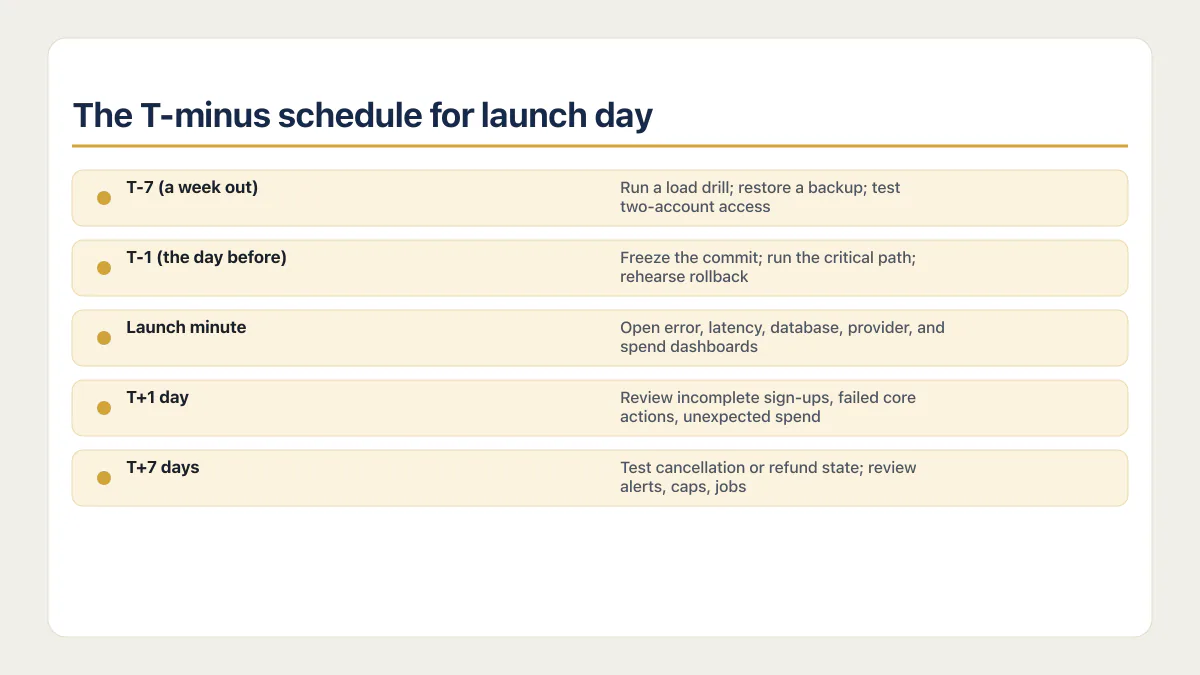
The T-minus schedule for launch day
Spread across the days around launch, each check gets the attention its consequence deserves instead of getting skipped at 12:01am because there wasn’t time.
| When | Technical check | Why it’s staged here |
|---|---|---|
| T-7 (a week out) | Run a load drill on the promised feature; restore a backup; test two-account access | A failed result may need code or a narrower launch plan |
| T-1 (the day before) | Freeze the commit; run the critical path; verify payment retries; rehearse rollback | The team needs one known release candidate, not a moving chat or branch |
| Launch minute | Open error, latency, database, provider, and spend dashboards; keep the decision owner available | Detection without authority to act still delays recovery |
| T+1 day | Review incomplete sign-ups, failed core actions, support reports, and unexpected spend | Funnel totals can hide a technical drop between steps |
| T+7 days | Test cancellation or refund state; review alerts, caps, jobs, and accepted gaps | The first real lifecycle extends beyond launch day |
The launch-minute row matters because an app can fail silently while returning 200 OK. A caught exception reported as success can make a dashboard and client treat a broken action as healthy, so trigger one deliberate failure before launch and confirm the signal is honest.
Two general references belong alongside this schedule. The launch readiness checklist, ordered by what actually breaks first, covers the full release baseline for any channel; this post owns the Product Hunt timing, live coverage, and event-specific controls. The fixed June–July 2026 AxonBuild cohort included 26 audited AI-built apps, 22 with at least one confirmed-critical finding and none in its historical green band. That selected cohort is context, not a Product Hunt failure rate, and the full ledger is told once, properly, in its own statistics post rather than repeated here.
Common questions before a Product Hunt launch
Will my app survive a Product Hunt launch?
No guide can predict that from the listing alone. Evidence comes from a controlled load drill on the promised feature, a tested spend limit, two-account authorization checks, a working alert, and a rehearsed rollback. If those fail, narrow or delay the technical launch rather than hoping the traffic stays low.
How much traffic does a Product Hunt launch bring?
There is no dependable universal number. Traffic varies with the product, category, timing, ranking, promotion, and outside events. Plan for a concentrated public window and test the app’s own expected and stretch scenarios instead of copying another launch’s visitor count.
What should I check before launching on Product Hunt?
The Product Hunt-specific checks are launch-time support coverage, a load drill on the feature in the listing, spend controls for metered actions, live dashboards, honest failure signals, and a named stop-or-rollback owner. The general web-app checklist still supplies access, payment, recovery, and release gates.
Is a Product Hunt launch the same as a release?
No. A release is the technical event: a version goes to production and can be rolled back. A Product Hunt launch is a scheduled public window pointed at a version that is already live. The safe order is release first, let the version run under real use for a few days, then point the listing at it. Doing both on the same morning means the first strangers to use the app are also the first to use the new code, and a rollback then costs the launch window as well as the version.
Is my app ready for Product Hunt?
Answer the load, cost, access, monitoring, and rollback questions above with a repeatable result rather than memory. The business questions are separate: who relies on the app, what stops if it fails, who handles technical changes, and whether there is a reason to act now. They do not technically certify the Product Hunt release.
If this checklist left you with more open items than you expected, the sprint below works through all of them in ten working days.
Built it with AI. Now it has to hold up for real customers.
The Production Hardening Sprint takes the app you already have and builds the production foundation underneath it. Authentication and access rules, payments that stay consistent, error handling, monitoring, backups, automated tests and a documented handover. Our engineers work inside your existing codebase for ten working days. All 123 deliverables are included, and you get the evidence for each one.
See the Production Hardening Sprint →  $2,500 fixed price · 10 working days · One codebase